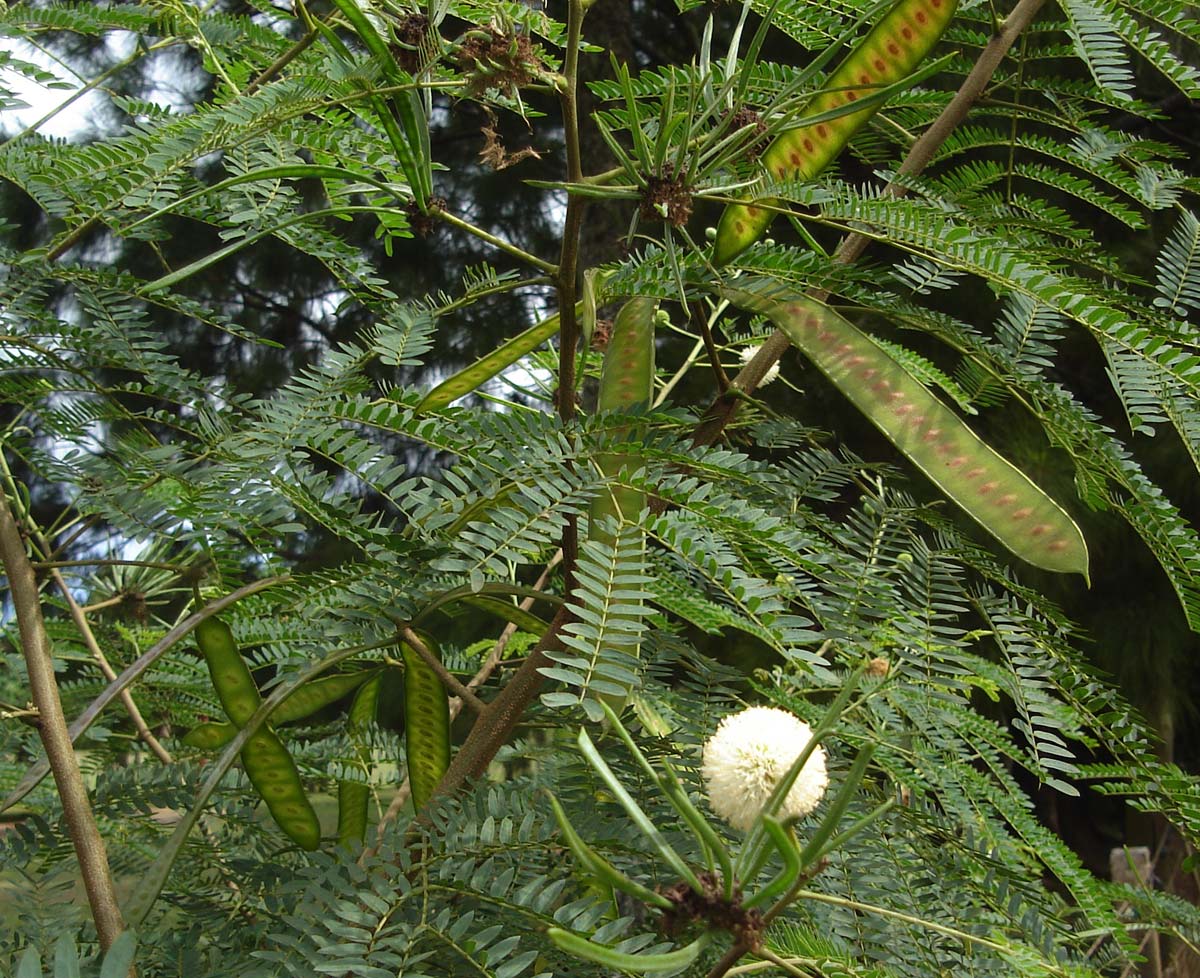
Leucaena is a genus of approximately 24 species of trees and shrubs in the mimosoid clade of the subfamily Caesalpinioideae within the legume family Fabaceae, order Fabales. Commonly known as leadtrees, these woody plants are native to the Americas, with their natural range extending from Texas in the southern United States southward through Mexico and Central America to Peru.
The genus was formally described by the botanist George Bentham in 1842, published in Hooker's Journal of Botany. The name comes from the Greek λευκός (leukos), meaning "white," a reference to the characteristic white flower heads that are typical of many species in the genus.
Leucaena species are ecologically and economically significant across their native range and beyond. They are widely cultivated for green manure, livestock fodder, firewood and charcoal, and soil conservation. The seeds of some species, particularly Leucaena esculenta, are consumed as food in Mexico, where they are known as guaje or huaje. Leucaena leucocephala, the white leadtree, is among the most widely planted tropical multipurpose trees in the world, valued for its rapid growth and high biomass yield — a 120 km² plantation can generate an energy equivalent of one million barrels of oil per year. Seeds of several species, known colloquially as jumbie beans, are also used as decorative beads.
A noteworthy biochemical feature of the genus is the presence of mimosine, a non-protein amino acid found at high concentrations in some species. In non-ruminant animals, excessive intake can cause hair loss and reproductive problems, which constrains their use as fodder in certain livestock systems.
Etymology
The name Leucaena is derived from the Greek word λευκός (leukos), meaning "white," referring to the pale white flower heads characteristic of species in the genus. It was formally described by botanist George Bentham and published in Hooker's Journal of Botany in 1842.
Distribution
Leucaena is native to the Americas, ranging from Texas in the southern United States south through Mexico, Central America, and into Peru and northwestern South America. The centre of diversity lies in Mexico and Central America, where most of the approximately 24 species are endemic. Leucaena leucocephala has been widely introduced and naturalized across tropical and subtropical regions globally.
Ecology
Some Leucaena species contain high concentrations of mimosine, a toxic non-protein amino acid. In non-ruminant animals, excessive consumption of mimosine-rich material can cause hair loss and infertility, limiting fodder use to ruminants (which harbour mimosine-degrading gut bacteria) in affected regions. As members of the Fabaceae, Leucaena species fix atmospheric nitrogen via root nodule symbiosis, making them valuable in soil improvement and agroforestry systems.
Cultural Uses
Leucaena species have a long history of multipurpose use across the Americas and tropical Asia. They are cultivated for livestock fodder, green manure, firewood, charcoal production, and soil conservation. The seeds of Leucaena esculenta — called guaje or huaje in Mexico — are eaten with salt as a traditional food. Seeds of various species, known as jumbie beans, are strung as beads in folk crafts. In Sumatra, Indonesia, anthelmintic (anti-worm) medicines are prepared from seed extracts. The rapid-growing L. leucocephala is among the most economically significant tropical trees, widely planted for bioenergy and agroforestry.










