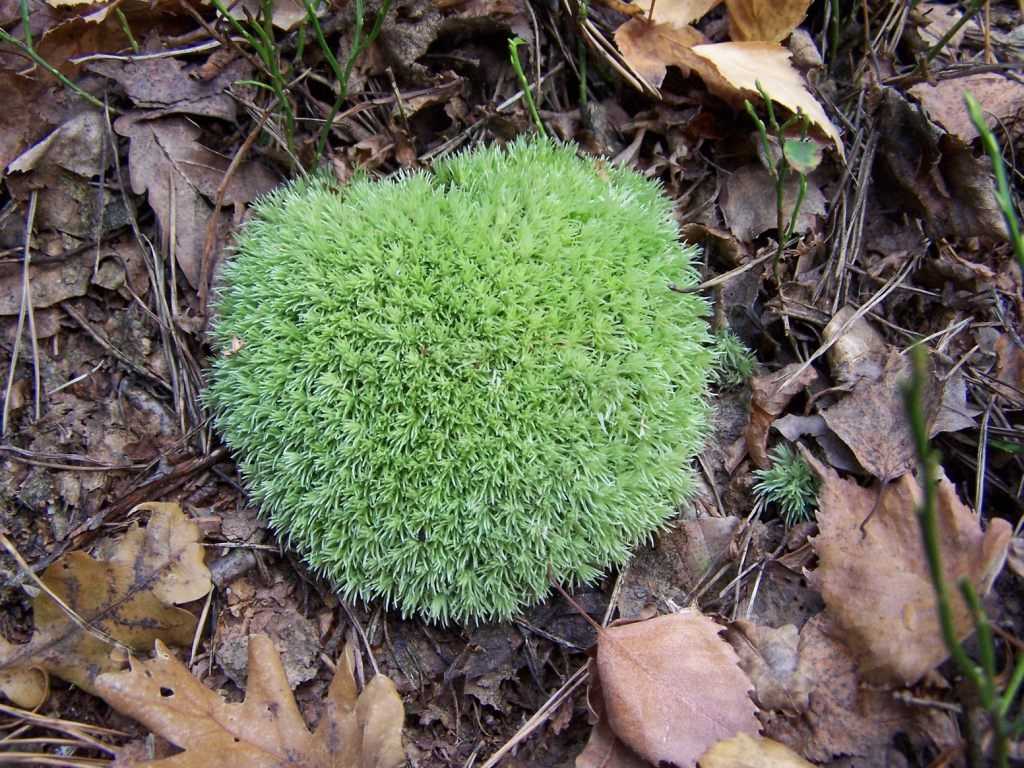
Leucobryum is a genus of mosses in the family Leucobryaceae, order Dicranales, class Bryopsida — belonging to the haplolepideous mosses within the larger division Bryophyta. The genus is distinguished by its characteristic growth habit: species form erect, dense, and often rounded cushions that range in color from white or grayish to bluish-green. This pale to whitish appearance, one of the most recognizable features of the genus, is produced by air bubbles trapped within specialized water-storing cells called leucocysts. These bubbles are thought to play a functional role in gas exchange, facilitating the activity of the photosynthetically active chlorocysts that lie between them.
The leaves are thick and notably broad, bearing a large, expanded costa (midrib) that occupies most of the leaf width. This distinctive leaf anatomy sets Leucobryum apart from most other mosses and makes it straightforward to identify in the field. The cushions can grow quite large and compact, giving them a pillow-like appearance on forest floors and rock surfaces.
Species are dioecious, meaning male and female reproductive structures are borne on separate plants. Male plants are typically stunted and intermixed among the leaves of the much larger female plants. Sporophytes (spore-bearing structures) are uncommon across the genus.
Leucobryum comprises approximately 122 species distributed worldwide, though only two species are known from North America. The name derives from the Greek leukos ("white") and bryon ("moss"), a direct reference to the genus's pale, distinctive cushions.
Etymology
The name Leucobryum combines the Greek leukos ("white") and bryon ("moss"), describing the genus's most conspicuous trait: its pale, whitish to grayish-green cushions. The characteristic color results from air-filled leucocysts within the leaves rather than from pigmentation.
Distribution
Leucobryum has a worldwide distribution, occurring across tropical, subtropical, and temperate zones. Despite the global range of approximately 122 species, only two species are recorded from North America, indicating that species richness is concentrated in tropical and subtropical regions.
Ecology
Leucobryum species typically grow on forest floors, rotting logs, shaded rock surfaces, and the bases of trees in humid environments. The cushion growth form helps retain moisture, and the leucocysts serve as internal water reservoirs. Species are dioecious and produce sporophytes infrequently, suggesting the genus relies heavily on vegetative dispersal; detached cushion fragments can establish new colonies.

