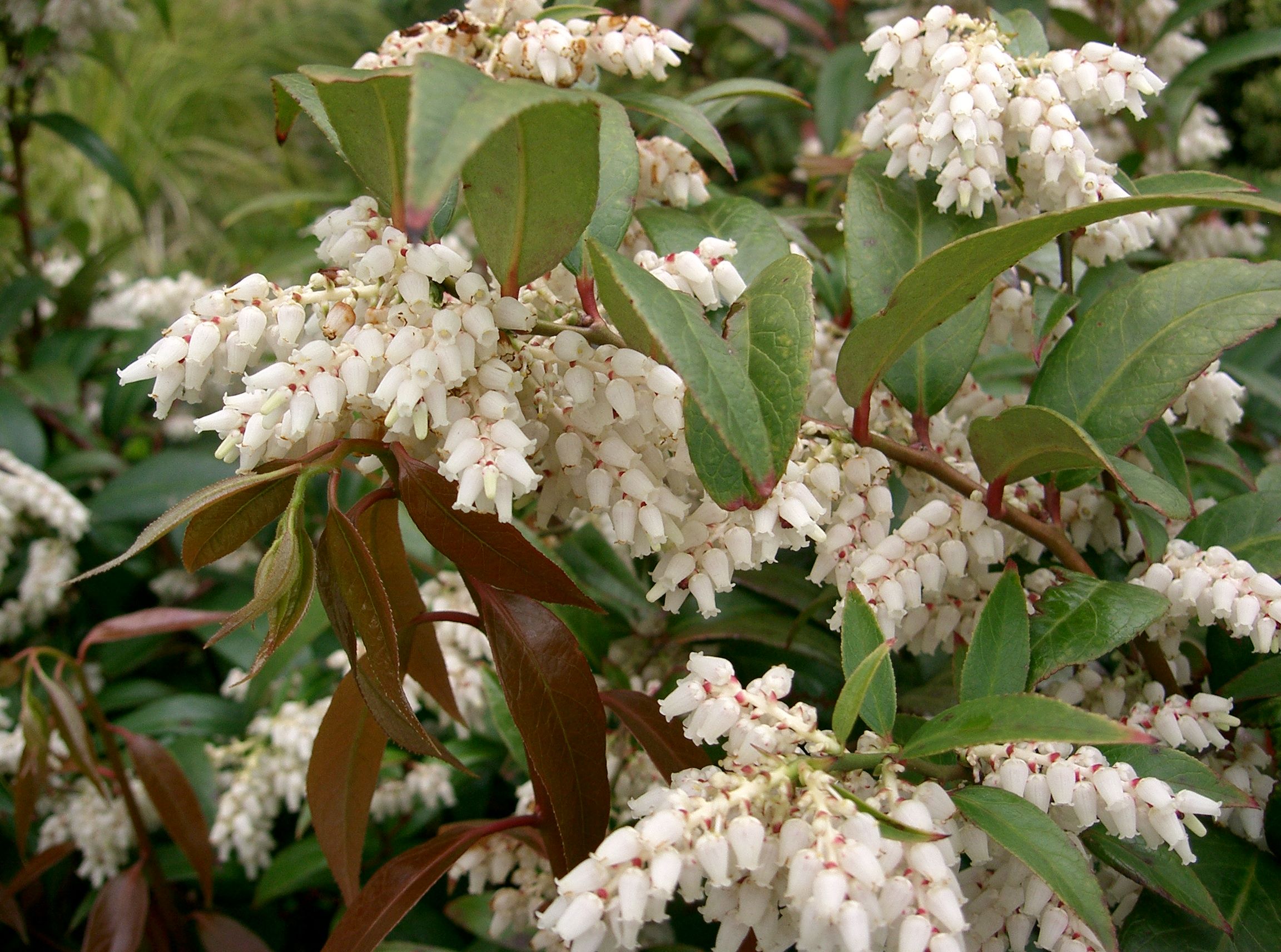
Leucothoe is a genus of flowering shrubs in the family Ericaceae (order Ericales), comprising about six species native to eastern Asia and the Americas. The genus was formally described by the Scottish botanist David Don in 1834.
Plants in this genus are shrubs typically growing 1–3 metres tall, either deciduous or evergreen depending on the species. The leaves are arranged alternately along the stems, oblong-lanceolate in shape and 2–15 cm long. Flowers are produced in elongated racemes 3–15 cm long; each individual flower is bell-shaped, 4–20 mm long, and usually white, occasionally tinged pink.
Leucotha species are notable for containing grayanotoxins, a group of closely related neurotoxins that were named after Leucothoe grayana, a species native to Japan. These compounds are found throughout the plant and contribute to the genus's common name "doghobble" — the toxicity makes the plants hazardous to livestock and wildlife.
Well-known members include Leucothoe fontanesiana (highland or drooping leucothoe) and Leucothoe axillaris (coastal doghobble), both native to the southeastern United States and widely cultivated as ornamental shrubs in shaded woodland gardens. Leucothoe davisiae (black laurel) is native to the Sierra Nevada of California and Oregon, while Leucothoe grayana and L. keiskei are native to Japan.
Etymology
The genus name Leucothoe derives from Greek mythology — Leucothoe (Λευκοθόη) was a sea-nymph and daughter of the sea-god Nereus. The neurotoxins characteristic of the genus, the grayanotoxins, take their name from the species Leucothoe grayana, which is native to Japan.
Distribution
Leucothoe is distributed across eastern Asia and the Americas. North American species are concentrated in the eastern United States (notably the Appalachian region and coastal Southeast), with one species (L. davisiae) reaching the Sierra Nevada of California and Oregon. Asian species occur in Japan, the eastern Himalayas, southwestern China, and northern Vietnam.
Ecology
All Leucothoe species produce grayanotoxins — a group of neurotoxic diterpenoids that affect voltage-gated sodium channels in animals. These toxins occur throughout the plant (leaves, nectar, and pollen) and are responsible for the common name "doghobble," reflecting the plants' capacity to impede or sicken dogs and livestock. The genus favors moist, acidic, woodland habitats, consistent with the broader Ericaceae association with acid soils.
Cultivation
Several Leucothoe species, particularly L. fontanesiana and L. axillaris, are cultivated as ornamental shrubs valued for their arching habit, attractive foliage, and shade tolerance. They prefer moist, humus-rich, acidic soils and partial to full shade, mimicking their native woodland habitats. Cultivars of L. fontanesiana with bronze or variegated foliage are popular in temperate garden settings. Because of the grayanotoxin content, all parts of the plant should be considered toxic to people and animals.

