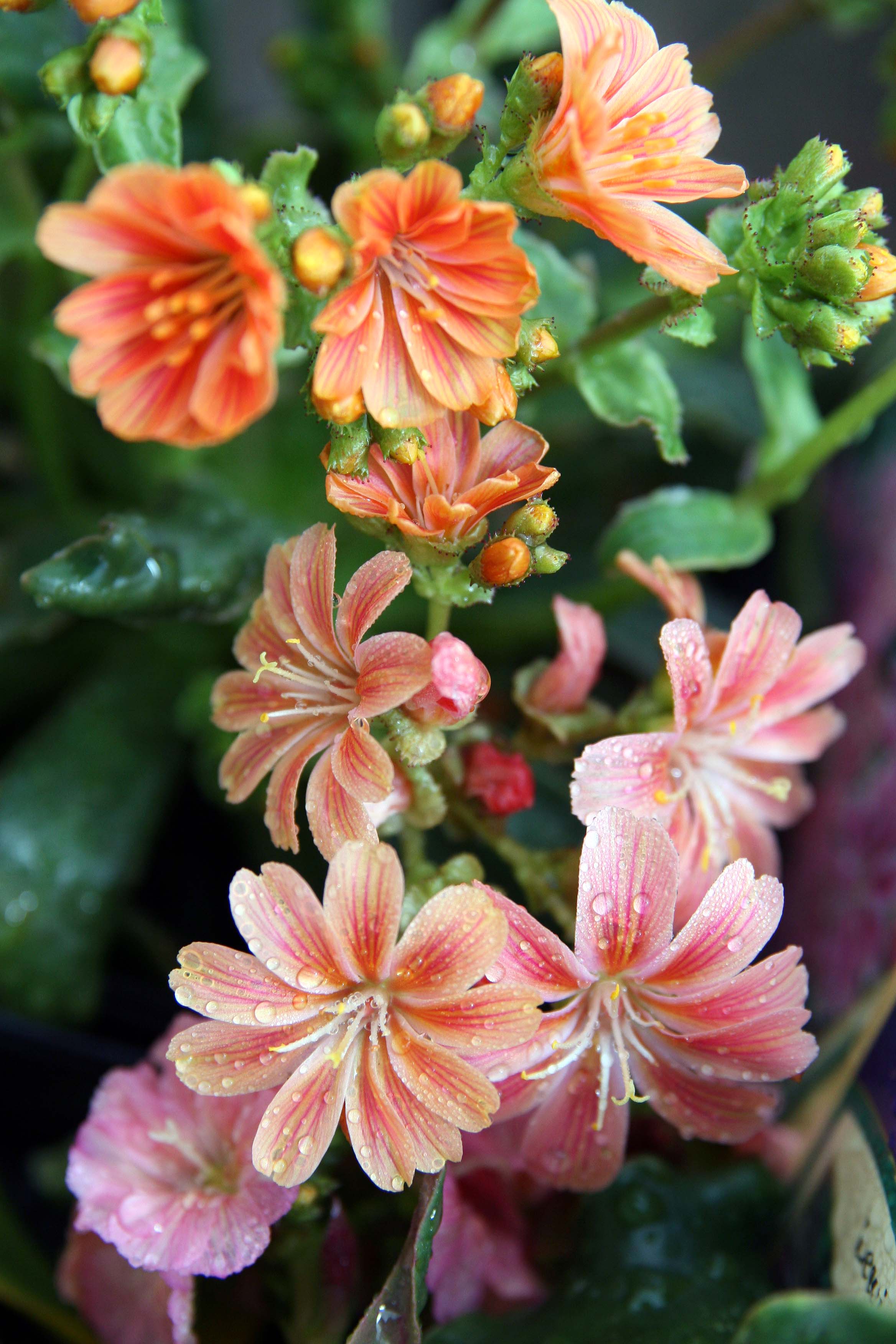
Lewisia is a genus of succulent perennial herbs in the family Montiaceae (order Caryophyllales), comprising 19 accepted species native exclusively to western North America. Plants form basal rosettes of fleshy leaves — linear to spatulate, with entire margins — and produce showy flowers ranging from white to dark pink or magenta, with 5–15 petals and 2 to 5–9 sepals. Flower arrangements vary from solitary blooms to cymose clusters of up to 60 flowers per plant, and the fruit is a circumscissile capsule containing many round, smooth, black seeds. Plants grow from a stout fleshy taproot and typically reach no more than 20 cm in height.
The genus is ecologically and horticulturally divided by deciduousness: roughly half the species die back to the root after their summer flowering period and resume growth in autumn, while others — most notably Lewisia cotyledon — are fully evergreen. Lewisia longipetala occupies an intermediate, semi-deciduous habit. In their native habitat of north-facing cliffs, talus slopes, and rocky ledges at elevations between roughly 1,300 and 2,400 metres, lewisias endure dramatic swings in temperature and moisture. This dependence on sharp drainage and tolerance for rocky, nutrient-poor soils gives the genus its strong association with rockery and alpine garden cultivation worldwide.
Lewisia rediviva, the bitterroot, is the state flower of Montana and holds particular cultural significance: Indigenous peoples of western North America peeled and dried the roots of several species as a nutritious winter food staple, and various groups used the root medicinally — for sore throats and to promote lactation. The genus was formally described by Frederick Pursh in 1814 (Fl. Amer. Sept. 368), based on material collected by the Lewis and Clark Expedition; the genus name honours Meriwether Lewis, who first documented the plants in 1806.
Etymology
The genus name Lewisia honours Meriwether Lewis (1774–1809), co-leader of the Lewis and Clark Expedition, who encountered the plants during the expedition's return journey in 1806. The genus was formally named and described by the botanist Frederick Pursh in 1814, in his Flora Americae Septentrionalis. The common name "bitterroot" refers specifically to the taste of the edible root of Lewisia rediviva, and that species was subsequently selected as the state flower of Montana in recognition of its cultural and historical importance to the region.
Distribution
Lewisia is endemic to western North America. The genus ranges from southern British Columbia and Alberta in Canada southward through the western United States — including Washington, Oregon, Idaho, Montana, California, Nevada, Utah, Arizona, and Colorado — and extends marginally into northern Baja California, Mexico. Species occupy a wide variety of rocky, well-drained habitats: north-facing cliffs, talus slopes, scree fields, chaparral, oak woodlands, and coniferous forest openings, from low-elevation foothills up to alpine zones at roughly 2,400 metres elevation. California, Utah, and Arizona are particularly species-rich states. SEINet records 16 species in western North America; GBIF recognizes 19 accepted species in total.
Ecology
In their native range, lewisias grow in rocky, nutrient-poor soils with excellent drainage — typically on north-facing cliffs and talus where moisture from snowmelt is available in spring but soils dry out significantly in summer. They are adapted to extremes: hard freezes in winter and drought stress in summer. Many deciduous species survive summer drought by dying back entirely to their fleshy taproot, re-emerging with autumn rains. Plants flower mainly in spring and are pollinated by insects. The genus is not recorded in global invasive species databases, indicating it presents no invasive risk outside its native range.
Cultivation
Lewisias are popular rockery and alpine garden plants, valued for their vivid flowers and compact habit. The key cultivation requirement is sharp, consistent drainage: plants are highly susceptible to root rot if water sits around the crown, particularly in winter. A gritty, humus-rich, neutral to slightly acidic soil in a sunny position is ideal. In containers, a free-draining alpine compost mix with added grit is standard. Deciduous species should be kept relatively dry once foliage dies back after flowering. Most species are hardy to approximately USDA zones 4–8, tolerating sustained cold well but disliking repeated freeze-thaw cycles or persistent winter wet. Evergreen species such as Lewisia cotyledon are most commonly grown and have given rise to numerous cultivars with flowers in shades of white, pink, orange, and magenta.
Propagation
Deciduous Lewisia species die back fully to the taproot after flowering in late spring or early summer, resuming growth in autumn. Division of offsets (where produced) and seed sowing are the principal propagation methods. Seed should be sown fresh or stratified cold before spring sowing. The outer layer of the fleshy root is most easily removed when the plant is in active flower — a detail relevant both to root division and to traditional food preparation.
Cultural Uses
Several Lewisia species were important food and medicine plants for Indigenous peoples of western North America. Roots of most species were peeled and dried for use as a winter food staple. Lewisia rediviva (bitterroot) was especially valued: the roots were gathered in spring, when the bitter outer skin slips off most easily, then cooked by boiling or steeping. Medicinally, chewing the root was used to relieve sore throats, and root preparations were used to promote milk flow during lactation. The cultural significance of bitterroot is commemorated in Montana's designation of Lewisia rediviva as its official state flower.
History
The genus entered Western botanical knowledge through the Lewis and Clark Expedition (1804–1806). Meriwether Lewis collected specimens of what would become Lewisia rediviva in 1806, and Frederick Pursh formally described and named the genus in his 1814 Flora Americae Septentrionalis, honouring Lewis in the genus name. The synonym Oreobroma Howell (published in Erythea 1: 31, 1893) was proposed for part of the group but is now treated as a synonym of Lewisia Pursh. The genus was historically placed in Portulacaceae; modern molecular phylogenetics led to its reclassification into the segregate family Montiaceae.
Taxonomy
Lewisia Pursh (1814) is the accepted name for this genus, placed in Montiaceae (order Caryophyllales). GBIF recognizes 19 accepted species plus one nothospecies (Lewisia ×whiteae), with 44 total descendant taxa including infraspecific entities. The only formally recognized synonym at genus rank is Oreobroma Howell (1893). The family Montiaceae is a relatively recently circumscribed family, segregated from the formerly broad Portulacaceae on the basis of molecular phylogenetic data; this reclassification moved Lewisia from Portulacaceae to Montiaceae.










