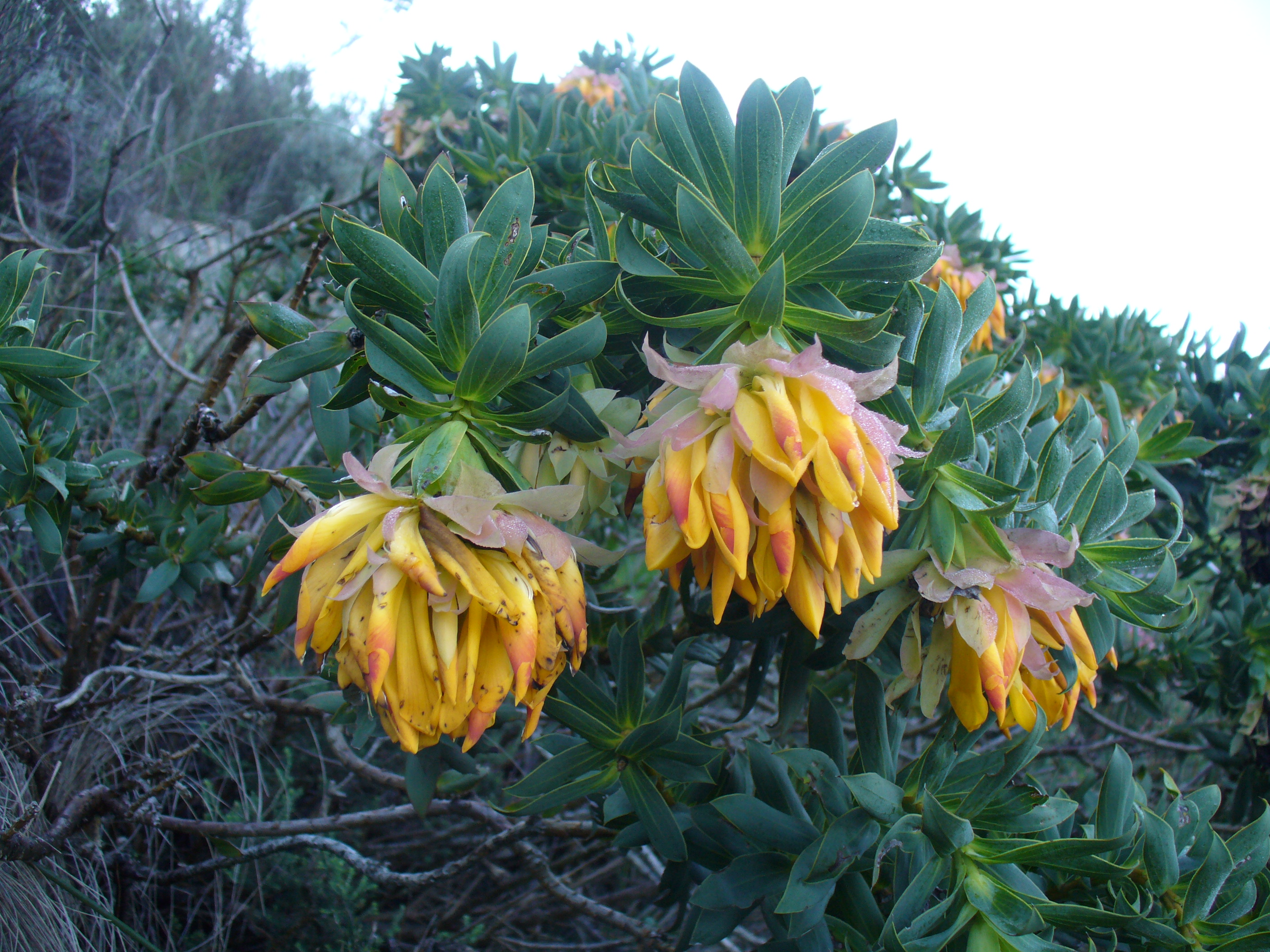
Liparia is a genus of approximately 20 species of flowering shrubs in the legume family Fabaceae, subfamily Faboideae, order Fabales. The genus was described by Carl Linnaeus in 1771 and is entirely native to the Cape Provinces of South Africa, where its members are characteristic elements of the fynbos biome.
Plants in the genus are typically multi-branching, re-sprouting shrubs reaching around one metre in height. They produce rounded flower heads, each composed of more than 15 individual pea-type flowers in shades of orange and yellow. The floral arrangement converges strikingly on the appearance of Protea flower heads — a remarkable case of parallel adaptation to the same pollinator guild: sunbirds (Nectarinia spp.) that visit both genera in the Cape fynbos. The genus is divided into two sections, Decussatae and Liparia.
The best-known member is Liparia splendens, variously called orange nodding-head, mountain dahlia, or Skaamblom (Afrikaans for "shy flower"). It is classed as Vulnerable on the IUCN global Red List. Like other fynbos plants, Liparia species are fire-adapted: they survive the frequent fynbos fires characteristic of the Cape Floristic Region by resprouting vigorously from large, deep underground root-stocks.
Etymology
The genus name Liparia is derived from the Greek liparos (λιπαρός), meaning "fat" or "shiny", likely in reference to the glossy or oily appearance of the leaves in some species. The genus was established by Carl Linnaeus in 1771.
Distribution
All species of Liparia are endemic to South Africa's Cape Provinces, occurring in the Cape Floristic Region. The most widely studied species, L. splendens, is restricted to mountain and lowland fynbos in the Western Cape, from the Cape Peninsula east to Albertinia and Riversdale.
Ecology
Liparia species are characteristic fynbos shrubs of the Cape Floristic Region. Their orange-yellow flower heads are adapted for pollination by sunbirds (Nectarinia spp.), a convergent strategy shared with the unrelated Protea genus in the same habitat. Members of the genus are fire-adapted, possessing large underground root-stocks that allow resprouting after the frequent wildfires that shape fynbos vegetation dynamics.
Conservation
Liparia splendens, the most prominent member of the genus, is listed as Vulnerable on the IUCN global Red List. Its restricted range within the fynbos of the Western Cape makes it susceptible to habitat loss and altered fire regimes.










