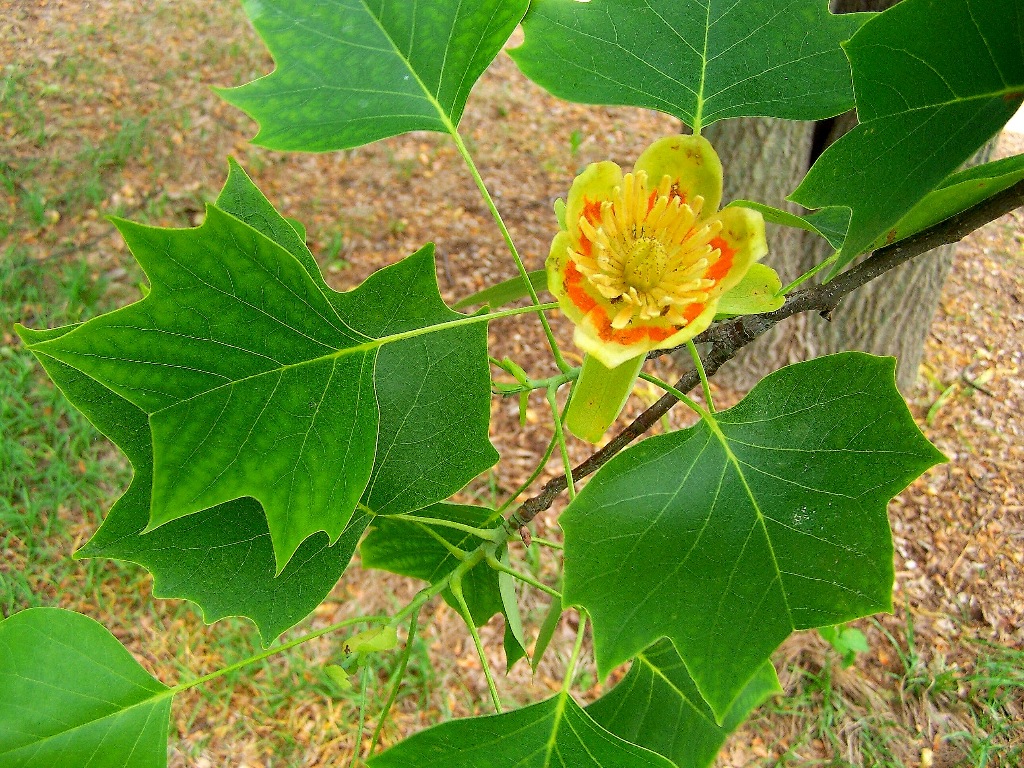
Liriodendron is a genus of two extant species of characteristically large deciduous trees in the magnolia family (Magnoliaceae), placed in the order Magnoliales. The genus is widely known by the common name tulip tree or tuliptree, owing to the large, tulip-shaped flowers that distinguish these trees; they are sometimes also called tulip poplar or yellow poplar, though they are unrelated to true poplars (Populus).
The two living species are Liriodendron tulipifera L. (tulip poplar or American tulip tree), native to eastern North America, and Liriodendron chinense (Hemsl.) Sarg. (Chinese tulip tree), native to China and Vietnam. A third taxon, Liriodendron × sinoamericanum, is an artificial hybrid between the two. Both species are among the tallest broadleaved trees in their respective ranges — the North American species has been measured at nearly 58.5 m (192 ft), making it the tallest native angiosperm known in North America. The genus was described by Carl Linnaeus in 1753, with L. tulipifera as the type species.
Liriodendron trees are readily identified by their distinctive leaves, which are four-lobed with a characteristically notched or flat apex, 8–22 cm long and 6–25 cm wide. The trunk is typically columnar, branch-free for much of its length, forming a compact conical crown. Flowers are 3–10 cm in diameter and bear nine tepals — three green outer sepals and six yellow-green inner petals, each with an orange flare at the base in L. tulipifera — arranged in a form superficially resembling a tulip. The fruit is a cone-like aggregate of winged samaras. Leaves turn yellow in autumn, and both species grow rapidly in rich, moist, well-drained temperate soils.
The fossil record shows that Liriodendron once had a much wider distribution, with specimens recorded from the Late Cretaceous and early Tertiary of North America and central Asia, and Tertiary-age fossils found across Europe — consistent with a formerly circumpolar northern range. The genus is thought to have gone extinct in Europe because the east-west orientation of European mountain ranges prevented southward migration during glacial periods.
Etymology
The generic name Liriodendron is derived from Greek: lirio- meaning lily and -dendron meaning tree, translating loosely as "lily tree." The common names tulip tree and tuliptree refer to the large, tulip-shaped flowers. The alternative names tulip poplar and yellow poplar are misnomers — Liriodendron is not closely related to the true poplars (genus Populus).
Distribution
Liriodendron tulipifera is native to eastern North America, where it reaches its greatest size in Appalachian cove forests; trees exceeding 165 ft are common there, and the tallest recorded specimen stands at 191.9 ft — the tallest native angiosperm in North America. Liriodendron chinense is native to China and Vietnam. Fossil evidence indicates the genus once ranged across Europe and had a circumpolar northern distribution during the Cretaceous and Tertiary; it became extinct in Europe when east-west mountain ranges prevented southward refugial migration during glaciations.
Cultivation
Liriodendron trees prefer temperate climates with full sun or part shade, and deep, fertile, moist, well-drained, slightly acidic soil. Propagation is by seed or grafting; seed-grown plants may take more than eight years to flower, while grafted plants flower according to the age of the scion. The wood of L. tulipifera — commercially sold as poplar or tulipwood — is fine-grained, stable, and easily worked, making it a common choice for cabinet and furniture framing, internal structural members, and veneering substrates.
History
The genus has a rich fossil history, with specimens recorded from the Late Cretaceous and early Tertiary of North America and central Asia, and Tertiary-age fossils known widely across Europe — well outside the genus's present range. This distribution reflects a once-circumpolar northern dispersal during warmer geological periods. Eastern Native American peoples used the large, straight trunks of L. tulipifera for dugout canoes, giving rise to the common name canoewood.
Taxonomy Notes
Liriodendron was described by Carl Linnaeus in 1753, with Liriodendron tulipifera L. as the type species, and is one of only two extant genera in the magnolia family Magnoliaceae alongside Magnolia. GBIF places the genus in order Magnoliales, class Magnoliopsida. Several fossil species have been described, including †L. balticum and †L. giganteum. The two living species hybridize readily, producing L. × sinoamericanum P.C.Yieh ex C.B.Shang & Zhang R.Wang.










