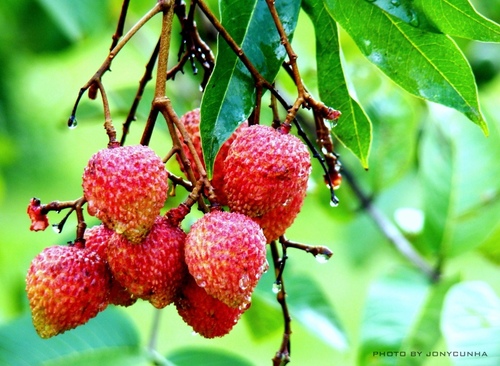
Litchi is a monotypic genus in the soapberry family Sapindaceae, containing a single species: Litchi chinensis, commonly known as lychee. The genus was described and named by French naturalist Pierre Sonnerat in 1782, based on his travels to the East Indies and China between 1774 and 1781.
The lychee is a tall, evergreen tree native to southern China, northern Vietnam, and Cambodia. It bears small, fleshy fruits encased in a pink-red, rough-textured outer shell. The edible aril within is sweet with a mildly tart flavor and a distinctive rose-like floral aroma. Three subspecies are recognized: subsp. chinensis, the only commercially cultivated form, found wild in southern China, northern Vietnam, and Cambodia; subsp. philippinensis, native to the Philippines and locally called alupag or matamata; and subsp. javensis, known only in cultivation in Malaysia and Indonesia.
Cultivation of lychees in southern China dates to at least 1059 AD, with unofficial records extending to 2000 BC. The fruit held great cultural significance in imperial China, serving as a valued tribute during the Han dynasty and reportedly being the favored fruit of Yang Guifei, a consort of the Tang Emperor Xuanzong. Today, China remains the world's primary producer, followed by India, Vietnam, and other countries in Southeast Asia and South Asia.
Taxonomically, Litchi is the sole genus in its immediate group within Sapindaceae, and Litchi chinensis is its only accepted species.
Etymology
The genus name Litchi is a Latinized form of the Chinese word for lychee (荔枝, lìzhī), the name by which the fruit has been known in China for centuries. The epithet chinensis in the sole species Litchi chinensis refers to China, the plant's region of origin.
Distribution
Litchi chinensis is native to southern China, northern Vietnam, and Cambodia, where the typical subspecies (subsp. chinensis) still grows wild. Subsp. philippinensis is native to the Philippines, and subsp. javensis is known only in cultivation in Malaysia and Indonesia. The lychee has been widely introduced throughout tropical Southeast Asia, South Asia, Madagascar, and South Africa, with China remaining the world's largest producer.
Ecology
Lychee trees require a frost-free tropical climate, tolerating temperatures no lower than −4 °C (25 °F). They thrive with high summer heat, substantial rainfall, and humidity. Optimal growth occurs on well-drained, slightly acidic soils rich in organic matter and mulch.
Cultivation
Lychees are extensively cultivated in southern China, Taiwan, Vietnam, Southeast Asia, and the Indian subcontinent. Some 200 cultivars exist, ranging from early to late maturing forms. The predominant propagation method is air layering: a branch of a mature tree is cut, covered with a moist rooting medium such as peat or sphagnum moss, wrapped in polyethylene film, and allowed to root before being detached and potted. Lychee trees are also grown as ornamentals.
History
Lychee cultivation in southern China is documented from 1059 AD, with traditional records placing its use as far back as 2000 BC. During the Han dynasty (1st century), fresh lychees were prized tribute items delivered to the Imperial Court by fast courier from Guangdong. The fruit was famously the favorite of Yang Guifei, consort of Tang Emperor Xuanzong. Juan González de Mendoza mentioned lychees in print in 1585, and Michał Boym formally introduced the tree to Western botanical literature in 1656. Chinese immigrants brought lychee trees to Jamaica in the 18th century, and commercial cultivation began in the Indian subcontinent in the 1960s.
Cultural Uses
The lychee has been a prestige fruit in Chinese culture for over a millennium, associated with the Imperial Court and celebrated in classical literature such as Cai Xiang's Li chi pu (Treatise on Lychees) during the Song Dynasty. In Jamaica, the fruit is closely tied to the Chinese Jamaican community and is featured in lychee cake, a popular dessert created in 1988. Lychee is widely consumed fresh and is also processed into juices, jellies, and preserves across Asia and beyond.

