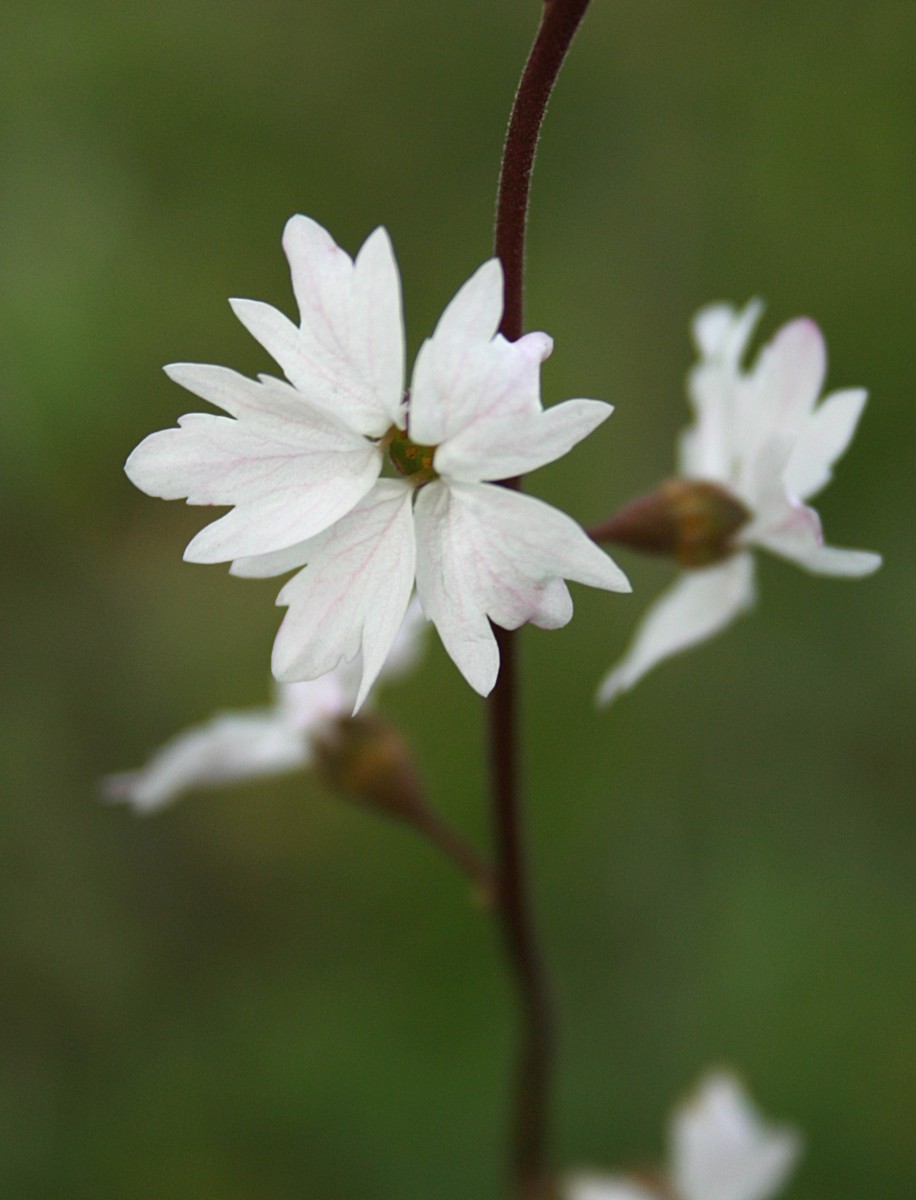
Lithophragma, commonly known as woodland stars, is a genus of approximately 9–10 species of herbaceous flowering plants in the saxifrage family (Saxifragaceae). All species are native to western North America, ranging across the Pacific states and mountain regions of the American West.
Plants are rhizomatous perennial herbs with erect, leafy, stipitate-glandular flowering stems that grow 8–85 cm tall. Leaves occur in a basal rosette and as cauline leaves; the blades are orbiculate to reniform in outline, palmately lobed, with cordate bases and glandular surfaces. One of the most distinctive traits is the genus's reproductive strategy: most species produce bulblets in stem and leaf axils and in the inflorescence, often using vegetative propagation rather than seeds.
The flowers are borne in compact or lax racemes of 2–12(–25) flowers. Each flower has 5 white (occasionally pink) petals with deeply cut lobes or teeth — so deeply that each petal can appear to be 3–5 separate petals, though the lobes unite at the base into a single structure. There are 10 stamens and a 3-carpellate pistil; the capsule fruit is 3-beaked and contains 50–200 small dark brown seeds.
Lithophragma has a remarkable ecological relationship with Greya moths (family Prodoxidae): the moths are the primary pollinators of woodland stars and also use the plants as exclusive egg-laying sites, making this one of the more studied examples of a mutualistic pollination–nursery interaction in North American flora.
One species, Lithophragma maximum (San Clemente Island woodland star), is federally listed as endangered in the United States. Notable members include L. parviflorum (smallflower woodland star), L. affine (San Francisco woodland star), L. bolanderi (Bolander's woodland star), and L. heterophyllum (hillside woodland star).
Etymology
The name Lithophragma derives from the Greek lithos (rock) and phragma (partition or fence), referring to the rocky habitats in which these plants characteristically grow. The generic name is considered grammatically neuter in gender.
Distribution
Lithophragma is endemic to western North America, with species distributed across California, the Pacific Northwest, and adjacent mountain ranges. The Flora of North America recognizes approximately 12 taxa in the genus within this region; the Jepson Manual treats L. trifoliatum as a variety of L. parviflorum restricted to California, while Plants of the World Online and FNA recognize it as a distinct species.
Ecology
Woodland stars are notable for their specialized mutualistic relationship with moths of the genus Greya (Prodoxidae). These moths are the primary pollinators of Lithophragma and also lay their eggs exclusively in the flowers, with larvae feeding on developing seeds — a classic example of a pollination–seed predation mutualism. Most species of Lithophragma reproduce predominantly via bulblets rather than seeds, which may be an adaptation to this partially antagonistic pollination system.
Conservation
Lithophragma maximum, the San Clemente Island woodland star, is federally listed as an endangered species in the United States, restricted to San Clemente Island off the coast of southern California.










