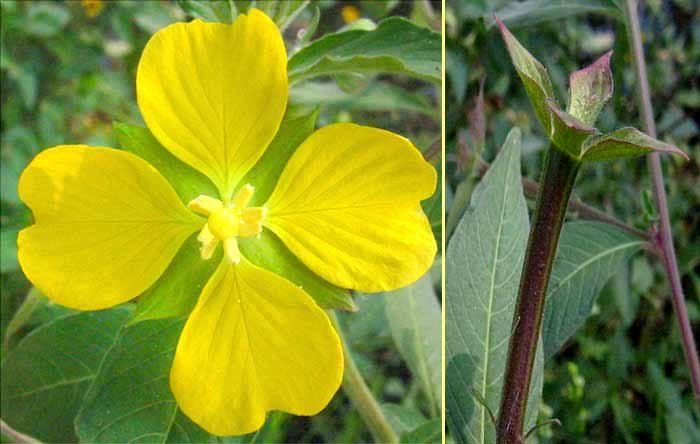
Ludwigia is a genus of approximately 75–82 species of aquatic and semi-aquatic flowering plants in the family Onagraceae, order Myrtales. Commonly called primrose-willows, water-primroses, or seedboxes, these plants grow as annuals, perennials, or subshrubs and are found across a broad range of wetland habitats — bogs, ponds, and lake margins — on every inhabited continent, with the greatest diversity concentrated in tropical America.
Plants in the genus are recognizable by their fleshy, often reddish stems that root readily at the nodes and can sprawl horizontally up to 2.7 metres (9 feet). Leaves are alternate or opposite, lance- to egg-shaped, up to 15 cm long, and range from green to reddish. The cheerful five-petaled yellow flowers (sometimes white) are typically small — around 1.5 cm across — and open from spring through autumn. Flowers are 4- or 5-merous, with sepals that persist on the fruit; ovaries are cylindric to prismatic, often angled or winged, and the fruits are capsules that dehisce longitudinally or through terminal pores to release numerous small seeds.
The genus has a cosmopolitan distribution rooted in tropical America, with species present across South and North America, Europe, Asia, and Africa. In Europe, several species — notably L. grandiflora and L. peploides — are considered invasive neophytes that colonize waterways rapidly owing to prolific seed production and vegetative spread via stem fragments.
Classification within Ludwigia remains an active area of study. Botanists place it in the subfamily Ludwigioideae (Onagraceae), and USDA botanists have been conducting genetic analyses to resolve ongoing taxonomic debates about species boundaries. GBIF currently recognises 178 descendant taxa under the genus.
Etymology
The genus name Ludwigia was coined by Carl Linnaeus and published in Species Plantarum in 1753. It honours Christian Gottlieb Ludwig (1709–1773), a German physician and botanist who was a professor at Leipzig and contributed to the study of cryptogams and plant classification in the mid-eighteenth century.
Distribution
Ludwigia has a cosmopolitan distribution, with native representatives on every inhabited continent. The centre of diversity lies in tropical America, and the genus is particularly species-rich in South and Central America. Species also occur natively across North America, sub-Saharan Africa, South and Southeast Asia, and parts of Europe. In Europe, the genus is represented by L. palustris as a native, with L. grandiflora, L. peploides, and the hybrid L. ×kentiana now established as invasive neophytes — all four are recorded in Switzerland, for example. The broad distribution reflects the genus's association with freshwater habitats (bogs, ponds, lake margins, slow-moving rivers) that occur across climatic zones.
Ecology
Members of Ludwigia are predominantly aquatic or semi-aquatic, favouring still or slow-moving freshwater: ponds, bogs, lake margins, ditches, and wet meadows. Most species require full sun and tolerate frequently waterlogged or inundated soil. Stems are often fleshy and root readily at nodes, enabling vigorous vegetative spread across water surfaces. Flowers open during the day and produce abundant seed. Several species — particularly L. grandiflora and L. peploides in Europe and L. hexapetala in other regions — are recognised as invasive, forming dense floating or emergent mats that shade out native aquatic vegetation, reduce oxygen levels, and disrupt aquatic food webs. The genus's ability to reproduce both sexually (via copious small seeds dispersed by water) and vegetatively (stem fragments) makes it highly competitive in disturbed wetland systems.
Cultivation
Ludwigia species are cultivated as ornamental aquatic plants for outdoor ponds and water gardens, valued for their bright yellow flowers and attractive reddish foliage. They perform best in full sun (at least 6 hours of direct sunlight daily) and in soil that is frequently wet or standing in shallow water. Some species are also grown in aquaria as submerged or emergent plants, where their colourful stems and leaves provide visual interest. Gardeners should note that in many temperate regions several species are classified as invasive; planting them in open water bodies or near natural waterways is restricted or prohibited. Aquarium hobbyists are similarly advised against releasing plants into the wild.
Conservation
While the genus as a whole is not globally threatened, certain species of Ludwigia have become significant conservation concerns as invasive plants. In Europe, L. grandiflora and L. peploides are listed as invasive neophytes and are the subject of eradication and control programmes in countries including France, the United Kingdom, and Switzerland. Their rapid vegetative spread and prolific seeding allow them to dominate wetland habitats, displacing native flora and degrading the ecological value of freshwater systems. Conversely, some native species in their home ranges may face localised pressure from habitat loss and wetland drainage, though no Ludwigia species is currently listed as globally threatened by the IUCN.
Taxonomy
Ludwigia L. (1753) is the type genus of the subfamily Ludwigioideae within Onagraceae. The genus belongs to the order Myrtales, class Magnoliopsida (eudicots), and its accepted placement is uncontested at family level. Within the genus, however, classification of individual species has been contentious: there is ongoing debate among taxonomists about species limits, and USDA botanists have been using genetic analyses to clarify relationships. GBIF currently lists 178 descendant taxa; other treatments cite figures closer to 75–82 accepted species, reflecting differences in species concepts and the treatment of subspecific taxa. Seeds may be pluriseriate or uniseriate within capsule locules — a morphological character used in species-level keys.
History
The evolutionary history of Ludwigia extends deep into the Cenozoic era. The oldest known fossil remains of the genus come from Eckfelder Maar in Germany, dating to the Eocene epoch. Fossil pollen from these deposits suggests that ancient Ludwigia flowers were likely pollinated by beetles rather than by bees or other Hymenoptera — a contrast with most modern members, which attract a range of insects. By the Middle Miocene, the genus was present in northern Europe: fossil seeds assigned to L. collinsoniae and L. corneri have been documented from Denmark.










