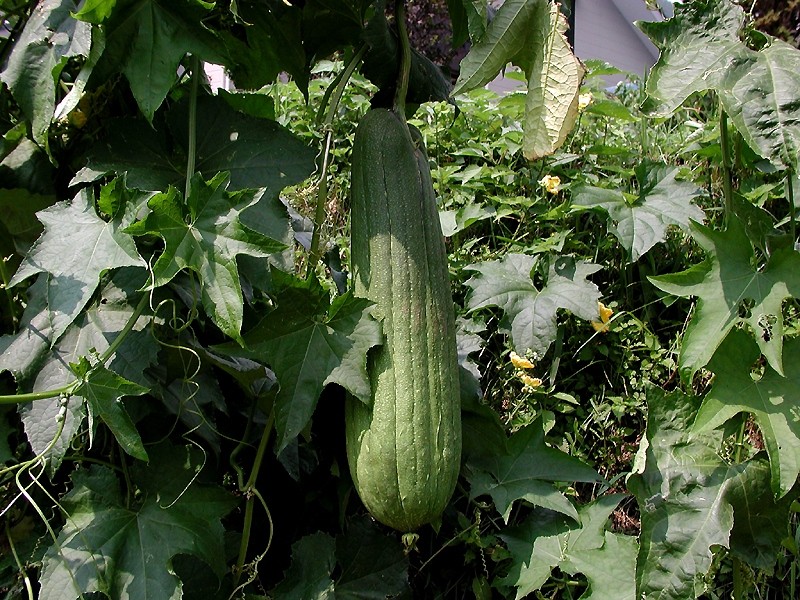
Luffa is a genus of tropical and subtropical climbing vines in the family Cucurbitaceae (the cucumber, gourd, and squash family), placed in the order Cucurbitales. Described formally by Philip Miller in 1754, the genus contains around seven to nine accepted species native to tropical Asia, though two species — Luffa aegyptiaca (the smooth or Egyptian luffa) and Luffa acutangula (the ridged or angled luffa) — are cultivated across the tropics and subtropics and account for virtually all of the genus's economic importance.
The plants are vigorous annual vines that climb by tendrils. Leaves are lobed and roughly palm-shaped, and the flowers are bright yellow. The fruit is elongated and cylindrical or ridged, resembling a large cucumber or gourd. When harvested young and immature, the flesh is tender and edible, with a mild flavour used in stir-fries, soups, and curries across South Asia, Southeast Asia, and East Asia. As the fruit matures fully and dries on the vine, the fleshy interior breaks down, leaving behind a dense, highly porous three-dimensional network of xylem fibres — the familiar loofah sponge used as a bath or kitchen scrubber.
Luffa aegyptiaca is particularly important commercially: its fibrous skeleton is harvested, cleaned, and sold globally both as a natural bathing sponge and, increasingly, as a sustainable industrial material. Research has shown that luffa sponge fibre bundles display a high specific modulus and notable energy-absorption capacity under compression, comparable in some respects to engineered aluminium foam. The sponge is also used in skincare products, notably in Taiwan where luffa water (liquid extract) has been marketed as a facial toner for decades.
The genus name derives from the Arabic lūf (لوف), the plant's traditional name in Egypt and the broader Arabic-speaking world. European botany encountered it through Johann Vesling's late-1620s descriptions of cultivated plants in Egypt, and Joseph Pitton de Tournefort formalised the genus name in 1706. The vegetable remains one of the most culturally embedded crops across the Indian subcontinent, known under dozens of regional names in Hindi, Bengali, Tamil, Kannada, Telugu, Malayalam, Marathi, and other languages.
Etymology
The genus name Luffa was adopted by European botanists in the 17th century from the Arabic lūf (لوف), the plant's common name in Egypt. Johann Vesling encountered the plant under cultivation in Egypt in the late 1620s, and Joseph Pitton de Tournefort formalised the genus name in 1706. Philip Miller's 1754 Gardeners Dictionary (abridged edition 4) established the authority Mill. used today. In North America the plant is sometimes called "Chinese okra," and in Spanish it is known as estropajo.
Distribution
Luffa species are native to tropical Asia, with the two principal cultivated species (L. aegyptiaca and L. acutangula) now grown throughout the tropics and subtropics. The vegetable form is particularly popular in Pakistan, India, Nepal, Bhutan, Bangladesh, China, Indonesia, Vietnam, and Japan, and both species have a long history of cultivation in Egypt, where Arabic-speaking peoples grew L. aegyptiaca by at least late medieval times.
Cultivation
The two commercially grown species are warm-season annuals requiring a long frost-free season, full sun, and a trellis or other support for their vigorous climbing growth. Fruit must be harvested when young and tender (before the fibre network fully develops) for culinary use. For sponge production, fruit is left on the vine until fully mature and dry; the outer skin is then peeled away and the seeds shaken out, leaving the fibrous skeleton ready for washing and sale. The crop is widely grown in kitchen gardens and smallholder plots across South and Southeast Asia.
Cultural Uses
Luffa has an exceptionally broad range of cultural uses. In culinary traditions across the Indian subcontinent the young fruit appears in dals, curries, stir-fries, and chutneys under many regional names (torai, jhinge, peerkangai, beerakaya, hirekayi, and others). In Japan, hechima (as luffa is known) is grown both as a summer vegetable in Okinawa and as a living sunscreen when trained over windows. In Taiwan, the liquid pressed from the plant — called cài guā shuǐ (菜瓜水, luffa water) — has been marketed as a natural facial toner for over two decades. The fibrous sponge is universally used as a bath scrubber and is also processed into panels for furniture and construction in Paraguay.
History
The genus was first documented for Western botany by Johann Vesling, who observed Luffa (then called "Luffa Arabum") under artificial irrigation in Egypt in the late 1620s. Joseph Pitton de Tournefort formalised the genus in 1706, identifying a single member species and providing detailed botanical illustrations — the plant now recognised as Luffa aegyptiaca. Linnaeus later placed the same species in Momordica without maintaining a separate Luffa genus; Philip Miller's 1754 Gardeners Dictionary restored and established the genus in its current form. The 1804 Japanese agricultural encyclopaedia Seikei Zusetsu depicts luffa alongside other cultivated crops, testifying to its long presence in East Asian agriculture.










