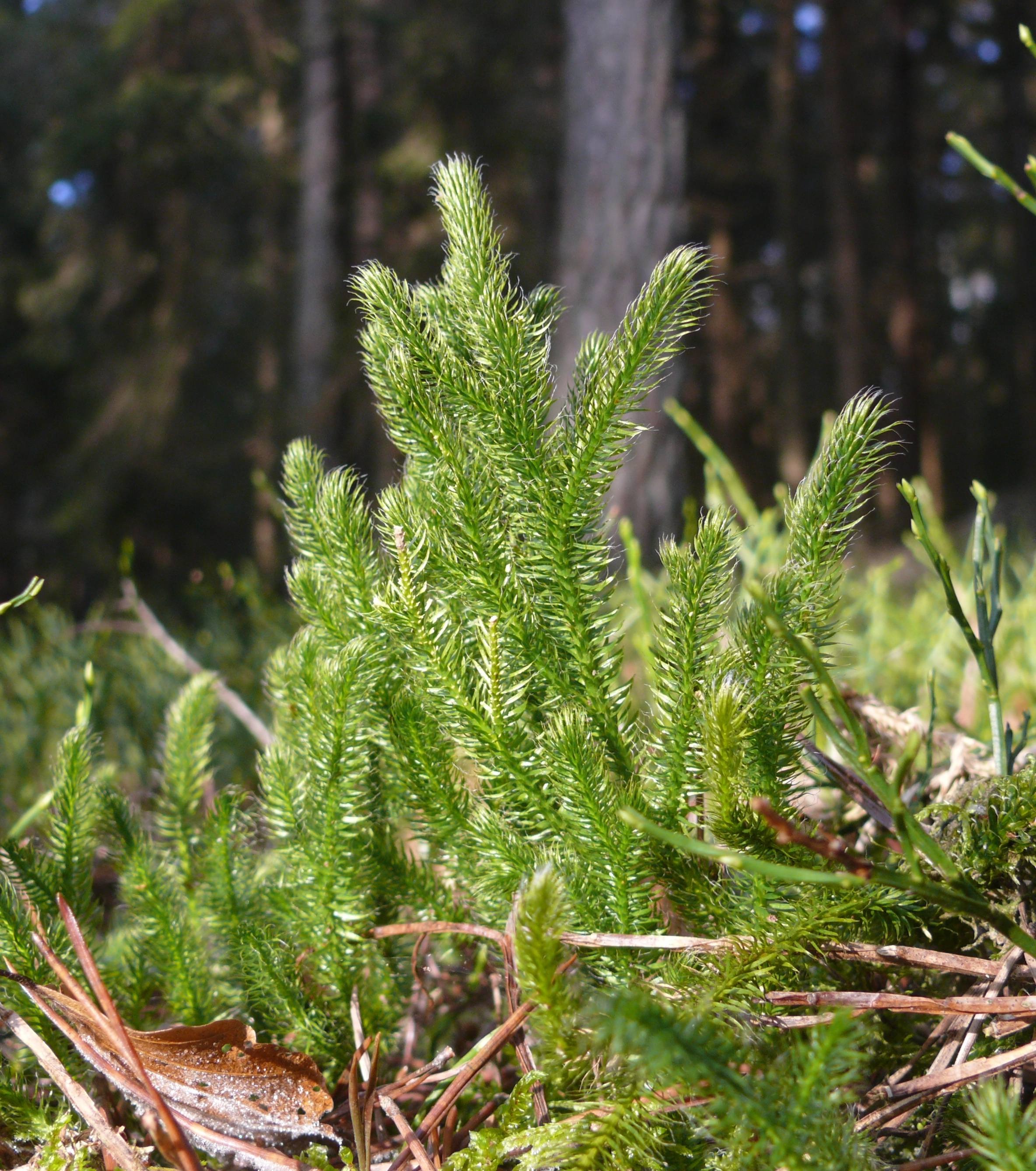
Lycopodium is a genus of clubmosses — ancient, flowerless vascular plants in the family Lycopodiaceae (order Lycopodiales, class Lycopodiopsida) — commonly known as ground pines or creeping cedars. The genus was first described by Carl Linnaeus in 1753 and represents one of the oldest lineages of vascular plants, with relatives dating back hundreds of millions of years.
Plants in Lycopodium are terrestrial or epiphytic, with widely branched stems that creep along the ground, forking at intervals, and small, needle-like or scale-like leaves (microphylls) densely covering the stems and branches. Reproduction is by spores: sporangia are borne on specialized leaves (sporophylls) grouped into a distinctive club-shaped, cone-like strobilus at the tip of upright fertile stems — the feature that gives the group its common name "clubmoss." Spores are all of one type (isosporous), and each germinating spore produces a subterranean gametophyte that bears both male and female sex organs. Plants also spread vegetatively via above- or below-ground rhizomes.
The circumscription of Lycopodium varies considerably among classification systems. In the Pteridophyte Phylogeny Group classification of 2016 (PPG I), Lycopodium is one of nine genera in the subfamily Lycopodioideae, comprising 9–15 species. In broader, traditional treatments, the genus encompasses all members of the subfamily, with more than 40 accepted species. The genus has a subcosmopolitan distribution, with species found from circumpolar subarctic regions to tropical islands of the Pacific, eastern Asia, South America, and New Guinea.
The spores of Lycopodium species are collected and sold as lycopodium powder, historically used in pharmacy, pyrotechnics, and scientific experiments. Several species have been used in traditional medicine, though claims of efficacy are unproven.
Etymology
The name Lycopodium derives from the Ancient Greek lykos (wolf) and podion, a diminutive of pous (foot), meaning roughly "wolf's foot" — a reference to the claw-like appearance of the branching, creeping stems.
Distribution
Lycopodium has a subcosmopolitan distribution. Species occur from circumpolar arctic and subarctic regions (L. lagopus) through temperate and tropical zones to the Pacific islands of Hawaii, Western Samoa, and the Society Islands (L. venustulum), eastern Asia, the Andes of northwestern South America (L. vestitum), and New Guinea (L. papuanum). Lycopodium clavatum, the stag's-horn clubmoss, is the most widespread species.
Ecology
Lycopodium species are terrestrial or epiphytic plants of forests, heathlands, and open subalpine or arctic habitats. They grow in both humid tropical and cold temperate environments. The gametophyte stage is subterranean and mycotrophic, relying on fungal associations for nutrients, which makes Lycopodium sensitive to soil disturbance and slow to recolonize after habitat loss.
Taxonomy Notes
Lycopodium was first published by Carl Linnaeus in 1753, originally placed among the mosses (Musci). Its circumscription has been debated ever since: traditional treatments treat it as the sole or dominant genus of Lycopodiaceae (40+ species), while the Pteridophyte Phylogeny Group classification (PPG I, 2016) restricts it to one of nine genera in the subfamily Lycopodioideae (9–15 species), with related genera including Huperzia and Lycopodiella separated out.
Cultural Uses
The spores of Lycopodium species — collected as lycopodium powder — are highly flammable and have been used in pyrotechnics, pharmacy (as a coating for pills), and scientific experiments. In traditional Austrian medicine, the herb was used internally as a tea and externally as compresses for disorders of the locomotor system, skin, kidneys, and urinary tract, as well as for rheumatism and gout, though no claims of efficacy are proven.










