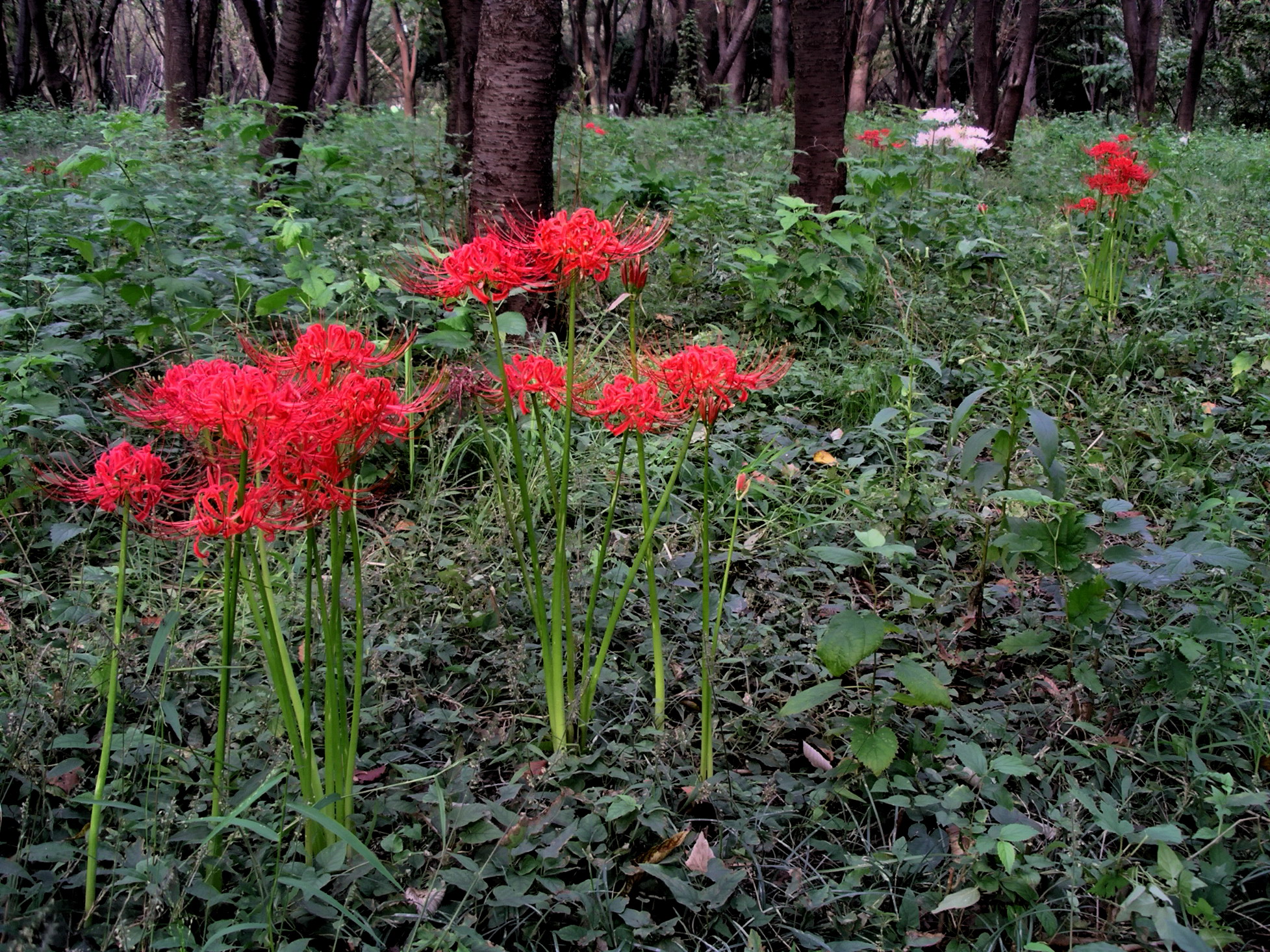
Lycoris is a genus of approximately 20 species of bulb-forming perennial flowering plants in the family Amaryllidaceae (subfamily Amaryllidoideae), order Asparagales. The genus is native to eastern and southern Asia, with its greatest diversity in China and Japan, and extends through southern Korea, northern Vietnam, Laos, Thailand, Myanmar, Nepal, Pakistan, Afghanistan, and eastern Iran.
Plants arise from tunicate bulbs and produce long, slender, strap-like leaves 30–60 cm long and only 0.5–2 cm broad. The leafless flowering scape is erect, 30–70 cm tall, bearing a terminal umbel of four to eight flowers that can be white, yellow, orange, or red. The genus is divided into two subgenera based on floral form: subgenus Lycoris, whose members bear very long, filamentous stamens two to three times as long as the tepals (typified by the red spider lily, L. radiata), and subgenus Symmanthus, whose stamens are shorter and not much longer than the tepals (typified by L. sanguinea). The fruit is a three-valved capsule containing several black seeds.
Many species in the genus are sterile and reproduce only vegetatively, and several are thought to be of hybrid origin. Phylogenetic analyses of chloroplast genes have found species of Lycoris nested within L. radiata, raising questions about whether all currently recognised species are truly distinct.
In English, Lycoris species are variously called spider lilies, hurricane lilies, cluster amaryllis, or surprise lilies — the last name reflecting the habit of flowers appearing on bare scapes before or without visible leaves. The genus shares the common name "spider lily" with the related genera Hymenocallis and Crinum. Lycoris has been extensively cultivated as an ornamental plant in China and Japan for centuries, with over 230 cultivars developed in Japan alone.
Etymology
The genus name Lycoris was given by botanist William Herbert in 1819, drawn from classical antiquity — Lycoris was the stage name of Cytheris, a celebrated Roman mime actress and freedwoman who was the mistress of Mark Antony and was also associated with the poet Gallus. The name evokes beauty and dramatic appearance, qualities reflected in the showy, often leafless-stemmed blooms.
Distribution
Lycoris is native to eastern and southern Asia, ranging across China, Japan, southern Korea, northern Vietnam, Laos, Thailand, Myanmar, Nepal, Pakistan, Afghanistan, and eastern Iran. The genus is most diverse in China and Japan. Some species, particularly L. radiata and L. squamigera, have become locally naturalised in the southeastern United States, where they persist around old homesteads and cemeteries.
Cultivation
Lycoris species are widely grown as ornamental bulbs in warm-temperate gardens throughout East Asia and beyond. In Japan, they are a staple of the late-summer landscape, planted extensively along the edges of rice paddy fields, where the toxicity of the bulbs deters rodents and moles, and the flowers provide dramatic seasonal colour; more than 230 cultivars have been selected for garden use. In China, they are used as decorations in festivals and celebrations. In Western gardens, L. squamigera (naked lady) and L. radiata (red spider lily) are the most commonly grown species; both thrive in well-drained soil with a summer dry period and require minimal maintenance once established.
Cultural Uses
In Japan, Lycoris radiata — known as higanbana (彼岸花, "higan flower") — blooms at the autumnal equinox and is deeply associated with Buddhist observances of Ohigan, the ancestral memorial period. The flowers are frequently planted in temple and cemetery grounds. Japanese folklore links higanbana with the afterlife and the road to the underworld, making it a potent cultural symbol with dual associations of beauty and death. In China, Lycoris species appear in traditional poetry and are incorporated into festival decorations.










