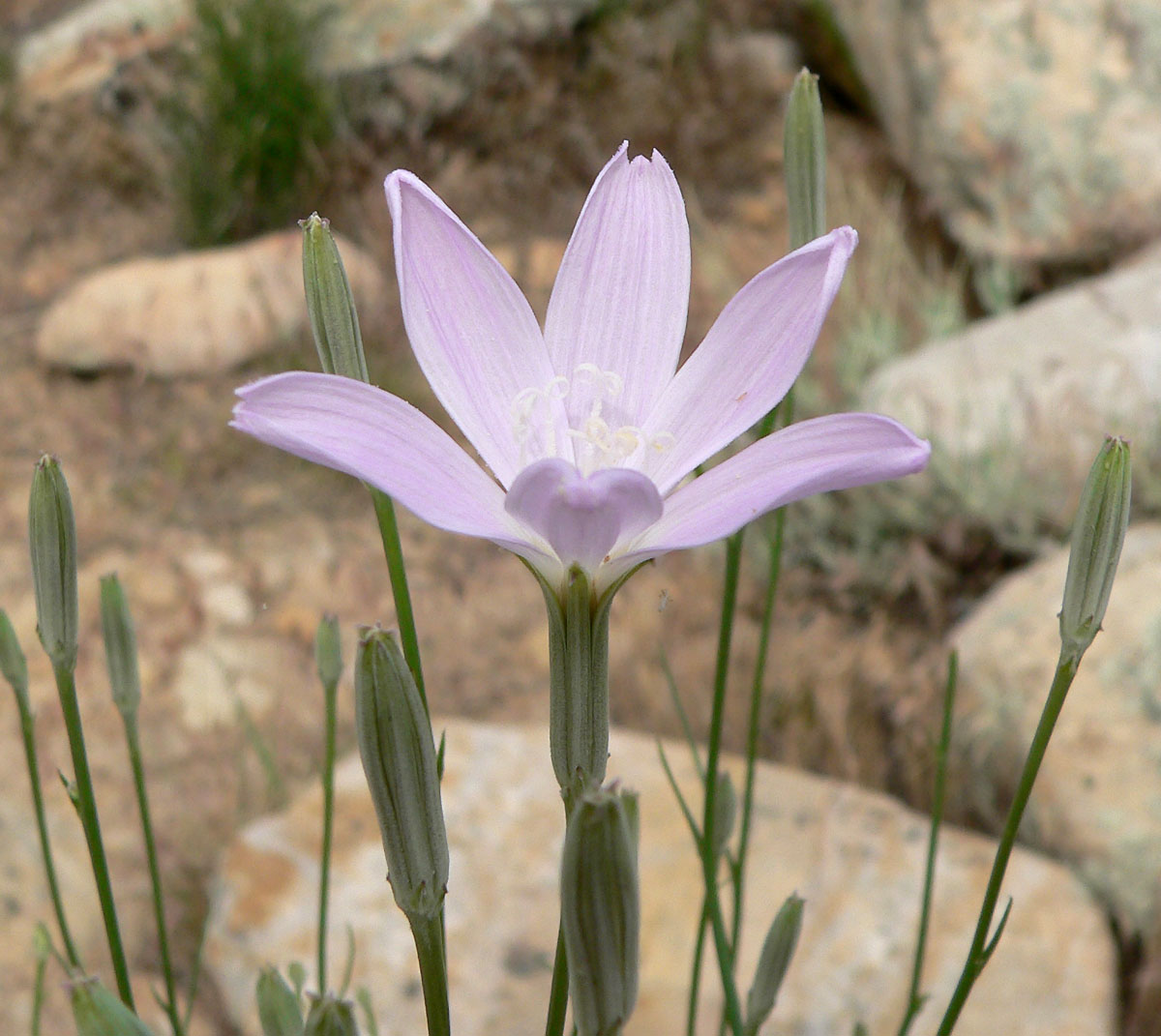
Lygodesmia, commonly known as skeletonplant or skeletonweed, is a small genus of flowering plants in the daisy family Asteraceae (tribe Cichorieae, order Asterales). It was described by the Scottish botanist David Don in 1829, originally published in the Edinburgh New Philosophical Journal. The genus was formerly also known under the synonym Erythremia Nutt.
Plants in this genus are native to North America, occurring primarily across the western and central United States and into western Canada, with a few species reaching Florida, Georgia, Alabama, Texas, and northern Mexico. They are characterised by slender, rush-like or twiggy stems that are either leafless or nearly so — a striking adaptation that gives rise to the common name "skeletonplant." Stems are typically fascicled (bundled), green, and photosynthetically active even when leaves are absent or much reduced. Flower heads are ligulate (composed entirely of strap-shaped ray florets), most commonly pink or lavender, and characteristic of the Cichorieae tribe within Asteraceae.
GBIF recognises approximately 9 accepted species in the genus. Well-known members include Lygodesmia juncea (rush skeletonplant), widespread across the Great Plains and Rocky Mountain region; Lygodesmia grandiflora, found from Arizona north to Wyoming; Lygodesmia texana, ranging across Texas, Oklahoma, and adjacent Mexico; and Lygodesmia aphylla, occurring in the southeastern coastal plain (Florida, Georgia, Alabama).
Etymology
The name Lygodesmia derives from the Greek lygos (a pliant twig) and desme (a bundle), referring to the characteristic fascicled, rush-like stems that define the genus. David Don coined the name when he described the genus in 1829.
Distribution
Lygodesmia species are distributed across North America, from the southeastern coastal plain (Florida, Georgia, Alabama) west through Texas, Oklahoma, New Mexico, Arizona, Utah, Colorado, Wyoming, Nevada, and Idaho, and broadly across western Canada. One species, L. ramosissima, extends southward into the Mexican states of Chihuahua, Durango, and Sonora. L. juncea has the widest range, occurring throughout the Great Plains and Rocky Mountain foothills.
Ecology
The genus is adapted to open, often arid or semi-arid habitats including prairies, grasslands, desert scrub, and disturbed ground. The reduced, rush-like stems minimise water loss, and the green photosynthetic stems allow plants to function with minimal leaf tissue — a strategy suited to dry, sunny environments across the western interior of North America.










