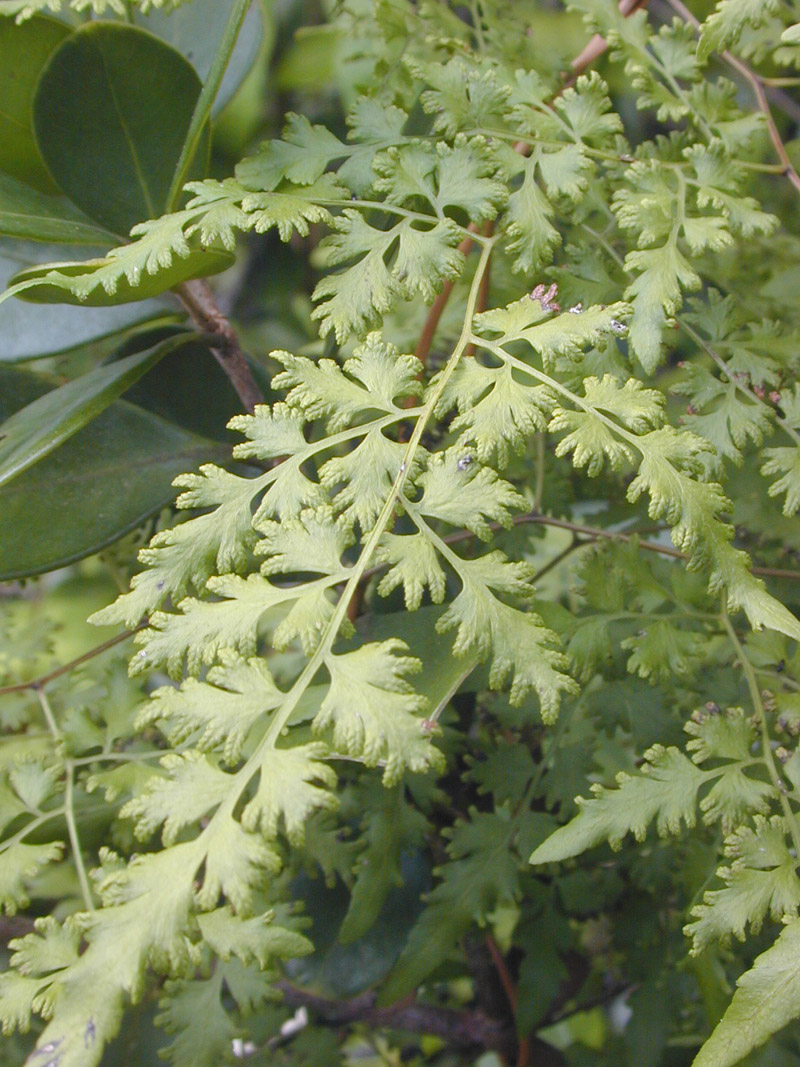
Lygodium, commonly known as climbing ferns, is a genus of approximately 40 fern species in the family Lygodiaceae, order Schizaeales, within the class Polypodiopsida. It is the sole genus in Lygodiaceae under the Pteridophyte Phylogeny Group classification of 2016 (PPG I); some authorities alternatively place it as subfamily Lygodioideae within the more broadly defined Schizaeaceae.
What makes Lygodium morphologically distinctive among ferns is the behavior of its fronds. Rather than producing short, erect fronds like most ferns, the rachis (the central midrib) is thin, flexible, and capable of indeterminate growth. It twines around available supports — tree branches, shrubs, or other vegetation — causing each frond to function as a climbing vine. Fronds can reach 3 to 12 meters in length depending on the species. The fronds also carry apical buds that remain dormant under normal conditions but are activated when the rachis is damaged, giving the plant exceptional regenerative capacity and resilience.
The genus is primarily tropical in distribution, with species found across Africa, Asia, the Pacific, and the Americas, though a handful of species extend into temperate zones, particularly in eastern Asia and eastern North America. Notable members include Lygodium japonicum (Japanese climbing fern) and Lygodium microphyllum (Old World climbing fern), both of which have become serious invasive weeds in the southeastern United States. Lygodium microphyllum in particular forms dense monocultures in Florida's cypress swamps and hydric habitats, displacing native flora and fauna. Lygodium palmatum is the sole native North American species and is considered rare.
Basal chromosome counts in the genus are n=28, 29, or 30.
Distribution
Lygodium is native to tropical regions across the world, including Africa, Asia, the Pacific Islands, and the Americas. A small number of species extend into temperate zones, with occurrences in eastern Asia and eastern North America. Several species — notably Lygodium japonicum and Lygodium microphyllum — have become established as invasive weeds in the southeastern United States, particularly in Florida.
Ecology
Lygodium species occupy forest edges, open woodlands, and disturbed habitats in tropical and subtropical regions. Their climbing habit allows them to colonize both ground-level and canopy-level niches. In invaded habitats in the southeastern United States, particularly Florida, species such as Lygodium microphyllum form impenetrable monocultures in cypress swamps and other hydric sites, suppressing all native vegetation and fundamentally altering local ecosystems. Populations of invasive Lygodium in Florida increased more than twelvefold over a single decade, according to the University of Florida's Institute of Food and Agricultural Sciences. Lygodium japonicum additionally causes problems in pine plantations by contaminating and impeding pine straw harvesting.
Cultural Uses
In the Philippines, several Lygodium species are known collectively as nito. Their flexible, wiry stems and rachises are harvested as natural fibers used in weaving. The most traditional application is the production of the salakot, a brimmed protective headgear historically worn across the Philippines and neighboring regions.
Taxonomy Notes
Lygodium is the sole genus in the family Lygodiaceae as recognized by the Pteridophyte Phylogeny Group (PPG I, 2016). An alternative treatment places it as subfamily Lygodioideae within a more broadly circumscribed Schizaeaceae — the arrangement followed by Plants of the World Online (as of 2019). Molecular evidence suggests Lygodiaceae diverged relatively early from other lineages within the order Schizaeales, supported by a high level of synonymous sequence divergence among the constituent families. The genus comprises roughly 40 species with basal chromosome counts of n=28, 29, and 30.










