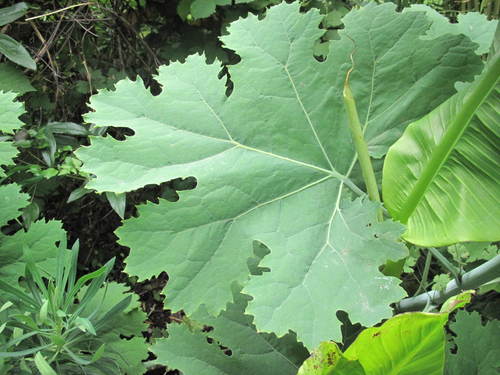
Macleaya, commonly known as plume poppy, is a genus of two to three species of flowering plants in the family Papaveraceae (the poppy family), placed in the order Ranunculales. The genus is native to eastern Asia, with Macleaya cordata found in both China and Japan, and Macleaya microcarpa restricted to China.
Plants in this genus are large rhizomatous herbaceous perennials, capable of reaching heights of four to six feet (roughly 1.2–1.8 m). The leaves are palmately lobed with frilly margins, olive green or grey in colour, and up to about 25 cm long. The flowers, borne in tall, airy terminal plumes, are individually small and lack petals; they are tubular, off-white to cream in colour, and collectively create a striking architectural effect.
Macleaya is monographically close within Papaveraceae and has been cultivated widely as an ornamental plant in temperate gardens. Both recognised species and the hybrid Macleaya × kewensis (M. cordata × M. microcarpa) are grown for their bold foliage and feathery inflorescences. The genus has invasive tendencies, spreading by underground rhizomes (suckers) and by seed, making it unsuitable for small gardens.
The genus name honours the Scottish entomologist Alexander Macleay (1767–1848).
Etymology
Macleaya is named after the Scottish entomologist Alexander Macleay (1767–1848). The common name "plume poppy" refers to the tall, feathery plumes of small petal-less flowers that characterise the genus.
Distribution
The genus is native to eastern Asia: Macleaya cordata occurs in both China and Japan, while Macleaya microcarpa is found in China only. Both species are widely naturalised elsewhere as garden escapes due to their vigorous rhizomatous spread.
Cultivation
Both species and the hybrid M. × kewensis are cultivated as ornamental plants in temperate gardens, valued for their bold architectural presence when grown in groups of tall stems. The cultivar M. × kewensis 'Flamingo' has received the Royal Horticultural Society's Award of Garden Merit. Plants are unsuitable for small gardens owing to their invasive tendencies: they spread by underground suckers and by seed and can be difficult to eradicate once established.

