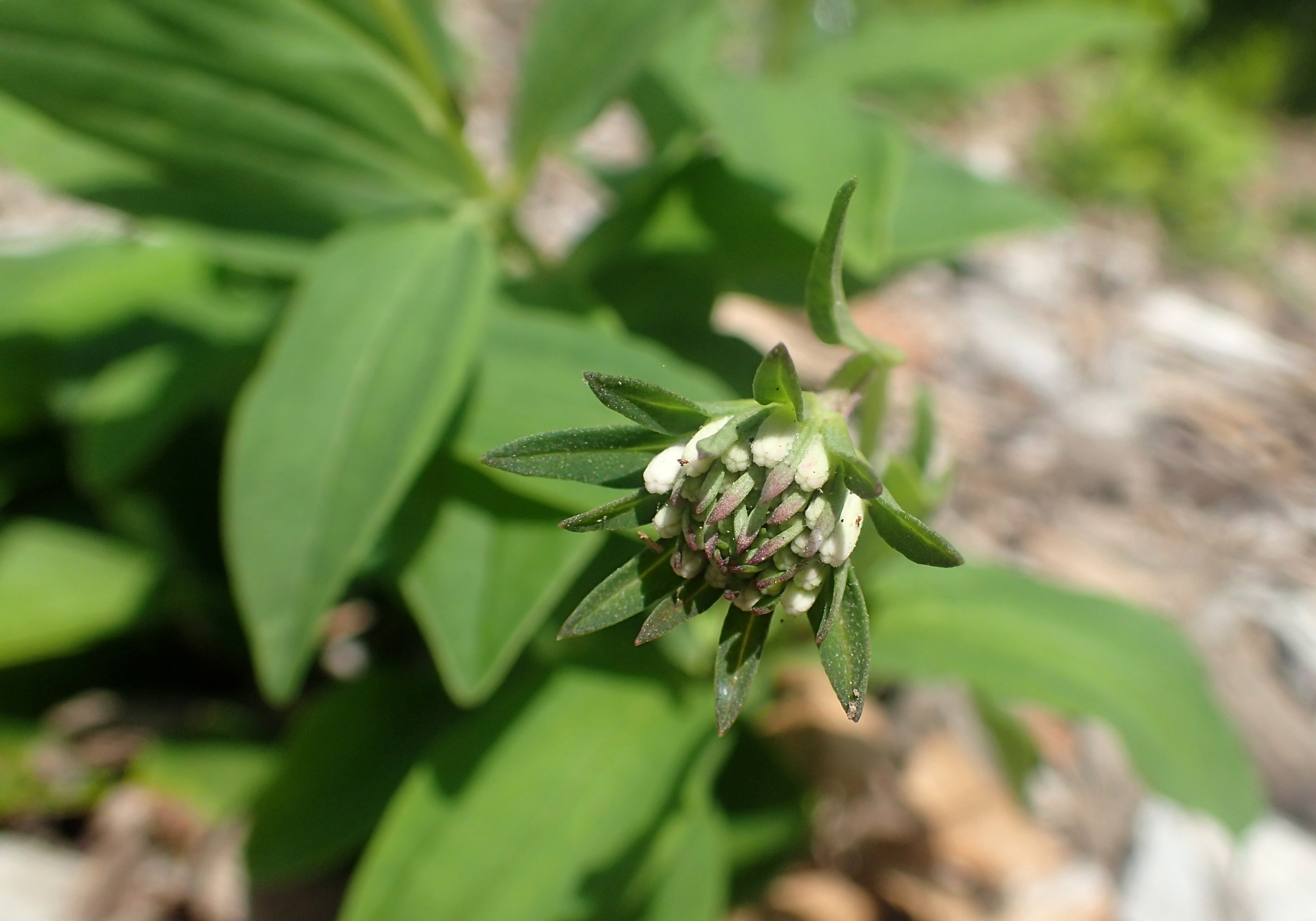
Marshallia is a small genus of perennial flowering plants in the tribe Helenieae within the family Asteraceae (the daisy family), order Asterales. Commonly known as "Barbara's buttons," the genus is endemic to the southeastern and south-central United States, with species ranging from Texas and Oklahoma east to the Atlantic coastal states and north into the mid-Atlantic region.
Plants inhabit open, often disturbed or wetland-influenced environments — roadsides, bogs, pitcher plant bogs, and open woodlands dominated by longleaf pine. Several species are obligate or facultative wetland plants, and some populations depend on periodic flooding or natural disturbance to keep habitat open. The genus typically blooms in late spring and early summer (May through early July), producing compact, spherical flower heads of small white to pinkish florets. These heads are notably attractive to pollinators, particularly butterflies and flower chafer beetles of the genus Euphoria.
The genus was described by the German botanist Johann Christian Daniel von Schreber in Genera Plantarum (1791), who named it in honor of Humphry Marshall and his nephew Moses Marshall, Pennsylvania botanists of the American colonial period and cousins of the celebrated naturalists John and William Bartram. The familiar common name "Barbara's buttons" entered print in John Kunkel Small's Manual of the Southeastern Flora (1933); its ultimate origin remains uncertain, though the button-like flower heads make the comparison apt.
With roughly ten species recognized, Marshallia is a tight-knit genus of conservation concern: one species, Marshallia grandiflora (Appalachian Barbara's buttons), is extinct, and several others are state-listed as endangered or threatened.
Etymology
The genus name Marshallia was coined by the botanist Schreber in Genera Plantarum (1791) to honor Humphry Marshall and his nephew Moses Marshall of Pennsylvania, colonial-era botanists and cousins of John and William Bartram. The common name "Barbara's buttons" first appeared in print in Small's Manual of the Southeastern Flora (1933); its origin is uncertain — possibly a reference to Saint Barbara — though the botanist B.W. Wells (1932) preferred the name "loudspeakers," describing the megaphone shape of the individual flowers.
Distribution
Marshallia is native exclusively to the southeastern and south-central United States, with species distributed across Texas, Oklahoma, Kansas, Missouri, Arkansas, Louisiana, Mississippi, Alabama, Georgia, Florida, South Carolina, North Carolina, Tennessee, Virginia, Kentucky, West Virginia, Maryland, and Pennsylvania. Most species have restricted ranges within this region, and several are known from only a few counties.
Ecology
Species of Marshallia grow in open, sun-exposed habitats including roadsides, pitcher plant bogs, and longleaf pine woodlands. Several species are wetland-associated, and at least one (M. pulchra) requires periodic flooding or scour to maintain the open riverbank and bog conditions it depends on. The compact flower heads bloom from May into early July and are important nectar sources for butterflies and flower chafer beetles (genus Euphoria).
Conservation
One species, Marshallia grandiflora (Appalachian Barbara's buttons), is extinct, having been eliminated in the early 20th century. Marshallia pulchra (Beautiful Barbara's buttons) is endangered in Kentucky, Pennsylvania, and Tennessee, and extirpated in Maryland; it inhabits bogs and scoured riverbanks and requires periodic flooding to maintain open habitat. Marshallia obovata (Spoonshape Barbara's buttons) is listed as endangered in Florida and threatened in Tennessee.

