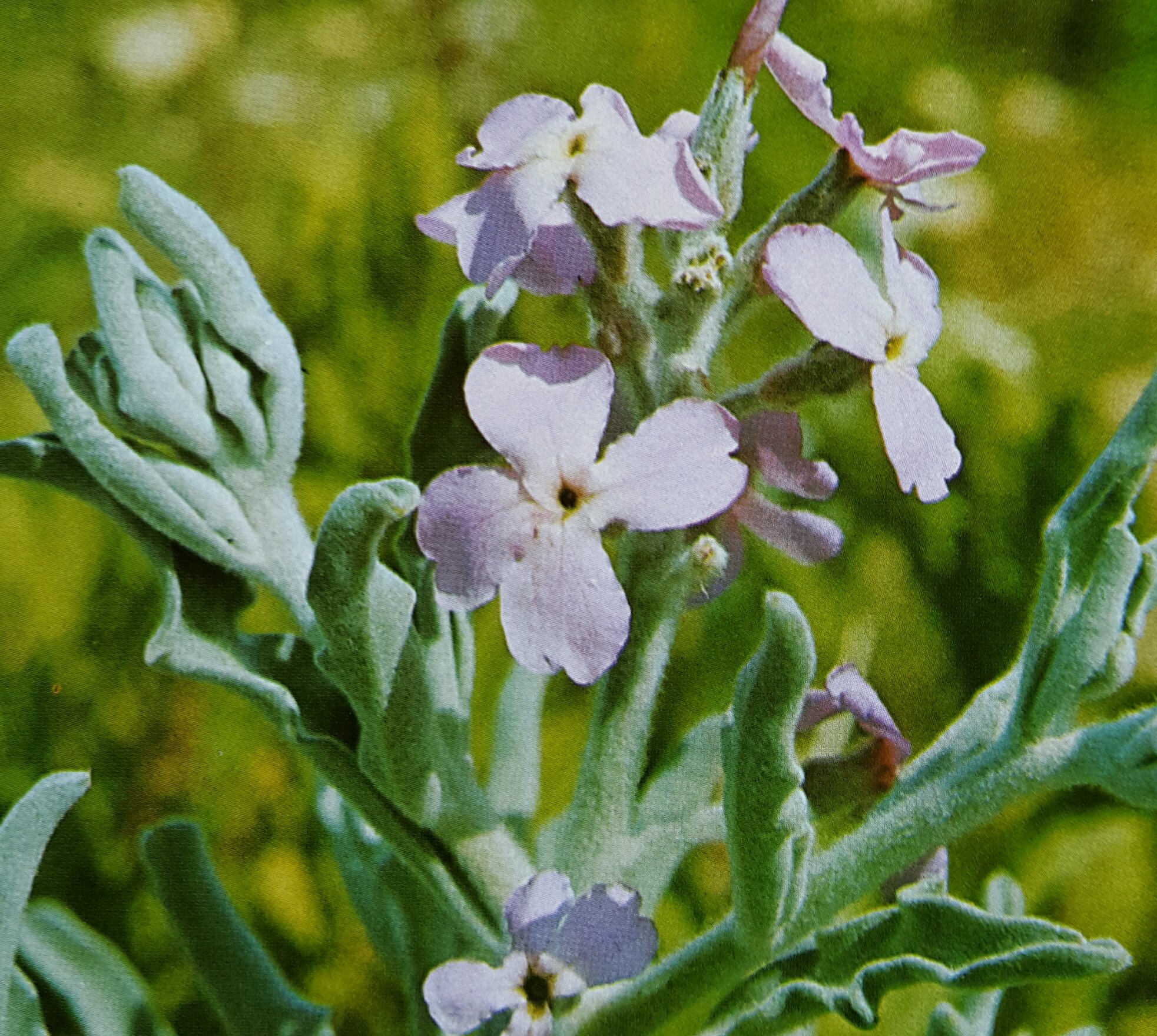
Matthiola is a genus of approximately 50 species of annual, biennial, and perennial herbaceous plants and subshrubs in the mustard family Brassicaceae. The genus was established by the botanist William Townsend Aiton in his 1812 publication Hortus Kewensis. Plants in this genus are commonly known as "stocks" and are widely cultivated for their dense spikes of richly fragrant, colorful flowers, which range from white and pink to purple and red.
The genus ranges across the Mediterranean basin, the Canary Islands and Macaronesia, North Africa, the Middle East, Central Asia, and into China and Pakistan. Many species inhabit sea cliffs, rocky coastal slopes, desert margins, and semi-arid hillsides, often preferring alkaline, well-drained soils and full sun.
The most economically significant species is Matthiola incana, the common garden stock or gillyflower, a staple of temperate horticulture grown as an annual or biennial for cut flowers and ornamental borders. Matthiola longipetala (night-scented stock) is valued for its powerful evening fragrance. Both species and their many cultivars form the backbone of the genus in commercial floriculture.
Beyond ornament, Matthiola incana has documented edible uses — its flowers can be eaten as a vegetable or garnish, the seedpods are edible, and a blue-purple dye is extractable from the flowers. Traditional medicine records the seeds as having diuretic, expectorant, and tonic properties.
Etymology
The genus name Matthiola honours Pietro Andrea Mattioli (1501–1577), an Italian physician and naturalist who was one of the most influential Renaissance botanists. Mattioli is best known for his extensive commentary on Dioscorides' De Materia Medica, which became one of the most widely read botanical works of the sixteenth century. The genus was formally named in his memory by William Townsend Aiton in 1812.
The common name "stock" — used for the whole genus, especially M. incana — has older English roots referring to the woody, stock-like stems of perennial forms. The term "gillyflower" is an archaic name also applied to M. incana, derived from the clove-like scent of the flowers.
Distribution
Matthiola species are distributed primarily across the Old World, with the centre of diversity in the Mediterranean basin, the Middle East, and Central Asia. Species occur in southern Europe (including Sicily and coastal Spain), North Africa (Morocco, Algeria), the Canary Islands and Macaronesia, the Levant, Iran, Afghanistan, Pakistan, and into western China. A few species extend into the Caucasus and Central Asian steppes. Matthiola incana has a native range along the coasts of southern Europe and possibly southern England, where it grows on sea cliffs and rocky coastal habitats. The genus is largely absent from tropical regions and from the Americas in its native range, though introduced populations of cultivated species occur widely.
Ecology
Most Matthiola species are adapted to open, dry, or semi-arid habitats — sea cliffs, rocky hillsides, desert margins, and sandy coastal plains. They generally require well-drained, neutral to alkaline soils and do not tolerate waterlogged or strongly acidic conditions. Many species are tolerant of maritime exposure and saline coastal air. Matthiola incana naturally colonises limestone sea cliffs and rocky coastal slopes. The flowers of stocks are strongly scented, particularly in the evening, and attract nocturnal pollinators such as moths. Plants in the genus are noted for attracting butterflies and other beneficial insects.
Cultivation
Stocks (Matthiola species, especially M. incana) have been cultivated for centuries as ornamental plants valued for their fragrant, colourful flower spikes. In gardens they are most commonly grown as annuals or biennials. They thrive in fertile, neutral to slightly alkaline, well-drained soil in full sun. Regular watering is needed but good drainage is essential, as plants are prone to root rot in waterlogged conditions. Garden forms are available in a wide range of flower colours — white, pink, red, lavender, and purple — and both single and double-flowered cultivars exist. Plants perform best in cool seasons; in warm climates they are grown as winter or spring annuals. They are suitable for borders, containers, and cutting gardens, producing long-lasting cut flowers with exceptional fragrance.
Propagation
Matthiola is propagated primarily from seed. For indoor or early-season production, seeds are sown under glass in early spring; germination typically occurs within two weeks at moderate temperatures. Seeds may also be sown directly outdoors in mid-to-late spring. For autumn-flowering stocks, seed can be sown in summer. Double-flowered forms do not breed true from seed — selection at the seedling stage is used commercially to increase the proportion of doubles. Plants grown as perennials in mild climates may be propagated by cuttings, though seed is the standard method for annual and biennial cultivation.
Cultural Uses
Matthiola incana has multiple documented non-ornamental uses. The flowers are edible and have been eaten as a vegetable or used as garnish, particularly with sweet dishes. The seedpods are also edible. A dark blue or purple dye can be extracted from the flowers. In traditional medicine, the seeds of M. incana were used for their reputed aphrodisiac, diuretic, expectorant, stimulant, stomachic, and tonic properties; historical preparations included infusions and wine-based remedies. The plant is also valued as a wildlife plant, attracting butterflies and other pollinators, and as a source of long-lasting fragrant cut flowers for the floriculture trade.

