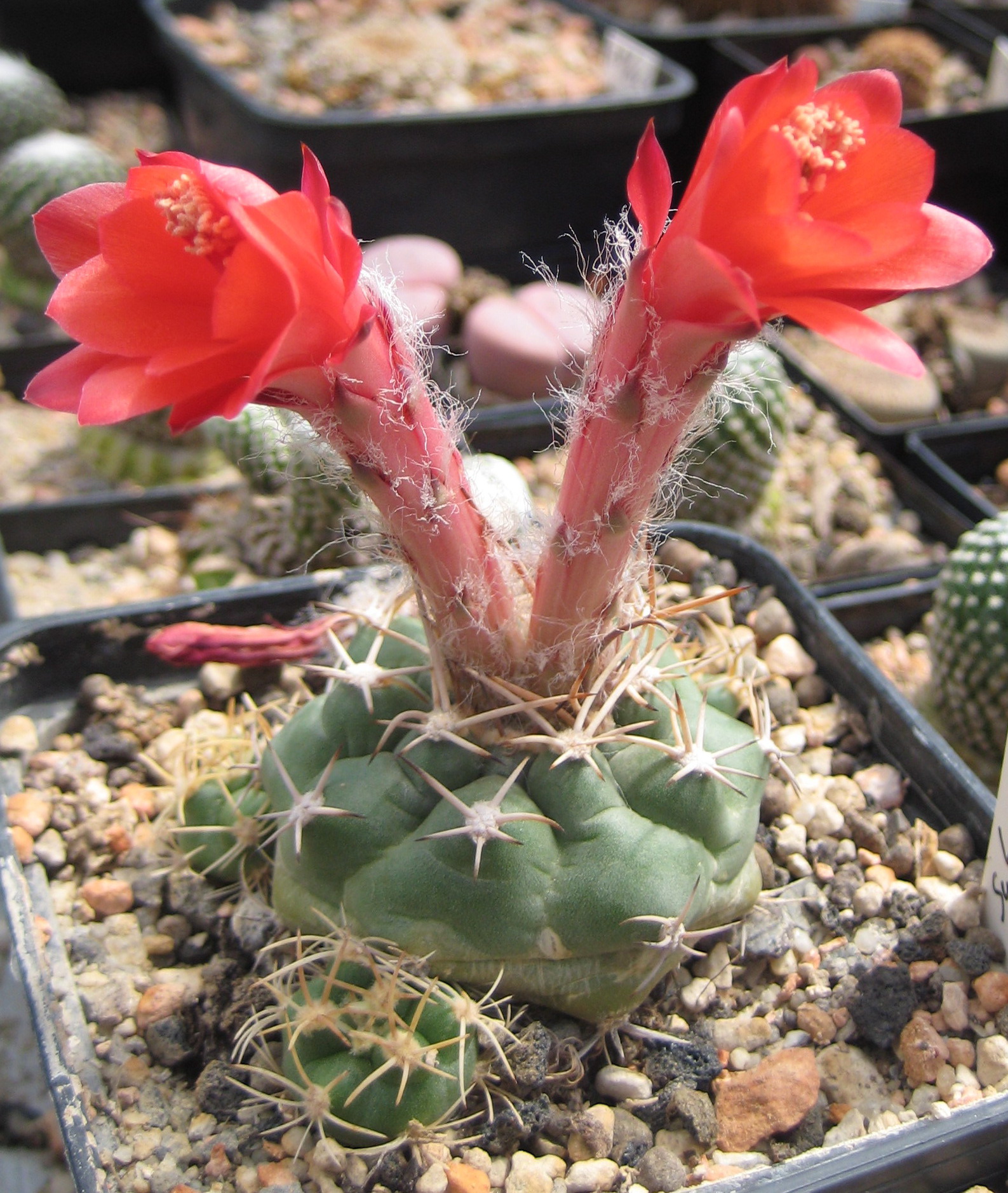
Matucana is a genus of cacti in the family Cactaceae, comprising approximately 20 species of mostly globular, slow-growing plants endemic to Peru. The genus was erected by Nathaniel Lord Britton and Joseph Nelson Rose in 1922 to separate these distinctive Peruvian cacti from the broadly defined genus Echinocactus; the first species had been described as Echinocactus haynii by Christoph Friedrich Otto in 1849, collected near the Peruvian town of Matucana.
Plants are characterized by low, globose to shortly cylindrical bodies that may grow solitary or in clusters. The most diagnostic feature is the fruit: at maturity the wall splits vertically along defined lines, releasing the seeds — a trait that reliably distinguishes Matucana from related genera. Most species produce subapical, somewhat zygomorphic (bilaterally symmetrical), diurnal flowers in shades of red, yellow, or pink. A notable exception is Matucana oreodoxa, whose actinomorphic flowers led F. Ritter to separate it into the segregate genus Eomatucana; that treatment is not universally accepted.
The genus is distributed almost exclusively along the Marañón River valley and surrounding Andean slopes of Peru. Several species are considered endangered, primarily due to over-collection for the specialist cactus trade. Members of Matucana are popular in cultivation for their compact size, attractive spination, and readiness to flower even as young plants.
Etymology
The genus name Matucana is taken from the town of Matucana in central Peru, near which the type species was first collected and described by C. F. Otto in 1849. The name thus commemorates the geographic origin of the genus rather than a person or morphological trait.
Distribution
Matucana is endemic to Peru, with the majority of species found along the Marañón River valley and the adjacent Andean slopes. The genus occupies a relatively restricted range and shows high endemism at the species level across different elevations and microhabitats within this corridor.
Cultivation
Matucana species cannot tolerate excessive moisture; watering should be restricted to the active growing season and only when the substrate has dried out completely. Plants are vulnerable to root loss if kept cold and damp during winter, and a warm, dry dormancy period is strongly recommended. Members of the genus are noted for growing relatively quickly and can be successfully raised from seed. Their compact size and willingness to flower at a young age make them popular among cactus collectors.
Conservation
Several Matucana species are endangered due to collection for the specialist cactus market. The genus's narrow endemic range along the Marañón River makes populations particularly vulnerable to over-collection and habitat disturbance.

