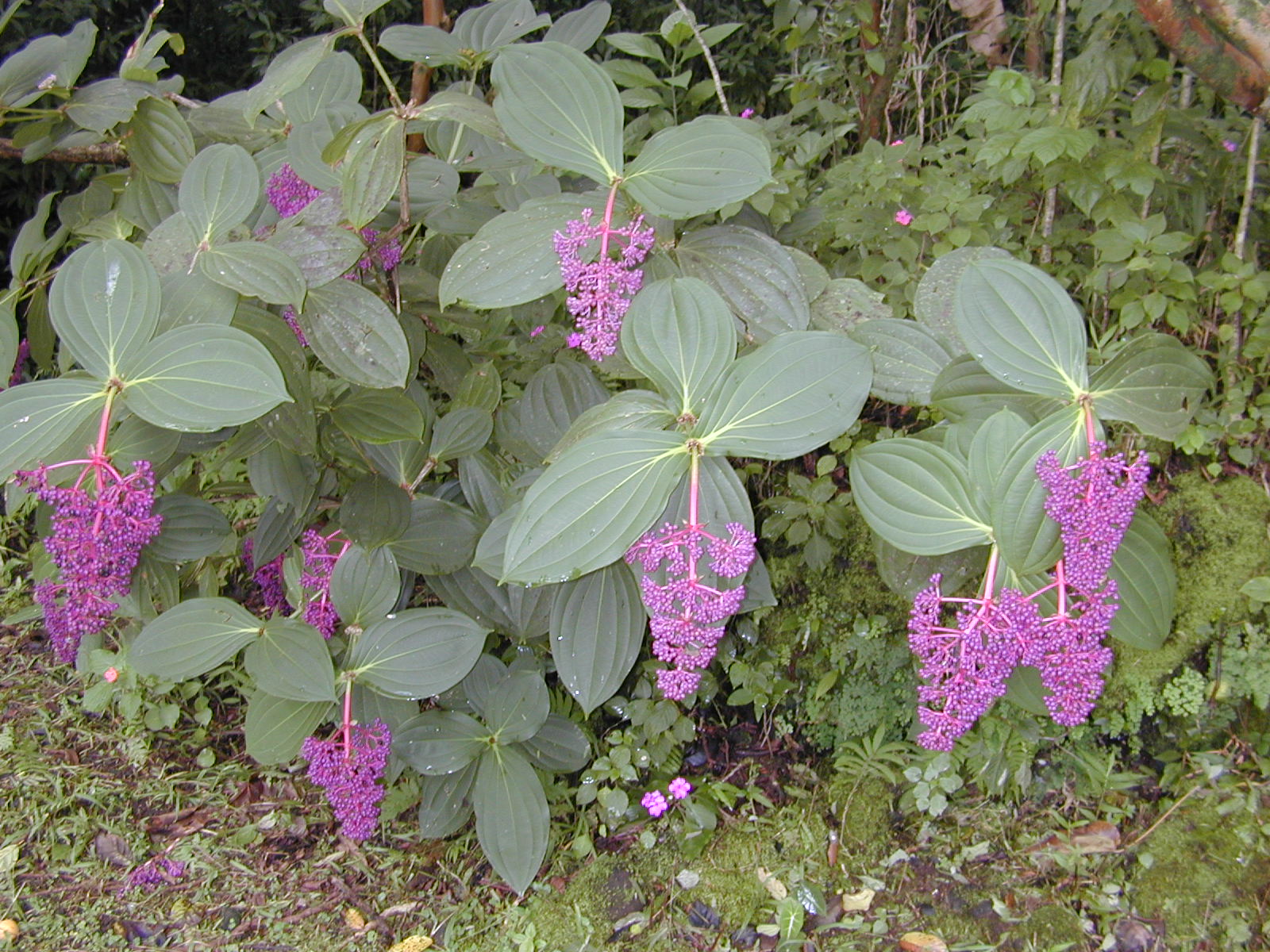
Medinilla is a large genus of approximately 370 species of flowering plants in the family Melastomataceae (order Myrtales), native to tropical regions of the Old World. Its range extends from sub-Saharan Africa eastward through Madagascar, South and Southeast Asia, the Philippines, New Guinea, Australia, and across the western Pacific to Fiji and nearby island groups — making it one of the most geographically widespread paleotropical plant genera.
Plants in the genus are typically evergreen shrubs or woody vines. Leaves are usually opposite or whorled, though alternate arrangements occur in some species. Flowers range in colour from white and pink to red and orange and are borne either singly or in showy, pendulous panicles that can carry dozens of blooms. The most celebrated member, Medinilla magnifica from the Philippines, produces large drooping pink flower clusters and is widely grown as an ornamental in tropical and subtropical gardens and as a houseplant in temperate climates.
Certain species have practical uses: several are employed in traditional medicine across their native range, and a number are prized ornamentals in horticulture. The genus was named in honour of José de Medinilla y Pineda, who served as governor of the Mariana Islands in 1820.
Etymology
The genus name Medinilla honours José de Medinilla y Pineda, who was governor of the Mariana Islands in 1820, at the time when the genus was described and named.
Distribution
Medinilla is native to tropical regions of the Old World, with a range stretching from Africa and Madagascar eastward through South and Southeast Asia, the Philippines, New Guinea, and northern Australia to the islands of the western Pacific Ocean.
Cultivation
Medinilla magnifica and related ornamental species are cultivated as houseplants in temperate climates and as garden shrubs in frost-free tropical and subtropical zones. They prefer bright indirect light, high humidity, and well-drained growing medium. In tropical regions several species are grown outdoors year-round; in cooler climates they are typically maintained as container plants.










