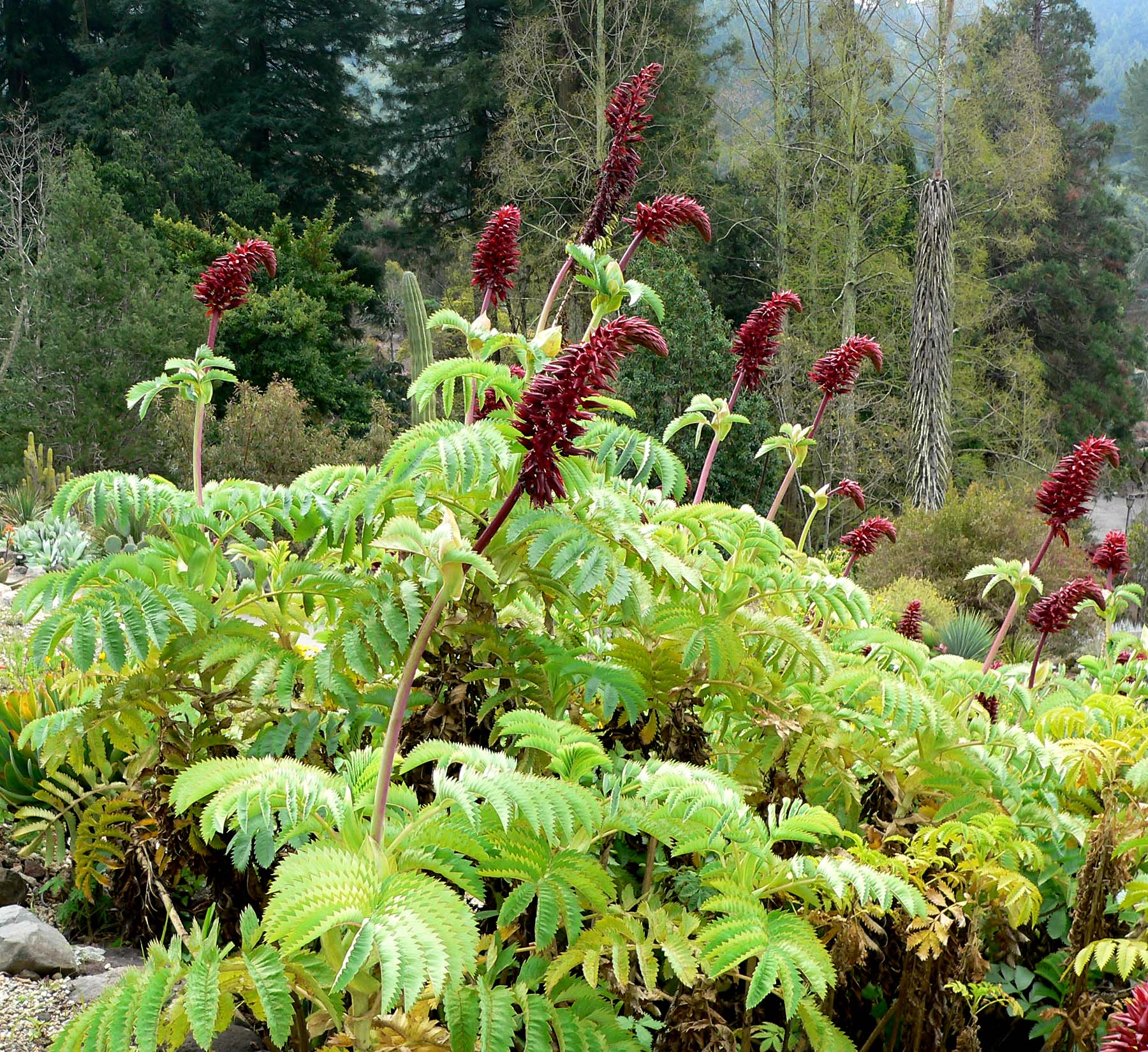
Melianthus is a small genus of evergreen flowering shrubs in the family Francoaceae (order Geraniales), native to southern Africa — primarily South Africa, Lesotho, and Namibia, where they grow in a wide range of habitats from elevated grasslands to sandstone slopes and streambanks.
The genus comprises up to six accepted species. Plants are fast-growing perennials reaching 1.5–2.5 m in height, spreading further through basal suckering. Their most distinctive feature is their large, pinnate blue-green leaves with toothed leaflets and a winged rachis; when touched, the foliage releases a strong, unpleasant nutty odour — earning the Afrikaans name kruidjie-roer-my-nie ("touch-me-not herb"). Despite their foliage's repellent quality, all vegetative parts are highly toxic to mammals, including grazing livestock.
The flowers are equally striking: borne on erect racemes, the dark maroon blooms feature a prominent cup-shaped nectary that produces copious quantities of black nectar. As the flowers mature they resupinate, twisting 180° on the pedicel to hang inverted. This nectar-production is so prolific that the English common name "honey flower" was in use well before Linnaeus formally described the genus in 1753 — the plants were already being cultivated in Holland from 1673. The genus name Melianthus encodes this quality directly, from the Greek meli (honey) and anthos (flower).
In the wild, Melianthus flowers are primarily pollinated by nectar-feeding birds such as sunbirds, along with bees. The genus has a long association with traditional medicine in southern Africa: leaves are applied as poultices for wounds, sores, and rheumatic joints, while roots and leaves are used in small doses as tonics or treatments for snakebite.
The best-known species is Melianthus major L. (giant honey flower), cultivated worldwide as a dramatic foliage plant. Other species include M. comosus, M. villosus, M. dregeanus, M. elongatus, and M. pectinatus, all endemic to southern Africa.
Etymology
The name Melianthus derives from the Greek meli (honey) and anthos (flower), a direct reference to the flowers' exceptionally nectar-rich character. The English common name "honey flower" was already in use before the genus was formally named: plants were introduced to European horticulture in Holland in 1673, and Linnaeus published the scientific name only in 1753.
Distribution
All six species of Melianthus are endemic to southern Africa. Melianthus major is found in the Western, Eastern, and Northern Cape Provinces of South Africa, growing on sandstone slopes, often alongside streams. M. comosus ranges from Namibia and the western Karoo into the Eastern Cape. Other species — M. dregeanus, M. elongatus, M. pectinatus, and M. villosus — are likewise confined to subregions of southern Africa, spanning a variety of habitats from winter-rainfall coastal fynbos to semi-arid Karoo.
Ecology
Melianthus flowers produce abundant nectar and are chiefly pollinated by birds, especially sunbirds, with occasional visits from white-eyes, red-winged starlings, and bees. Despite the reported toxicity of the whole plant, bees are said to produce good honey from the flowers. Melianthus major is adapted to the winter-rainfall Mediterranean climate of the Cape: it grows actively through the wet winter and may die back to its rootstock during dry summers, re-sprouting when autumn rains return. All vegetative parts — leaves, stems, and roots — contain potent toxins that can kill grazing livestock within hours; the toxic principle is not destroyed by drying.
Cultivation
Melianthus major is the most widely cultivated species and is grown globally as a bold foliage plant for its large, architectural blue-green leaves. It performs best in a warm, sunny position with good drainage and regular water, though it is adaptable and will tolerate poorer conditions. It suits mixed borders, accent plantings, large containers, and positions beside water features. All parts of the plant are toxic; gloves are advisable when handling the foliage.
Propagation
Melianthus is readily propagated by seed or cuttings. Seed is sown in autumn in a well-drained medium and lightly covered; germination typically occurs within about one month. Cuttings are taken from basal shoots and can be made at any time of year when material is available.
Cultural Uses
In southern Africa, Melianthus major has an established role in traditional medicine. Leaf poultices and decoctions are applied to septic wounds, sores, ulcers, boils, abscesses, bruises, backache, painful feet, and rheumatic joints. Roots and leaves are used in very small doses as tonics or as treatments for snakebite. Dried flowers and leaves are also used to repel insects from storage cupboards. Despite these medicinal uses, the plant is toxic when taken internally and must be handled with caution.

