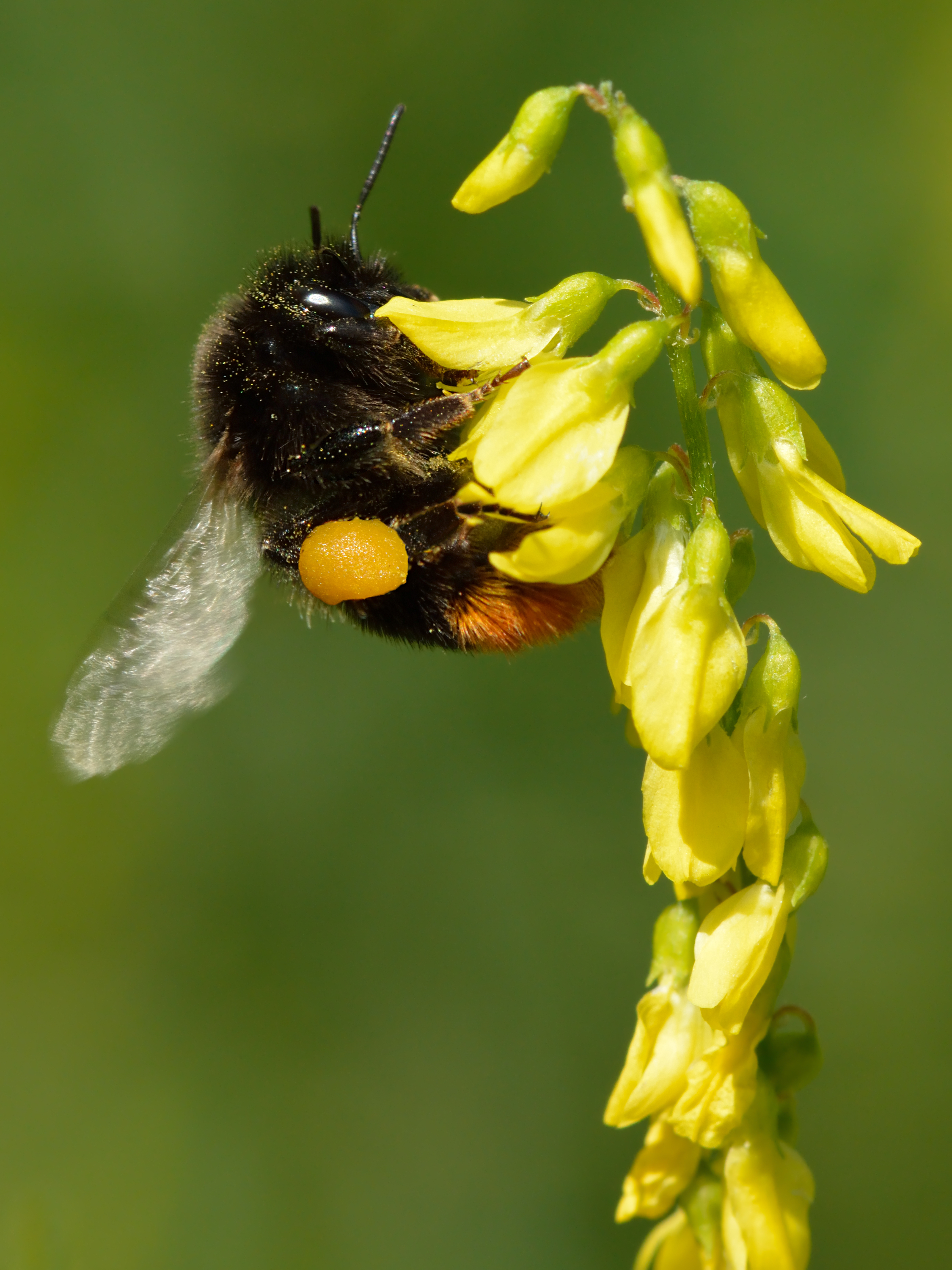
Melilotus is a small genus of herbaceous legumes commonly called sweet clovers or melilots. Botanically the genus sits in family Fabaceae, subfamily Faboideae, tribe Trifolieae, placing it as a close relative of true clovers (Trifolium). The genus was formally described by Philip Miller in the 1754 edition of his Gardeners' Dictionary, and current taxonomic checklists recognise roughly twenty to twenty-three accepted species along with two natural hybrids.
Plants in the genus are annual, biennial, or short-lived perennial herbs that typically grow between fifty and one hundred fifty centimetres tall. Leaves are alternate and trifoliate, with serrated margins; the leaflets are noticeably narrower than those of clovers, giving sweet clovers a wirier, more open silhouette. The small pea-type flowers are arranged in elongate, peduncled racemes that arise from the upper leaf axils, and they are almost always either white or yellow depending on species. Each flower carries ten stamens in a diadelphous arrangement and matures into a small, mostly indehiscent pod containing one to four seeds.
The native range of Melilotus spans Europe, Asia, and Africa, but agricultural use and accidental introductions have carried several species to nearly every continent. Melilotus albus (white sweet clover) and Melilotus officinalis (yellow sweet clover or ribbed melilot) are the two most widespread members and the ones most commonly encountered outside the natural range. Both are introduced rather than native in North America and Australia, and both are documented as invasive in parts of their introduced range, particularly in open grasslands and woodlands where they can shade out native vegetation.
Sweet clovers are agriculturally important well beyond their wild ecology. Deep taproots and nitrogen-fixing root nodules make the genus a useful green manure and cover crop, especially on heavy soils. The plants are also valued as bee forage and as a source of high-quality honey, and low-coumarin cultivars have been bred for safer hay and silage. Coumarin gives cut sweet clover its characteristic sweet, hay-like fragrance; if poorly cured hay is colonised by certain fungi, that coumarin can be converted to dicoumarol, the anticoagulant responsible for the historic livestock condition known as sweet-clover disease.
Etymology
The genus name Melilotus comes from the Greek melílōtos, literally "honey lotus," combining méli ("honey") with lōtos ("lotus"). The word passed through Latin and Old French mélilot before being formalised by Philip Miller when he established the genus in the 1754 edition of his Gardeners' Dictionary. The name reflects the genus's long-standing reputation as a major bee-forage and honey plant.
Distribution
Melilotus is native to temperate Europe, Asia, and Africa. Through deliberate use as a fodder and soil-improvement crop, plus accidental introduction along roads and disturbed ground, the genus has naturalised worldwide. Regional floras illustrate this spread: Info Flora documents six Melilotus species in Switzerland, the Atlas of Living Australia records six species in Australia (all introduced, since none are native to the continent), and SEINet documents the genus across the southwestern United States in both adventive and weedy contexts. Within the genus, M. officinalis and M. albus are the most cosmopolitan species, each now found across Europe, Asia, North America, Africa, and Australia.
Ecology
Sweet clovers are insect-pollinated; SEINet notes a "repeating trip-mechanism" in the flowers, characteristic of legumes that require a pollinator's weight to release the pollen-bearing keel. The genus is a significant nectar source for honeybees, bumblebees, and other native bees, and serves as a host plant for the larvae of various Lepidoptera. Like most legumes, Melilotus species fix atmospheric nitrogen through root-nodule symbiosis, which underlies both their agricultural value and their ability to colonise nutrient-poor disturbed ground.
Cultivation
Melilotus species are grown chiefly as forage, cover crops, green manure, and pollinator plants. Their deep taproots open compacted soils and lift mineral nutrients, and the nitrogen-fixing nodules add organic nitrogen — together making them particularly useful on heavy or depleted soils. They are also widely planted to support honey production. Because raw foliage and cured hay contain coumarin, breeders have developed low-coumarin cultivars specifically for safer hay and silage feeding. The salt-tolerant cultivar 'Neptune' of M. siculus has been identified as the most salinity-tolerant and persistent pasture legume on record.
Conservation
The genus itself is not of conservation concern; rather, the conservation literature treats Melilotus primarily as an introduced and sometimes invasive presence. Melilotus officinalis is described as invasive in parts of its introduced range, where it shades and outcompetes native vegetation in open grasslands and woodlands. The IUCN Global Invasive Species Database, however, holds no archive entry for the genus or its species as of the fetch date, indicating that formal invasive listings come from regional agencies rather than the GISD itself.
Cultural Uses
The dried foliage of Melilotus species has long been valued for its sweet, hay-like scent — a quality driven by the coumarin content the genus is famous for. That same coumarin became a turning point in twentieth-century medicine: in the 1920s, livestock veterinarians traced an epidemic of haemorrhagic disease in cattle to dicoumarol, formed when fungi spoiled coumarin-rich sweet-clover hay. The discovery directly informed the development of the anticoagulant warfarin. In Australia, the genus is known collectively as "melilot," the same vernacular used historically in English herbals.
History
The genus was established by Philip Miller in the 1754 edition of his Gardeners' Dictionary, well before the consolidation of binomial nomenclature in Linnaeus's Species Plantarum. Several of the most economically important species — M. officinalis, M. albus, M. indicus — have been moved between Trifolium, Trigonella, and Melilotus over the centuries, which is reflected in their compound author citations (e.g. Melilotus officinalis (L.) Lam., M. indicus (L.) All., M. siculus (Turra) B.D.Jacks.).
Taxonomy notes
Melilotus Mill. is an accepted genus in family Fabaceae, subfamily Faboideae, tribe Trifolieae — placing it close to Trifolium, Medicago, and Trigonella. Modern checklists recognise about 20–23 accepted species plus two natural hybrids, with GBIF indexing 61 descendant taxa overall once subspecies and synonyms are included. Distinguishing characters at the genus level include trifoliate leaves with toothed margins, small white or yellow flowers in elongate axillary racemes, ten diadelphous stamens, and short, often indehiscent pods containing only one to four seeds.










