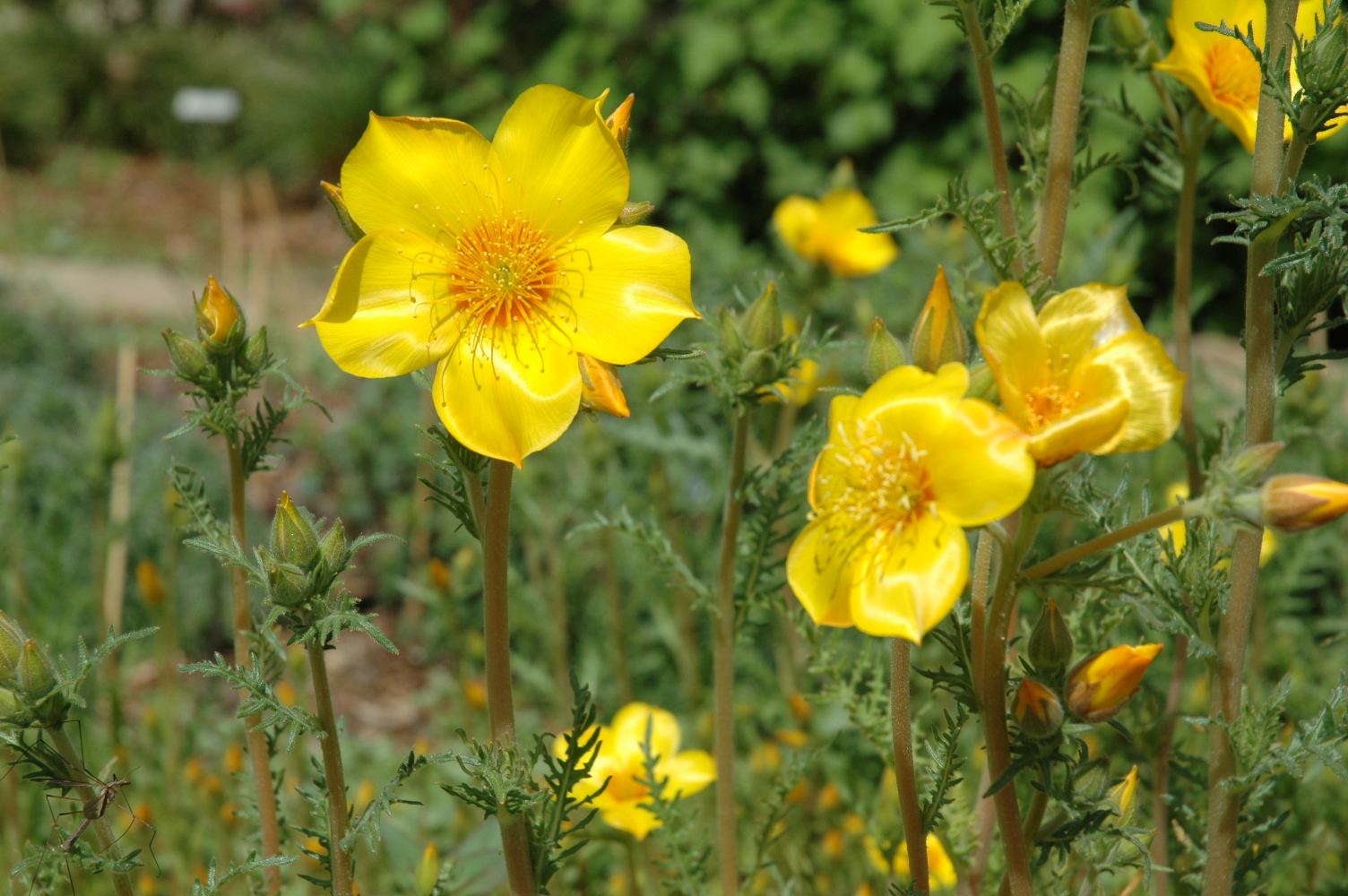
Mentzelia is a genus of about 100 flowering plants in the family Loasaceae, the stickleaf or rock-nettle family. The genus is wholly American in distribution, with its center of diversity in the arid and semi-arid regions of the western and southwestern United States and Mexico, where its species inhabit deserts, dry slopes, sandy washes, and rocky outcrops. Common names applied to Mentzelia include blazing stars, stickleafs, evening stars, and moonflowers — the latter two reflecting the fact that the showy yellow, cream, or white flowers of many species open in the late afternoon or evening.
The genus encompasses annuals, biennials, and herbaceous perennials, along with a small number of shrubby species. Most plants are clothed in stiff, barbed or hooked hairs that cling readily to clothing and animal fur, a feature shared across the family Loasaceae and the source of the "stickleaf" name. Leaves are alternate, sessile to distinctly petiolate, and bear variable margins; flowers are borne in cymose inflorescences and typically have five petals (or apparent petals derived from staminodes in some sections) and many showy stamens that radiate outward, giving the open blooms a star-like appearance. The pistil is three-carpellate, ripening into a capsule that splits open by three valves to release the seeds — seed morphology is one of the principal characters used to distinguish species, and reliable identification within Mentzelia generally requires mature fruit.
The genus was established by Carl Linnaeus and honors the German botanist Christian Mentzel. Its closest taxonomic affinities lie within the order Cornales among the asterid eudicots. Several segregate names — most notably Acrolasia C.Presl and the preoccupied Bartonia — have at various times been used for groups now treated as Mentzelia sections; the modern circumscription is broad, but the infrageneric sections are distinctive enough that they have repeatedly been proposed as separate genera. The greatest taxonomic richness occurs in Arizona, New Mexico, and the Colorado Plateau.
Taxonomy
Mentzelia was described by Carl Linnaeus and is placed in family Loasaceae, order Cornales, within the asterid eudicots. The accepted authority is Mentzelia L. The genus is broadly circumscribed and includes roughly 100 accepted species, although taxonomic databases differ on the precise count — GBIF, for instance, lists 151 descendant taxa under the genus, a figure that includes infraspecific names and synonyms in addition to accepted species. The genus has been divided into a number of morphologically distinct sections, several of which have at various times been proposed for elevation to separate generic rank; segregate names that have circulated include Acrolasia C.Presl and the preoccupied Bartonia. Reliable species identification within Mentzelia typically depends on mature fruit and seed characters, and depauperate specimens are often impossible to identify with certainty.
Distribution
Mentzelia is exclusively a New World genus, distributed across the Americas with its diversity strongly concentrated in the arid and semi-arid regions of the western and southwestern United States and northern Mexico. The genus is especially well represented in Arizona, New Mexico, and the broader Colorado Plateau, where many species are restricted to specific substrates such as sandstones, gypsum soils, or volcanic gravels. Other species extend into the deserts of the Great Basin, the Mojave, and the Sonoran, with additional representation in Mexico, parts of South America, and a small number of species reaching the southeastern United States and Florida.
Ecology
The dense, barbed or hooked indumentum that covers Mentzelia stems and leaves is one of the genus's most ecologically distinctive features: the hairs adhere strongly to clothing, fur, and feathers, giving rise to the common name "stickleaf" and likely contributing to seed and propagule dispersal as plant fragments cling to passing animals. Most species favor open, sunny, often disturbed or sparsely vegetated habitats — dry slopes, sandy or gravelly washes, roadsides, and rocky outcrops — where competition is low and the plants' deep taproots can exploit episodic moisture.
Cultivation
Mentzelia species generally succeed in ordinary, moderately fertile garden soil, but they perform best in well-drained substrates and warm, sunny, sheltered positions that mimic the open, exposed habitats of their native range. They tolerate a wide range of soil textures — light, medium, or heavy — and prefer a neutral to alkaline pH, in keeping with the calcareous and gypseous soils many wild species occupy. Plants accept either dry or moderately moist conditions but resent waterlogging.
Cultural Uses
Several Mentzelia species have been used as food and medicine by Indigenous peoples of the American West. The oily seeds are edible and were traditionally parched and ground into a fine meal that could be mixed with water to make a thin mush, or further worked into a paste resembling seed butter; the seeds were also eaten raw or cooked. Ethnobotanically, a poultice prepared from crushed and soaked seeds has been applied to burns and used to relieve the pain of toothache.
Conservation
At the genus level, Mentzelia is not flagged as invasive in the ISSG Global Invasive Species Database, and no member of the genus is listed there. Many narrow-range Mentzelia species native to the southwestern United States are, however, edaphic specialists tied to specific soil types or geological substrates, and several individual species carry state or federal conservation concern; those statuses are best assessed at the species level rather than across the genus as a whole.










