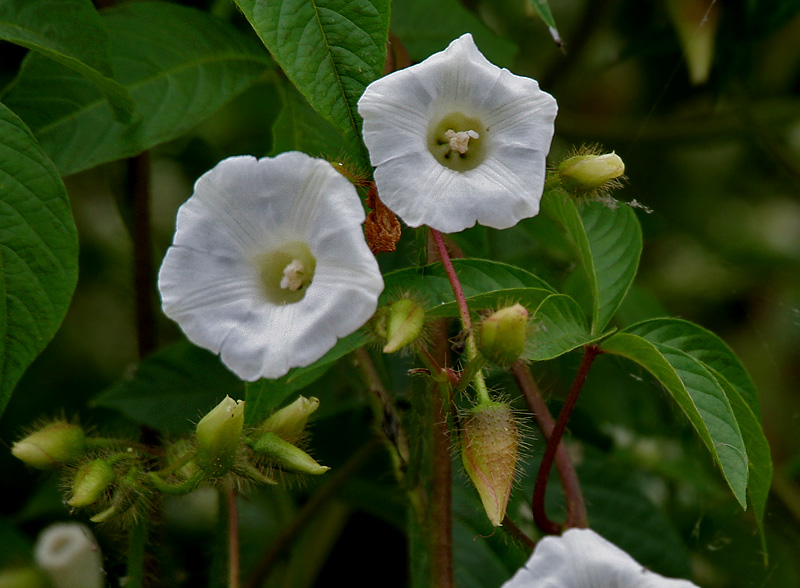
Merremia is a genus of approximately 80 species of flowering vines and herbaceous climbers in the morning glory family, Convolvulaceae, placed in the order Solanales. The genus was formally described by Dennstedt and published by Endlicher in 1841 (Gen. Pl. 1: 1403). Members of the genus are commonly known as woodroses, a name that refers to the distinctive woody, rose-like calyx that persists around the seed capsule after the petals fall.
Species of Merremia are distributed across tropical and subtropical regions of Africa, Asia, the Americas, and Australia. Like other members of Convolvulaceae, they typically bear funnel-shaped or bell-shaped flowers and twining stems, often with palmate or simple leaves. The genus includes the type species Merremia hederacea (ivy woodrose), as well as notable members such as M. discoidesperma and M. thorelii.
Some species have longstanding uses in traditional and indigenous medicine. Merremia emarginata (also known as Ipomoea reniformis) has been used in South Asian traditional medicine for conditions including cough, headache, rheumatism, and as a diuretic.
Etymology
The common name "woodrose" refers to the persistent woody calyx that remains around the seed capsule after the petals drop, forming a rose-like structure. The genus name Merremia commemorates the German botanist Blasius Merrem (1761–1824), though the genus was formally described by Dennstedt and published by Endlicher in 1841.
Distribution
Merremia species are distributed across tropical and subtropical regions worldwide, with representatives in Africa, South and Southeast Asia, the Pacific, the Americas, and Australia. The broad pantropical range is consistent with the species list recognised by Wikipedia, which includes African, Asian, and American members.
Taxonomy Notes
The genus Merremia was described by Dennstedt and validly published by Endlicher (1841) as a nomen conservandum. It is placed in the family Convolvulaceae, order Solanales, class Magnoliopsida. The GBIF backbone recognises approximately 78 descendants. The type species is Merremia hederacea (Burm.f.) Hallier f. (ivy woodrose).
Cultural Uses
Merremia emarginata (syn. Ipomoea reniformis) is used in Indigenous and tribal medicine in South Asia for a wide range of conditions, including cough, headache, neuralgia, rheumatism, fever associated with liver enlargement, kidney disease, snake bites, ulcers, abscesses, and glandular swelling. It is also employed as a diuretic and purgative.










