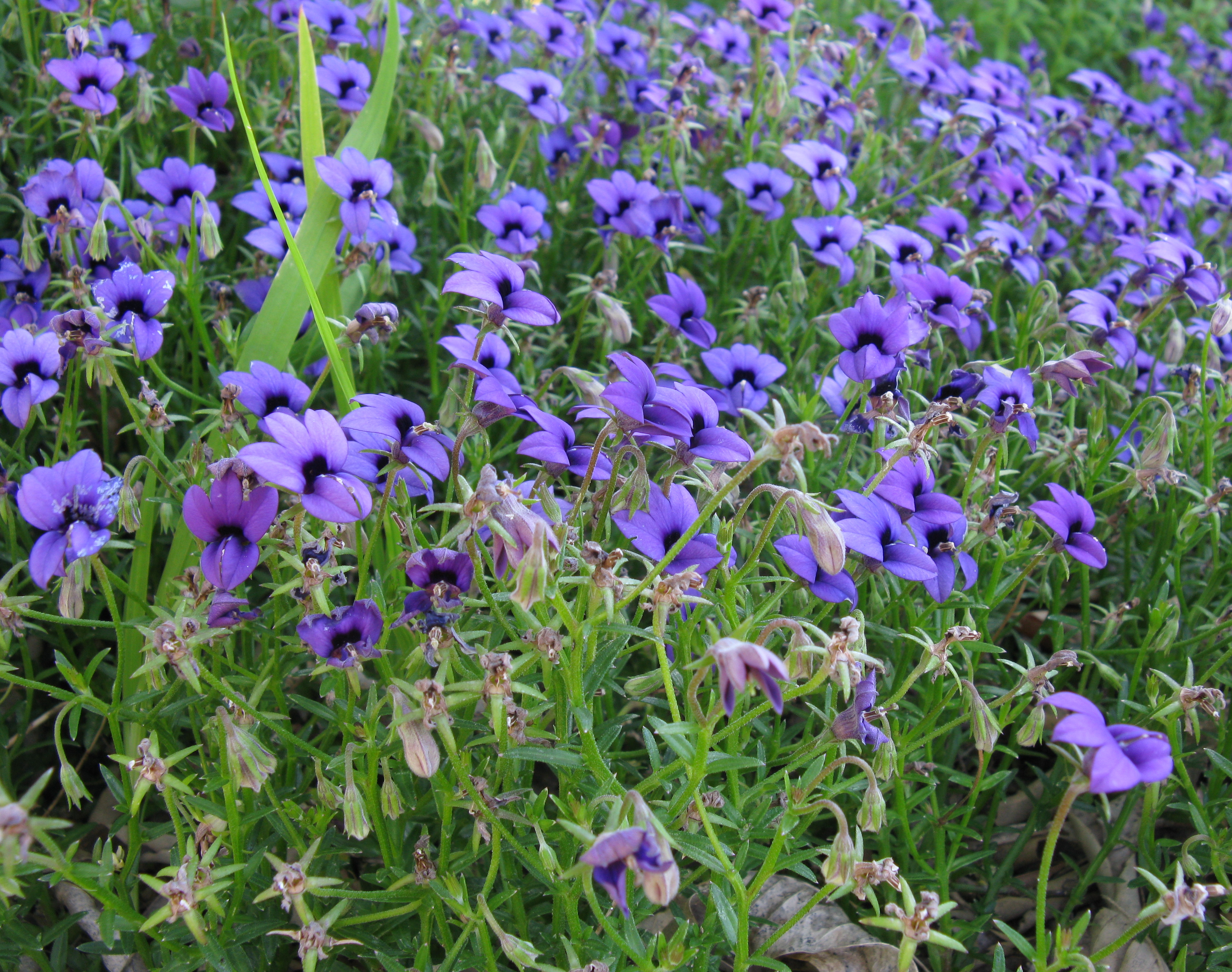
Monopsis is a genus of around 15 species of small, Lobelia-like herbaceous flowering plants in the family Campanulaceae (order Asterales), all native to Africa. Most species are perennials, though a few are annuals. The genus is closely allied to Lobelia and was historically placed in the family Lobeliaceae before that family was subsumed into Campanulaceae.
Plants are typically compact and low-growing. Their stems are variously but irregularly branched and, in many species, prostrate and creeping, rooting at nodes — a habit that makes them useful as ground-cover plants in horticulture. Leaves are small and generally lightly to markedly toothed; phyllotaxis varies by species between alternate and opposite arrangements; leaf shape ranges from elliptic through lanceolate to short linear.
The flowers are a distinctive feature of the genus. Most species produce vibrant yellow or purple blooms, reminiscent in intensity of many Lobelia species; a few bear white or intermediate salmon-coloured flowers, and some, such as Monopsis decipiens, are colourfully patterned. Flowers are typically borne singly on pedicels in leaf axils rather than in terminal racemes. The pedicels usually twist so that the three-petalled upper lip is presented uppermost — an orientation thought to be an adaptation favouring specific pollinators. The corolla tube is split nearly to its base into two lips; the calyx has five lobes fused to the inferior ovary. The five anthers are united into a ring around the style and are bearded with brushes of white hair at their tips.
Common names in use include "wild violet" for Monopsis unidentata, "yellow lobelia" for Monopsis lutea, and "pansy lobelia" for Monopsis debilis.
Distribution
Monopsis is endemic to Africa. Of the approximately 15 accepted species, all but two occur mainly in Southern Africa, with one species extending to the Comoro Islands. Roughly half of the Southern African species are fynbos endemics, restricted to the Cape Floristic Region of South Africa.
Ecology
Most Monopsis species inhabit fynbos and related habitats in Southern Africa. The prostrate, node-rooting growth form of many species suits low, open ground-cover niches. Flower orientation — pedicels twisting to present one lip uppermost — is understood as an adaptation favouring specific pollinators by allowing efficient access to nectar and pollen.
Taxonomy Notes
Monopsis was historically placed in the family Lobeliaceae, which is now treated as a subfamily (Lobelioideae) within the broader family Campanulaceae. GBIF lists the genus under Campanulaceae (order Asterales). Wikipedia accepts 15 species; GBIF records 9 descendants in this checklist. The taxonomy and nomenclature of Monopsis debilis was discussed by Phillipson (1986) and that of Monopsis unidentata by Phillipson (1989).

