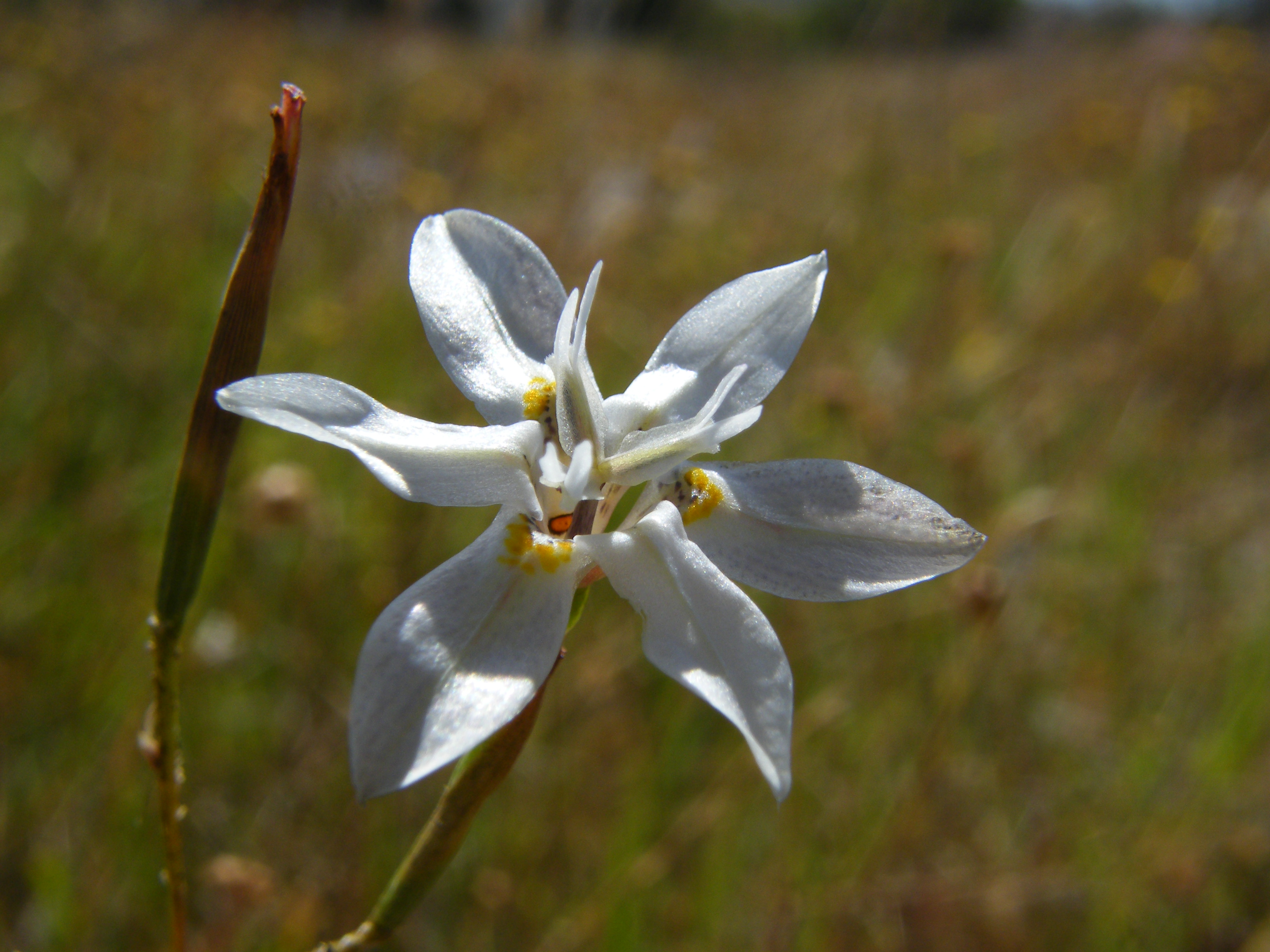
Moraea is a genus of corm-forming flowering plants in the iris family (Iridaceae), placed in the subfamily Iridoideae, tribe Irideae, and order Asparagales. The genus encompasses more than 200 to over 400 recognized species — GBIF records 332 descendants — making it one of the larger genera in Iridaceae. Plants produce iris-like blooms with nectar guides at the center, blooming in summer in shades of blue, yellow, orange, pink, and white. Individual flowers are short-lived, lasting only about six hours, but plants generate a succession of blooms throughout the season. Most species grow from corms and reach up to 0.5 m in height.
The vast majority of species are native to sub-Saharan Africa, particularly southern Africa, with the genus's range extending into tropical Africa, the Mediterranean region, and central and southwestern Asia as far as the western Himalaya. Common English names include "Cape Tulips" and "Moraeas," while Afrikaans speakers know them as "Wildetulpe" and Zulu as "inDlolothi."
The genus was first formally described by Philip Miller in 1758, with Moraea viscaria designated as the type species. Over its taxonomic history, Moraea has absorbed numerous formerly separate genera — including Homeria, Galaxia, Gynandriris, Hexaglottis, Barnardiella, Rheome, Roggeveldia, Sessilistigma, Diaphane, Freuchenia, Helixyra, Iridopsis, Phaianthes, Plantia, Vieusseuxia, and Sisyrinchium (Mill.) — reflecting extensive systematic revision of the Iridaceae.
In cultivation, most species require full sun, sharply drained soil, and a dry dormant period. Several species introduced beyond their native range have become significant invasive weeds. The corms of some species have historically been used as food, though a number of species are toxic.
Etymology
The genus name Moraea honors Robert More (1703–1780), an English botanist and plant collector. The name was established by Philip Miller when he first formally described the genus in 1758. The type species is Moraea viscaria.
Distribution
Moraea is primarily a southern African genus, with the greatest species diversity in the Cape Floristic Region of South Africa. The range extends through tropical Africa, north into the Mediterranean basin, and east through the Arabian Peninsula to central Asia and the western Himalaya. NCSU characterizes the native range as "Tropical and South Africa, Mediterranean to Western Himalaya."
Within southern Africa, species occupy a range of habitats including flat coastal lowlands, mountain slopes, deep sandy soils, rocky sandstone outcrops, and granitic substrates. Some South African species are hardy enough to persist in Southeastern US gardens (USDA zones 8–11), and certain species introduced to Australia and other regions have become significant weeds.
Ecology
Moraea species are geophytes (corm-forming), adapted to seasonally dry climates. Most species are drought-tolerant once established and are well-suited to rock gardens and drought-tolerant plantings. The iris-like flowers feature conspicuous nectar guides that attract butterflies and other pollinators.
Individual flowers of many species are ephemeral, persisting only about six hours, but plants produce a succession of blooms through the summer season. Species typically grow on well-drained soils — sandy, granitic, or rocky sandstone substrates — and require full sun. Corms undergo a dry dormant period and must not be waterlogged while dormant.
Cultivation
Most Moraea species require full sun (at least 6 hours per day) and sharply drained soil. They tolerate both sandy and clay soils provided drainage is adequate. USDA hardiness zones 8–11 cover most cultivated species (UK hardiness zone 9). Corms should be planted at a depth of approximately 4 inches, with 5–6 corms per 6-inch pot for container culture.
The key cultivation requirement is a dry dormant period: corms must be kept dry while dormant and should be lifted or stored in peat or vermiculite at 35–50°F (2–10°C) where winters are wet or frosty. Plants are largely pest-free, though aphids and narcissus fly can occasionally affect them.
Propagation
Moraea is propagated by division of corm offsets or by seed. Division is the more reliable method for maintaining cultivar characteristics and is best carried out during dormancy (approximately September to January in the Southern Hemisphere). Offsets should be stored in peat or vermiculite at 35–50°F until replanting. Plants raised from seed take 2–3 years to reach flowering maturity.
Conservation
Several Moraea species introduced to Australia and other regions outside their native range have become significant invasive weeds. In the United States, Moraea collina, M. flaccida, M. miniata, M. ochroleuca, and M. pallida are federally listed noxious weeds and should not be planted. The GBIF Global Invasive Species Database does not currently hold a Moraea entry, though the USDA noxious-weed listing confirms regulatory concern for introduced Cape Tulip species.
Cultural Uses
The corms of some Moraea species have historically been consumed as food in southern Africa. PFAF rates the edibility of the cooked corm at 3 out of 5, describing its flavor as resembling sweet chestnuts or potatoes — palatable and nourishing. However, Wikipedia notes that corms are generally small, some have an unpleasant taste, and some species are poisonous, so identification to species level is important before consumption.
Taxonomy Notes
Moraea Mill. (1758) belongs to the family Iridaceae, subfamily Iridoideae, tribe Irideae, order Asparagales. GBIF recognizes 332 descendants; other authorities cite figures ranging from more than 200 to over 400 accepted species, reflecting ongoing circumscription work.
The genus has a notably complex synonymy. Many formerly independent genera have been subsumed into Moraea following phylogenetic revisions: Homeria Vent., Galaxia Thunb., Gynandriris Parl., Hexaglottis Vent., Barnardiella Goldblatt, Rheome Goldblatt, Roggeveldia Goldblatt, Sessilistigma Goldblatt, Diaphane Salisb., Freuchenia Eckl., Helixyra Salisb. ex N.E.Br., Iridopsis Welw. ex Baker, Jania Schult. & Schult.f., Phaianthes Raf., Plantia Herb., Vieusseuxia D.Delaroche, and Sisyrinchium Mill. This broad circumscription is accepted by GBIF and aligns with modern molecular treatments of Iridaceae.










