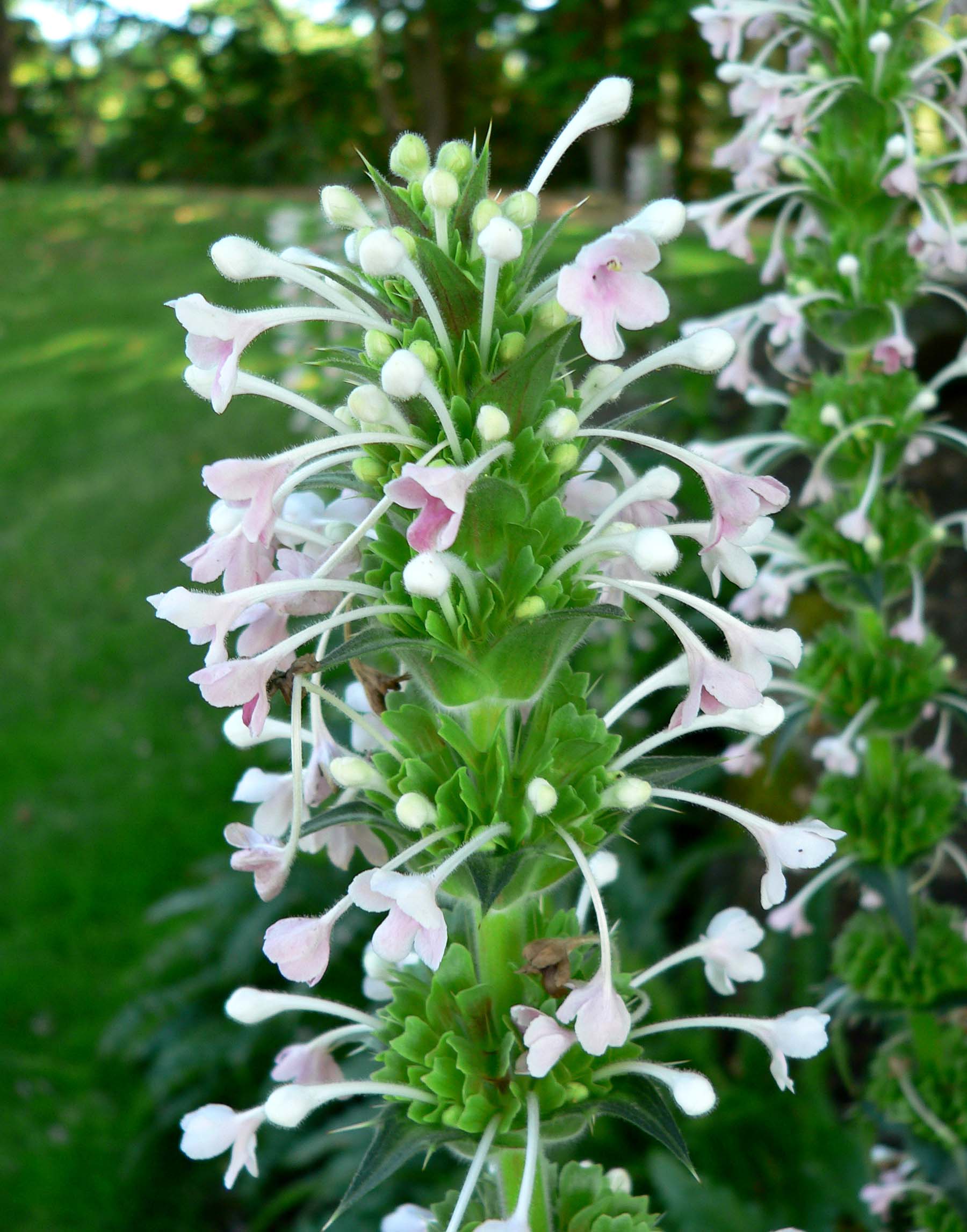
Morina is a genus of flowering plants in the family Caprifoliaceae, placed within the order Dipsacales. The genus comprises approximately 14 accepted species, all native to Eurasia. Its range extends from southeastern Europe across Western and Central Asia into the Himalayas, reaching as far east as China, Bangladesh, and Myanmar.
Plants in this genus are herbaceous perennials, typically producing whorls of tubular, two-lipped flowers arranged in spiny-bracted whorls along the stem — a striking architectural form that has made several species, particularly Morina longifolia and Morina persica, popular in ornamental horticulture. The spiny bracts surrounding the flower whorls superficially resemble thistles, and the genus is sometimes called whorlflower. Flowers are typically white, pink, or red, and often change colour after pollination.
The genus was named in honor of Louis Morin de Saint-Victor (1635–1715), a French physician, botanist, and meteorologist. It is the sole or near-sole genus in the subfamily Morinoideae and was historically placed in the now-dissolved family Morinaceae before broader molecular phylogenetic studies incorporated it into Caprifoliaceae.
Morina longifolia, native to the Himalayas, is the most widely cultivated species in temperate gardens, valued for its bold rosette of spiny leaves and long-lasting flower spikes. Morina persica has a broader range across the Middle East and Central Asia and is noted for its cultural significance; the genus as a whole is informally regarded as a provincial emblem of the Khyber Pakhtunkhwa province of Pakistan.
Etymology
The genus name Morina honors Louis Morin de Saint-Victor (1635–1715), a French physician, botanist, and meteorologist. The name was applied by early botanists in recognition of his contributions to natural history.
Distribution
Morina is native to a broad Eurasian belt stretching from southeastern Europe through Western and Central Asia to the Himalayas, and continuing east into China, Bangladesh, and Myanmar. The genus reaches its greatest diversity in the montane regions of the Himalayas and Central Asia.
Taxonomy Notes
Morina was historically placed in its own family, Morinaceae, and sometimes in Dipsacaceae. Molecular phylogenetic analyses have since placed it within Caprifoliaceae (order Dipsacales), where it constitutes the subfamily Morinoideae. GBIF places the genus in Caprifoliaceae / Dipsacales, consistent with current APG treatments.

