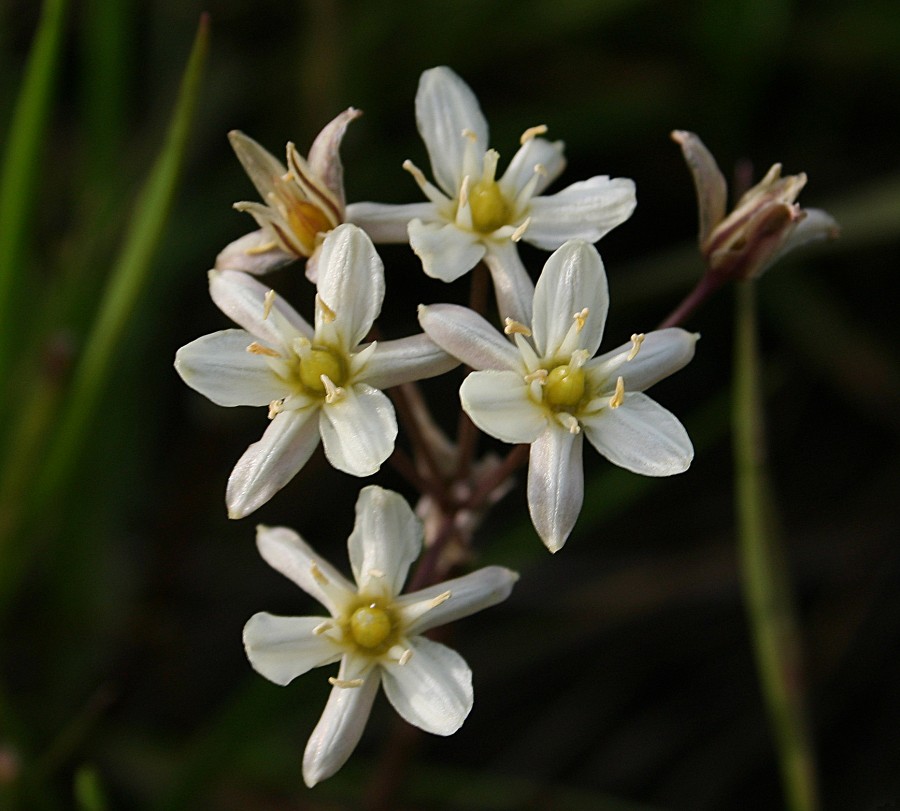
Muilla is a small genus of bulbous monocots in the family Asparagaceae, placed within the subfamily Brodiaeoideae under the APG III classification system. The subfamily has at times been treated as an independent family, Themidaceae. The genus comprises four to five species of flowering plants, all native to southwestern North America, where they grow in dry, open habitats characteristic of the region.
Plants in this genus produce slender, grass-like leaves and small, star-shaped flowers borne on naked scapes. Their overall appearance resembles members of the related genus Allium (the onions and garlics), which is reflected in the genus name itself — Muilla is an exact reverse anagram of Allium. The two most widely recognized species are Muilla maritima, found in coastal and inland California, and Muilla coronata, known from more arid interior habitats of the southwestern United States.
Etymology
The name Muilla is a taxonomic anagram of Allium, the onion genus — the letters are arranged in exact reverse order. The name alludes to the resemblance of Muilla flowers to those of Allium.
Distribution
Muilla species are native to southwestern North America. The genus is centered in California and adjacent arid regions of the western United States.
Taxonomy Notes
Under the APG III classification, Muilla is placed in the family Asparagaceae, subfamily Brodiaeoideae. The subfamily Brodiaeoideae has previously been treated as a distinct family, Themidaceae. Muilla clevelandii (S.Watson) Hoover is now considered a synonym of Bloomeria clevelandii S.Watson and is excluded from the genus.










