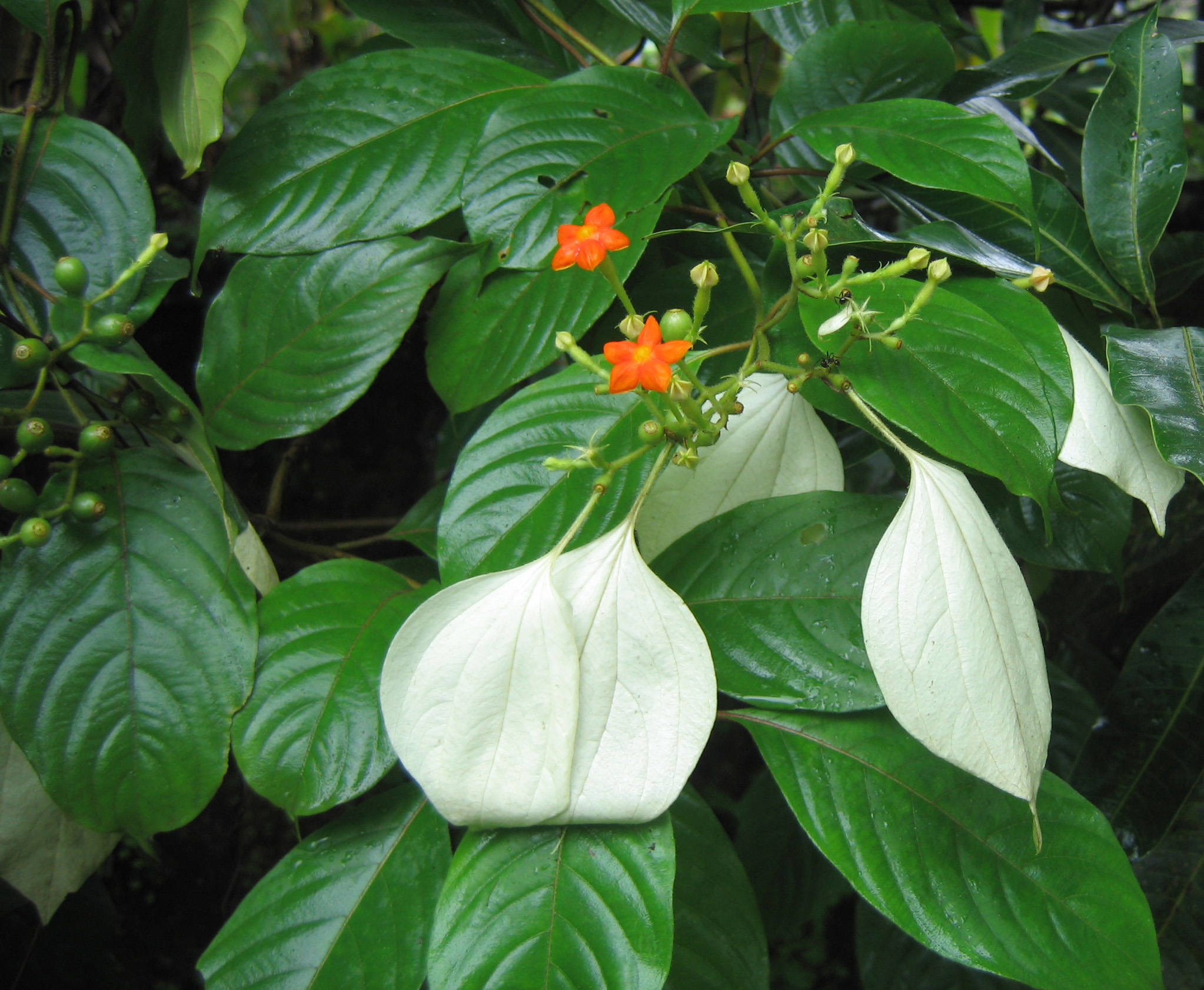
Mussaenda is a genus of tropical and subtropical flowering plants in the family Rubiaceae (the coffee family), placed in the order Gentianales. The genus belongs to the tribe Mussaendeae within the subfamily Dialypetalanthoideae, and its type species is Mussaenda frondosa L., described by Linnaeus in 1753.
The genus is most distinctive for a floral adaptation seen across many of its members: one or more of the five calyx lobes is greatly enlarged and transformed into a showy, leaf-like, brightly coloured sepal — often white, pink, red, or yellow — that functions to attract pollinators in place of, or in addition to, the true petals. The small tubular corolla is typically yellow or orange and less conspicuous than these enlarged sepals. Leaves are simple, opposite or whorled, and often softly hairy.
Mussaenda is native to the tropical and subtropical regions of Africa and Asia, with the greatest diversity in tropical Asia, extending from the Indian Subcontinent and Sri Lanka through Southeast Asia to southern China, the Philippines, and into the Pacific. Several African species are also recognised, primarily in Central and West Africa.
The genus comprises well over 100 described species of shrubs, subshrubs, and occasionally climbing woody plants. Many species are cultivated as ornamental garden and landscape plants in tropical and subtropical climates worldwide, prized for the long-lasting, colourful enlarged sepals that give plants a floriferous appearance over extended seasons. Selections and hybrids — notably those derived from M. philippica and M. erythrophylla — are widely grown in tropical horticulture.
Etymology
The genus name Mussaenda derives from a vernacular Sinhalese name used in Sri Lanka for Mussaenda frondosa, the type species. The name was taken up by pre-Linnaean botanists and formally adopted by Linnaeus in his Species Plantarum (1753).
Distribution
Mussaenda is native to the tropical and subtropical zones of Africa and Asia. African species occur primarily in Central and West Africa (including Tanzania and Mozambique). Asian species range from the Indian Subcontinent, Sri Lanka, and the Andaman Islands eastward through mainland Southeast Asia, southern China, and into the Philippines and other island groups of the Indo-Pacific.
Cultivation
Several Mussaenda species and their hybrids are grown as ornamental shrubs in tropical and subtropical gardens and as potted specimens in warmer temperate regions. They are valued for the enlarged, persistent, brightly coloured sepals — ranging from white and cream to deep pink, red, and salmon — that remain attractive over a long flowering season. Cultivated selections often trace to M. philippica and M. erythrophylla. Plants perform best in full sun with regular moisture and well-drained soil.










