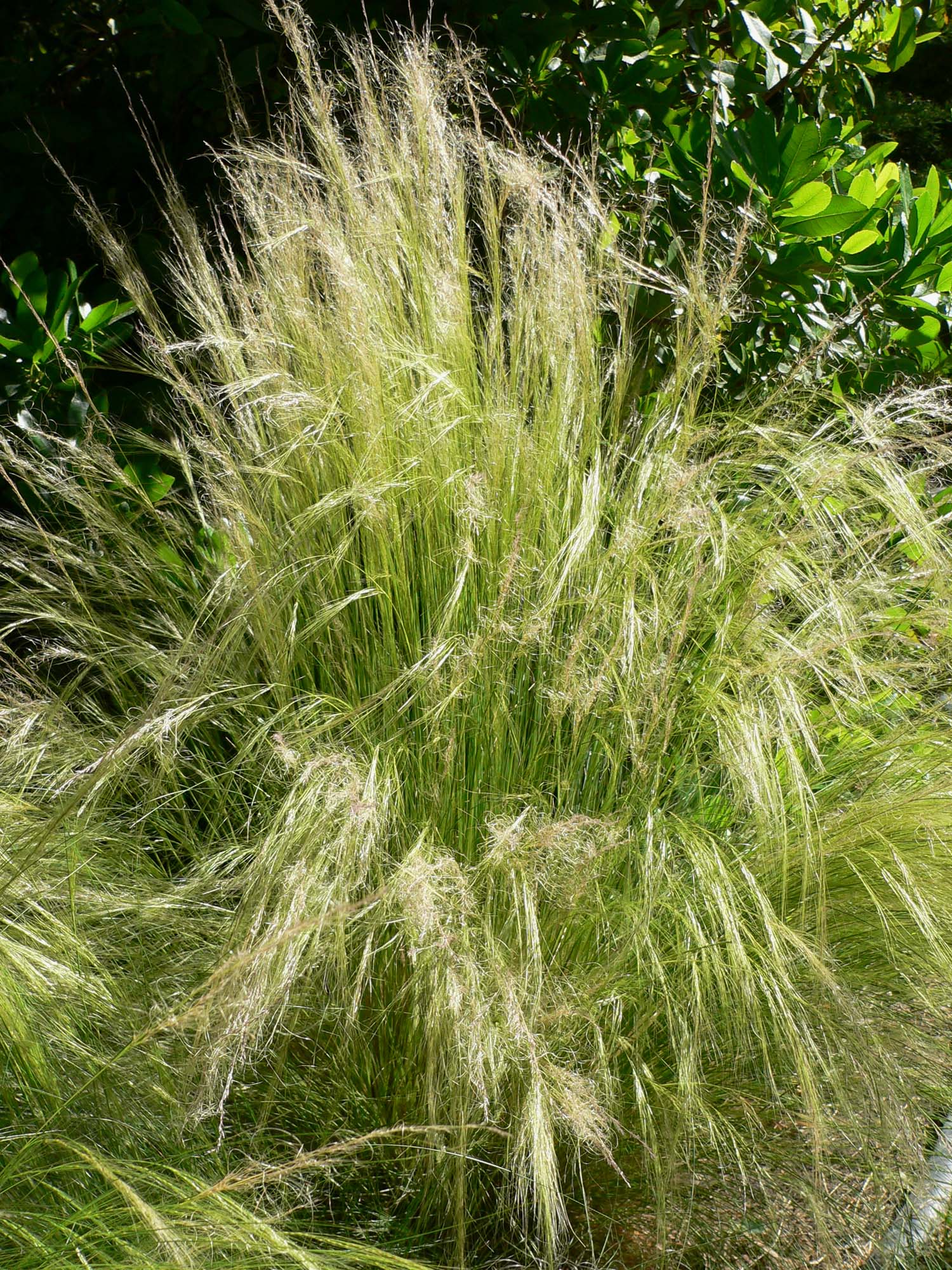
Nassella, commonly known as needlegrass, is a genus of over 100 perennial bunchgrasses in the family Poaceae (order Poales), native to the Americas. The genus ranges from the grasslands and chaparral of North America southward through the Andes and pampas of South America, making it one of the most ecologically significant grass genera of the New World.
Morphologically, Nassella is distinguished from related genera by its strongly overlapping lemma margins and reduced, nearly veinless paleae. The most diagnostic feature is the fused lemma tip, which forms a short membranous structure called the "crown" — a collar-like rim that encircles the base of the awn and is typically fringed with hairs. Awns are often long and geniculate (bent), aiding in seed dispersal by attaching to animal fur and clothing.
The genus has a complex reproductive strategy: many species produce both cross-pollinating (chasmogamous) and self-pollinating (cleistogamous) florets within the same terminal panicle. Cross-pollinating florets bear three longer anthers, while self-pollinating florets have one to three reduced anthers. Some species go further and produce additional cleistogamous inflorescences hidden within their basal leaf sheaths; these lack glumes and awns entirely.
Nassella is generally treated as a segregate of the large, cosmopolitan genus Stipa, with New World Stipa species reassigned to Nassella on morphological and molecular grounds. Classification remains in flux: the Jepson Manual (as of 2011) treats California species under Stipa rather than Nassella, and individual species may appear under either name depending on the authority followed.
Notable members include Nassella pulchra (purple needlegrass), the official State Grass of California and an important plant in native grassland restoration; Nassella tenuissima (Mexican feathergrass), widely cultivated as an ornamental for its fine, airy foliage; and Nassella viridula (green needlegrass), a valuable forage grass of the North American Great Plains. Several species — notably Nassella neesiana (Chilean needle grass) and Nassella trichotoma (serrated tussockgrass) — are regarded as serious invasive weeds in Australia, New Zealand, and parts of Europe, as the barbed seeds are not properly digested by ruminants and the plants spread aggressively into disturbed habitats.
Etymology
The genus name Nassella derives from the Latin nassa, meaning "a basket with a narrow neck," an allusion to the crown-like fused tip of the lemma that encircles the base of the awn like a narrow-mouthed basket. The common name "needlegrass" refers to the long, sharp-pointed seeds and awns characteristic of the group.
Distribution
Nassella is native to the Americas, with its centre of diversity in South America (particularly the Andean foothills, Patagonian steppe, and Río de la Plata grasslands) and extending north through Central America into the western and central United States. In California, species such as Nassella pulchra were once dominant constituents of the Central Valley grasslands before displacement by introduced European annuals. Several species have naturalised as invasive weeds far outside their native range, including in Australia, New Zealand, South Africa, and parts of Mediterranean Europe.
Ecology
Many Nassella species are key components of native grassland and savanna ecosystems in the Americas, providing ground cover, preventing erosion, and supplying seed food for birds and small mammals. The seeds of Nassella pulchra were an important dietary resource for Indigenous peoples of California. The genus employs a mixed mating system — combining wind-pollinated open florets with cleistogamous (self-fertile) florets hidden in basal sheaths — which allows reproduction even in the absence of pollinators or when weather limits pollen dispersal. In invaded regions, Nassella neesiana and Nassella trichotoma form dense, persistent swards that suppress native vegetation; the barbed lemmas attach to wool and cause significant production losses in sheep farming.
Taxonomy Notes
Nassella is treated as a New World segregate of the large, cosmopolitan genus Stipa (family Poaceae, subfamily Pooideae, tribe Stipeae). The split is supported by morphological characters — especially the distinctive fused lemma crown — and by molecular phylogenetic analyses. Classification remains unsettled: some authorities (including the Jepson Manual as of 2011) retain California species within Stipa, so species such as Nassella pulchra may be cited as Stipa pulchra. GBIF recognises Nassella as an accepted genus in Poaceae with approximately 70 accepted species.
Cultivation
Nassella tenuissima (Mexican feathergrass) is widely grown as an ornamental grass for its extremely fine, bright-green foliage and feathery, golden-tan inflorescences that move gracefully in light breezes. It tolerates drought, full sun, and poor soils, making it popular in low-water and Mediterranean-style gardens. However, it self-seeds prolifically and has naturalised as an invasive species in California, Oregon, and parts of Australia and New Zealand; gardeners in these regions are advised to deadhead the plants before seed set or to avoid the species altogether. Nassella pulchra is used in native grassland restoration plantings in California.

