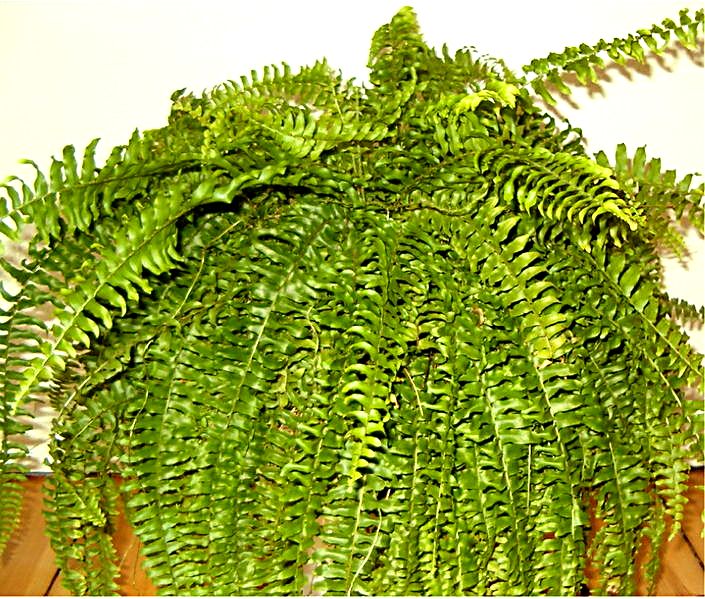
Nephrolepis is a genus of approximately 30 fern species in the family Nephrolepidaceae, order Polypodiales. Commonly known as sword ferns, Boston ferns, or fishbone ferns, these plants are distinguished by long, arching fronds that are narrow and once-pinnate — the pinnae arranged in a regular ladder-like pattern along either side of the rachis. Frond lengths vary widely across the genus; most cultivated species produce fronds of 40–90 cm, while some tropical giants such as the species found in Borneo can reach up to nine metres.
The genus was established by the Austrian botanist Heinrich Wilhelm Schott in 1834 (Gen. Fil. Pl. 3), with Nephrolepis exaltata as the type species. Under the Pteridophyte Phylogeny Group 2016 classification, Nephrolepis stands as the sole genus of Nephrolepidaceae, placed in the suborder Aspleniineae of Polypodiales, though older treatments sometimes included it in Dryopteridaceae or Lomariopsidaceae.
Members of the genus spread by means of wiry stolons — slender horizontal runners that produce new plantlets — as well as by spores. The sori are round and covered by a kidney-shaped (reniform) indusium, a feature reflected in the generic name (from Greek nephros, kidney, and lepis, scale). Species occur across the pantropical and subtropical belt, inhabiting humid forests, swamps, and disturbed ground from sea level to moderate elevations, and growing both terrestrially and epiphytically.
Nephrolepis exaltata and its numerous cultivars are among the most widely grown ornamental ferns worldwide, valued for cascading foliage and adaptability as houseplants in hanging baskets. Some species — notably Nephrolepis cordifolia — have become invasive outside their native ranges. Research has also identified potential antimicrobial compounds in genus members.
Etymology
The generic name Nephrolepis derives from the Greek nephros (kidney) and lepis (scale), a direct reference to the kidney-shaped (reniform) indusium — the protective flap of tissue that covers each cluster of spores (sorus) on the underside of the frond. This distinctive indusium shape is shared across all members of the genus and distinguishes them from related fern groups.
Distribution
Nephrolepis has a pantropical and subtropical distribution. The genus is native to humid forests, swamps, and disturbed habitats across northern South America, Central America, Mexico, Florida, the Caribbean, Polynesia, and Africa. The type species, Nephrolepis exaltata, grows both terrestrially and epiphytically across this range. In Australia, at least 13 species have been recorded, including Nephrolepis biserrata, Nephrolepis brownii, Nephrolepis cordifolia, Nephrolepis exaltata, and several endemic species such as Nephrolepis arida. The genus is known in Australia by the common names sword ferns and fishbone ferns.
Taxonomy
Nephrolepis was described by the Austrian botanist Heinrich Wilhelm Schott in 1834 in Genera Filicum (Gen. Fil. Pl. 3), with Nephrolepis exaltata (L.) Schott as the type species. The genus is the sole member of the family Nephrolepidaceae under the Pteridophyte Phylogeny Group 2016 classification, placed in suborder Aspleniineae of order Polypodiales, class Polypodiopsida, phylum Tracheophyta. Older taxonomic systems have alternatively accommodated the genus within Dryopteridaceae or Lomariopsidaceae; the Atlas of Living Australia currently records the family as Lomariopsidaceae. The GBIF backbone recognises 86 descendants under genus key 2650926; ITIS assigns it Taxonomic Serial Number 17601. Around 30 species are generally accepted.
Ecology
Nephrolepis species are characteristic of humid tropical and subtropical environments — forests, swamp margins, and disturbed ground at low to moderate elevations. They grow terrestrially in leaf litter or soil and epiphytically on tree trunks and branches. Fronds are produced from creeping rhizomes, and the plants spread vegetatively by slender stolons that produce daughter rosettes, enabling rapid colonisation of suitable ground. High humidity is critical: Nephrolepis exaltata, for example, requires relative humidity above approximately 80% for optimal growth. Some species in the genus have been identified as sources of antimicrobial compounds of potential pharmaceutical interest.
Cultivation
Many Nephrolepis species and their cultivars are grown as ornamental plants. Nephrolepis exaltata and its cultivars are among the most popular houseplants worldwide, typically displayed in hanging baskets where their arching fronds can cascade freely. Indoors, the plants respond best to bright filtered light; direct sun should be avoided. Outdoors in suitable climates (USDA zones 9–11) they prefer partial to full shade. Soil should be kept consistently moist and nutrient-rich, though not waterlogged. High ambient humidity is important — regular misting is recommended when relative humidity falls below 80%. Nephrolepis exaltata holds the Royal Horticultural Society Award of Garden Merit and is considered non-toxic to pets. Several species also tolerate outdoor conditions in frost-free subtropical and tropical gardens.
Propagation
Named Nephrolepis cultivars are propagated vegetatively by division of rooted stolons (runners), since such cultivars do not produce viable spores. The stolons — slender wiry stems that radiate from the base — root where they contact moist soil or potting medium, producing daughter plants that can be separated and potted individually. Straight species can also be raised from spores sown on moist, sterile substrate in warm, humid conditions. Division of established clumps is the standard method for maintaining true-to-type cultivar characteristics.
Cultural Uses
Nephrolepis ferns, especially Nephrolepis exaltata and its cultivars, have been extensively cultivated as ornamental houseplants since the Victorian era and remain one of the most commercially important foliage plants globally. They are typically sold in hanging baskets or large containers for interior decoration. Beyond ornament, scientific studies have suggested that some Nephrolepis species may be a useful source of antimicrobial chemical compounds, though this application remains at the research stage.










