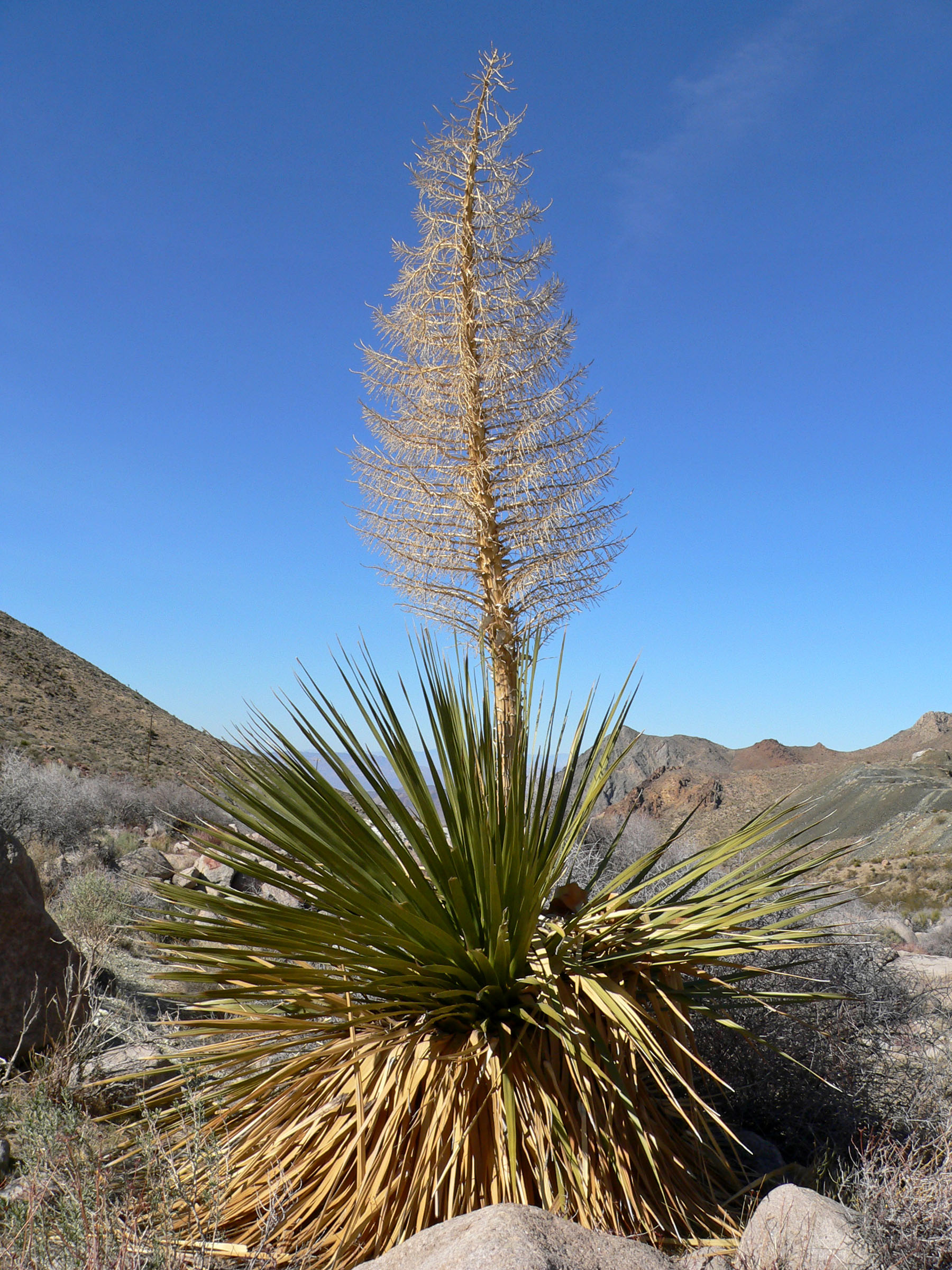
Nolina is a genus of perennial monocots in the family Asparagaceae, order Asparagales, comprising roughly 30–41 species depending on the authority consulted. Plants are native to Mexico and the southern United States, ranging from Florida and the Carolinas in the east to California in the west, reaching north to Nevada and Colorado.
Growth forms span a wide spectrum: some species are stemless and cespitose, clustering at ground level, while others develop stout, branching trunks that elevate their leaf rosettes to heights of 2–7 metres, giving arborescent individuals a striking, yucca-like silhouette. All species produce dense rosettes of long, linear leaves from branched woody caudices or bulb-like structures, and plants frequently grow in colonies of several rosettes. The chromosome base number is x = 19.
Nolinas are dioecious — male and female flowers are borne on separate individuals. Flowering stems (scapes) range from 5 to 250 cm tall and carry large, branched panicles of small white, cream, or light tan flowers. Fruits are capsular, three-locular, and often notably inflated. In the United States the genus is commonly called beargrass, a name shared with unrelated monocots, reflecting the grass-like foliage of many species.
Etymology
The genus name Nolina was given by the French botanist André Michaux in his 1803 work Flora Boreali-Americana (Fl. Bor.-Amer. 1: 207). Michaux named it in honour of Abbé C. P. Nolin, an 18th-century French arboriculturist. The type species is Nolina georgiana, native to Georgia and South Carolina.
Distribution
Nolina is centred on Mexico and the Chihuahuan, Sonoran, and Mojave desert regions of the southwestern United States. The genus ranges from the southeastern coastal plain (Georgia, South Carolina, Florida) westward through Texas, New Mexico, and Arizona to California, and northward to Nevada and Colorado. Within Mexico, species are especially diverse in the arid interior highlands. Most species occupy xeric scrub, desert grassland, chaparral, and oak-pine woodland habitats at varying elevations. Western Texas, New Mexico, and Arizona represent the heart of its US diversity, with some species extending into Baja California.
Ecology
Nolinas are perennial and typically long-lived. They grow from branched, woody caudices or bulb-like structures and often form multi-stemmed colonies. The genus is adapted to arid and semi-arid conditions, thriving on rocky slopes, desert grasslands, chaparral, and open woodland. Plants are dioecious, requiring both male and female individuals for seed set. Morphological variation across the range — particularly in leaf margins and inflorescence structure — has historically complicated species delimitation. The chromosome base number of x = 19 is consistent across the genus. Several species are extremely rare, appearing on federal and state endangered species lists.
Conservation
Species richness figures vary by authority: World Flora Online accepts 30 species, Plants of the World Online (Kew) accepts 35, and GBIF recognizes 41 descendant taxa. Several Nolina species are listed on US federal and state endangered species lists due to their restricted ranges and habitat vulnerability. Nolina is not recorded in the IUCN Global Invasive Species Database, indicating no species are recognized as problematic invasives.
Taxonomy
Nolina Michx. was published in 1803. The genus has been placed in several families over its taxonomic history — Nolinaceae, Ruscaceae, and Agavaceae — before being subsumed into Asparagaceae under the APG classification system. Molecular phylogenetic work confirmed that Beaucarnea (the ponytail palms and elephant-foot trees, sometimes sold as Nolina recurvata) constitutes a distinct genus that should not be merged with Nolina. The number of accepted species differs substantially among global checklists (30–41), reflecting ongoing uncertainty in species boundaries, particularly in the morphologically variable southwestern populations.
Cultural Uses
Throughout their range in the United States, Nolina species are colloquially called "beargrass," a name that also applies to several unrelated plants with similar strap-like foliage. Some species are cultivated as ornamental plants, prized for their bold, architectural rosettes and drought tolerance in xeric garden designs.










