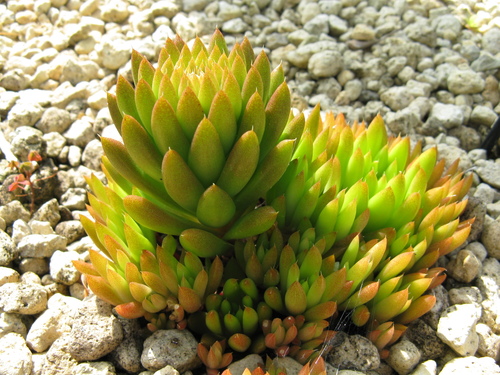
Orostachys is a genus of succulent plants in the family Crassulaceae, the stonecrop family, placed within tribe Telephieae of the subfamily Sempervivoideae. The genus comprises roughly 12 to 17 accepted species and is distributed across temperate to continental Asia, occurring in China (where about eight species are found), Japan, Korea, Mongolia, Kazakhstan, and Russia.
Members of Orostachys are considered the most morphologically distinct genus within Sempervivoideae. They are predominantly biennial herbs with fleshy, water-storing foliage. In their first year, plants form tight, flat or slightly domed basal rosettes with leaves that are linear to ovate, often marked with dull purple dots, and tipped with a cartilaginous to spiny white point. In the second year a single erect stem, 5 to 60 cm tall, rises from the rosette centre and bears a dense, narrowly pyramidal to cylindrical terminal spike packed with many small, predominantly yellow — occasionally white, yellow-green, or pinkish — pentamerous flowers with five nearly free petals and two whorls of five stamens. After flowering and seed-set the monocarpic rosette dies; plants propagate from offsets produced before the flowering stem emerges.
The taxonomy of the genus is unstable. Molecular phylogenetic studies have shown Orostachys as currently circumscribed to be polyphyletic with respect to Hylotelephium, and the genus has variously included or excluded Meterostachys and sections transferred from Sinocrassula. The subsection Appendiculatae has been proposed for recognition as a separate genus. Broadly recognised infrageneric divisions include series Appendiculatae and Eappendiculatae, and sections Orostachys and Schoenlandia (the latter also treated as genus Kungia).
Etymology
The genus name Orostachys derives from the Greek words oros (mountain) and stachys (spike or ear of grain), referring to the tall, spike-like inflorescence that rises from the mountain-dwelling rosette plants in their second year.
Distribution
Orostachys is native to temperate continental Asia, with its centre of diversity in China, where approximately eight species occur. The genus also grows in Japan, Korea, Mongolia, Kazakhstan, and Russia, typically in rocky, mountainous, or steppe habitats.
Taxonomy
Orostachys is placed in tribe Telephieae of subfamily Sempervivoideae within Crassulaceae. Molecular phylogenetic data have revealed the genus to be polyphyletic with respect to Hylotelephium, making its circumscription unstable and subject to ongoing revision. Infrageneric classifications recognise series Appendiculatae and Eappendiculatae, and sections Orostachys and Schoenlandia; the latter overlaps with the segregate genera Kungia and (historically) Meterostachys. Subsection Appendiculatae has been proposed as a separate genus on the basis of molecular data.
Cultivation
Orostachys species are cultivated as ornamental succulents, prized for their geometric rosettes and architectural flower spikes. They thrive in well-drained, gritty or rocky substrates in full sun and are tolerant of cold winters. Because the flowering rosette is monocarpic, plants are typically grown for their offsets, which propagate readily and maintain the clump after the parent rosette sets seed and dies.










