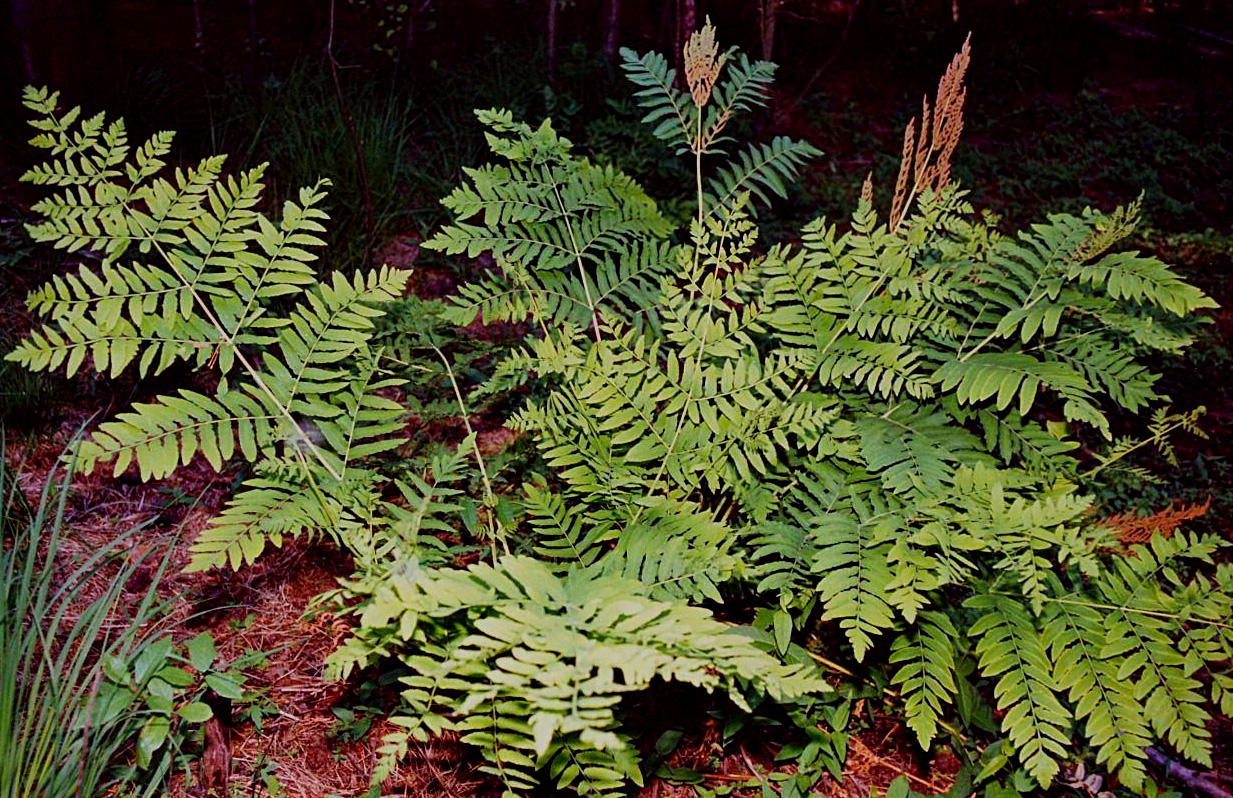
Osmunda is a genus of ancient, primarily temperate ferns in the family Osmundaceae, order Osmundales. Five to ten species are recognized, and the lineage has existed since the Early Cretaceous, making Osmunda one of the oldest known fern genera with a substantial fossil record.
Plants in this genus are characterized by dimorphic or hemidimorphic fronds: sterile pinnae are green and photosynthetic, while fertile pinnae are non-photosynthetic and bear large, naked sporangia. When the sporangia ripen simultaneously to a bright golden color, the plants can appear to be in flower — the origin of the common name "flowering ferns." The rootstocks are massive and densely matted with wiry roots, a structure that has long been harvested as osmundine fiber for use in horticulture, particularly in growing orchids.
Taxonomically, Osmunda is the type genus of the order Osmundales. It was historically the largest genus in Osmundaceae, but molecular phylogenetic work by Metzgar et al. (2008) demonstrated that the broadly circumscribed Osmunda was paraphyletic. This led to the resurrection of Osmundastrum as a separate genus and, subsequently, the Pteridophyte Phylogeny Group (2016) further split off Claytosmunda and Plenasium, leaving Osmunda in a stricter, monophyletic sense.
Notable members include Osmunda regalis (the Old World royal fern), Osmunda spectabilis (the American royal fern), Osmunda japonica (the Japanese flowering fern), and Osmunda claytoniana (the interrupted fern). Species are distributed across temperate regions of Europe, East Asia, and the Americas.
Etymology
The origin of the genus name Osmunda is uncertain. The most widely cited theory derives it from Osmunder, a Saxon epithet for the god Thor. Alternative explanations trace it to Middle English and Middle French terms for a type of fern, while an English folk tale describes a boatman named Osmund who concealed his wife and children among royal ferns during a Danish invasion.
Distribution
Osmunda species occur across temperate regions worldwide. The genus includes European representatives (O. regalis), East Asian species (O. japonica, O. lancea), and North American species (O. spectabilis, O. claytoniana). The lineage has a fossil record extending to the Early Cretaceous, indicating a long and geographically broad history.
Ecology
Osmunda ferns serve as larval food plants for certain Lepidoptera, including the engrailed moth. The plants develop massive rootstocks with dense, wiry roots that form excellent substrates for epiphytic plants. This fibrous root mass — known commercially as osmundine — is collected and used horticulturally, especially as a growing medium for orchids and other epiphytes.
Taxonomy Notes
Osmunda is the type genus of the order Osmundales. Historically treated as the largest genus in Osmundaceae and divided into subgenera Osmunda, Osmundastrum, and Plenasium, it was shown to be paraphyletic by a 2008 molecular phylogeny (Metzgar et al.). Osmundastrum was resurrected as a separate genus to contain O. cinnamomea, and in 2016 the Pteridophyte Phylogeny Group elevated the remaining subgenera to the genera Claytosmunda and Plenasium, rendering Osmunda monophyletic in its current circumscription.

