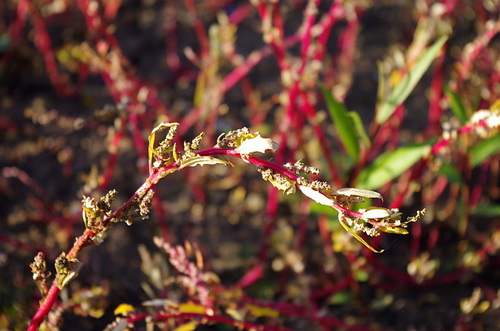
Oxybasis is a small genus of non-aromatic annual herbs in the subfamily Chenopodioideae of the family Amaranthaceae, within the order Caryophyllales. The genus was first described in 1841 but fell into disuse; it was re-instated in 2012 by Fuentes-Bazan and colleagues to accommodate a group of species previously classified within the large and heterogeneous genus Chenopodium. The genus currently comprises around five to six species distributed across Europe, Asia, North Africa, and the Americas.
Plants in Oxybasis are herbaceous annuals with erect to ascending or sometimes prostrate stems that branch freely, usually with alternate branches that may be nearly opposite near the base. The leaves are alternate, each composed of a petiole and a simple blade that is somewhat thickened or slightly fleshy in texture. Leaf shape varies across species from triangular and hastate to rhombic or lanceolate, with margins ranging from entire to toothed (dentate).
The inflorescences are axillary and terminal, composed of compact clusters (glomerules) arranged in spike-like or sometimes panicle-like patterns, either without bracts or subtended by leaf-like bracts. Oxybasis characteristically produces two types of flowers within the same inflorescence: terminal flowers that are bisexual with three to five nearly free perianth segments and one to five stamens, and lateral flowers that are typically female with three to four variably fused perianth segments and two stigmas. The fruit is small with a membranous pericarp that is free or loosely attached to the seed; seeds are oval to orbicular with a brownish or black coat that may be smooth, finely reticulate, or minutely pitted.
Notable species include Oxybasis rubra (red goosefoot) and Oxybasis glauca (oak-leaved goosefoot), both of which were formerly treated as Chenopodium species and remain common across much of their wide range.
Etymology
The genus name Oxybasis derives from Greek, combining oxys (sharp, acid) and basis (base or step), a reference to characteristics of the plants within the group. The name was first published in 1841 and re-adopted in 2012 when molecular phylogenetic work by Fuentes-Bazan et al. confirmed that these species form a distinct lineage separate from Chenopodium.
Distribution
Oxybasis species occur across a wide range spanning Europe, Asia, North Africa, and the Americas. Individual species such as Oxybasis rubra and Oxybasis glauca are broadly distributed across temperate regions, often found in disturbed, saline, or nitrogen-rich habitats.
Taxonomy
Oxybasis was originally described in 1841 but was long subsumed within Chenopodium, one of the largest genera in Amaranthaceae. In 2012, Fuentes-Bazan et al. used molecular phylogenetic data to reorganize subfamily Chenopodioideae, segregating several smaller genera including Oxybasis from the para- or polyphyletic Chenopodium aggregate. GBIF recognises five accepted species in the genus.

