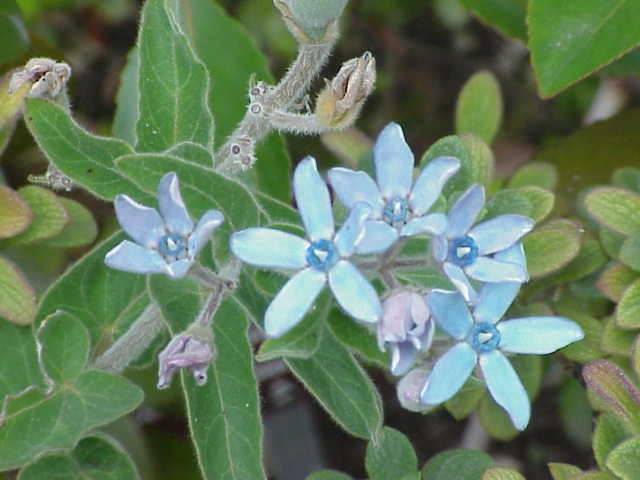
Oxypetalum is a genus of flowering plants in the family Apocynaceae, placed in the order Gentianales. It was first described under this name in 1810 and comprises species native to South America. The genus belongs to the subfamily Asclepiadoideae (the former milkweed family), and its members are characterized by twining or straggling perennial habits, opposite leaves, and distinctive five-petaled star-shaped flowers. The seed pods are elongated and boat-shaped, producing seeds equipped with downy, parachute-like hair tufts that aid wind dispersal — a hallmark of the broader milkweed alliance.
The most celebrated member of the genus is Oxypetalum coeruleum (also known under the synonym Tweedia caerulea), native from southern Brazil to Uruguay. It is widely grown as an ornamental for its unusually clear pale blue flowers — a relatively rare color in the garden — which age to lilac-purple and are prized as long-lasting cut flowers. The plant grows to about 100 cm with heart-shaped, gray-green, downy leaves and produces narrow seed pods up to 30 cm in length.
Taxonomically, Oxypetalum has undergone significant revision: a number of species formerly placed here have been transferred to related genera including Cynanchum, Morrenia, Philibertia, Tassadia, and Tweedia. This reshuffling reflects ongoing molecular and morphological work within Apocynaceae that has redefined genus boundaries across the family.
Etymology
The name Oxypetalum derives from the Greek oxys (sharp, pointed) and petalon (petal), referring to the pointed petals characteristic of the genus's star-shaped flowers.
Distribution
Oxypetalum is native to South America. The most widely known species, O. coeruleum, occurs from southern Brazil to Uruguay. The genus as a whole is confined to South America.
Taxonomy Notes
Oxypetalum was first formally described in 1810. It belongs to the family Apocynaceae (order Gentianales), within the milkweed subfamily Asclepiadoideae. A substantial number of species formerly included in Oxypetalum have been transferred to other genera — Cynanchum, Morrenia, Philibertia, Tassadia, and Tweedia — following revisions to subfamily Asclepiadoideae. The most widely grown species, O. coeruleum, is also commonly referred to by the synonym Tweedia caerulea, reflecting its past placement.
Cultivation
Oxypetalum coeruleum is the primary cultivated member of the genus and is grown as an ornamental for its pale blue, star-shaped summer flowers, which are long-lasting and suitable for cutting. It requires full sun and well-drained, dry soil. Hardy only to about 3–5 °C, it is typically grown outdoors in frost-free sheltered positions or treated as a half-hardy annual in cooler climates. Propagation is by seed. Named cultivars include 'Alba' (white flowers) and 'Rosea' (pink flowers). O. coeruleum has received the Royal Horticultural Society's Award of Garden Merit.










