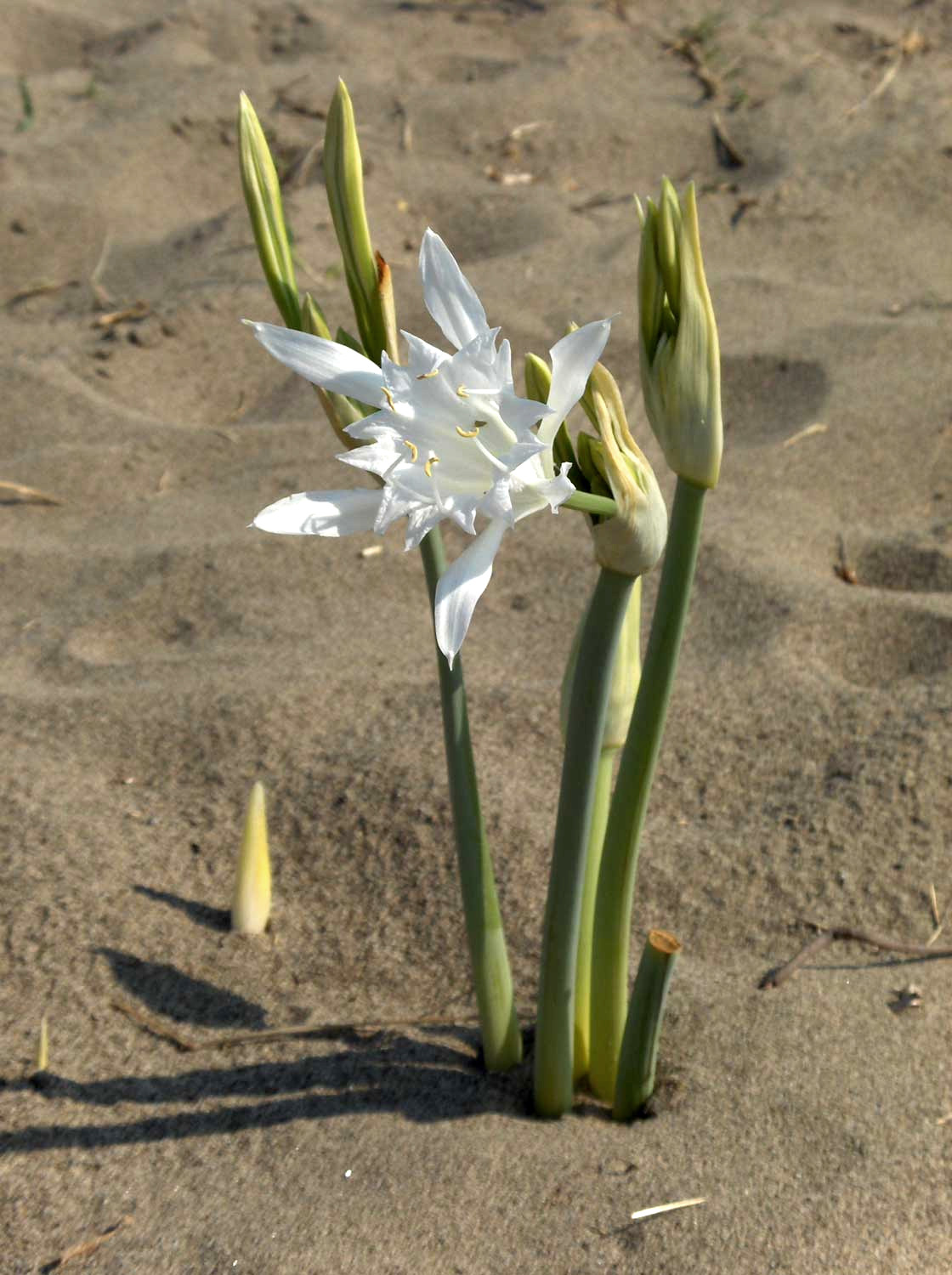
Pancratium is a genus of perennial, bulbous, herbaceous plants in the family Amaryllidaceae (subfamily Amaryllidoideae, tribe Pancratieae), within the order Asparagales. The genus was described by Carl Linnaeus in 1753, with Pancratium maritimum L. designated as the lectotype species in 1918.
Plants in this genus grow from bulbs and typically produce strap-shaped leaves and large, white, fragrant flowers arranged in umbels atop a solid scape. The flowers are notable for a prominent corona — a cup or funnel-shaped structure formed from the bases of the filaments — which distinguishes them from related amaryllid genera. Blooming commonly occurs in summer or autumn.
The genus name is derived from Greek and means "all-strength," a reference to the plants' remarkable tolerance of harsh, dry, and sandy environments. Many species are indeed adapted to coastal dunes, rocky Mediterranean shores, and semi-arid landscapes.
Pancratium is native to Africa, the Mediterranean Basin, and Malesia, with populations introduced to the Azores, Bermuda, the Comoros, Great Britain, and the USA. The genus is most diverse around the Mediterranean, where the sea daffodil, Pancratium maritimum, is one of the most recognisable coastal wildflowers. As of 2023, Plants of the World Online (Royal Botanic Gardens, Kew) accepts approximately 24 species.
The genus once encompassed far more species, but extensive revision has resulted in many former Pancratium species being transferred to related genera including Clinanthus, Hymenocallis, Ismene, Proiphys, and Stenomesson. Pollination is primarily carried out by hawkmoths — particularly Agrius convolvuli — which are attracted to the pale, heavily scented night-blooming flowers.
Etymology
The genus name Pancratium is derived from Greek and translates as "all-strength," likely alluding to the plants' ability to thrive in extreme, sun-scorched, and drought-prone habitats. Many species inhabit coastal sand dunes and arid rocky ground that few other bulbous plants can tolerate.
Distribution
Pancratium is native to Africa, the Mediterranean region, and Malesia. It has also been introduced beyond its native range to the Azores, Bermuda, the Comoros, Great Britain, and the USA. The genus reaches its greatest diversity around the Mediterranean Basin, where several species grow on coastal dunes and rocky limestone slopes.
Ecology
Pollination in this genus is primarily moth-mediated. Both Pancratium maritimum and P. tenuifolium are pollinated by the convolvulus hawk-moth (Agrius convolvuli). Bees including Xylocopa violacea, Apis mellifera, and Anthophora bimaculata have been observed visiting P. maritimum flowers, but are not regarded as effective pollinators; the species is considered fully dependent on hawkmoths for successful pollination. The large, white, intensely fragrant flowers and nocturnal opening are typical adaptations to hawkmoth pollination.
Taxonomy Notes
The genus was published by Carl Linnaeus in 1753 and is placed in tribe Pancratieae within subfamily Amaryllidoideae, family Amaryllidaceae. The lectotype, Pancratium maritimum, was designated in 1918. Historical circumscriptions of the genus were broad, but taxonomic revision has transferred many former Pancratium species to other genera, including Clinanthus, Hymenocallis, Ismene, Proiphys, and Stenomesson. As of June 2023, Plants of the World Online accepts 24 species.
Cultivation
Only a few species of Pancratium are in general cultivation. Pancratium maritimum and P. illyricum are the hardiest for outdoor growing, though both flower shyly in cool or overcast climates. P. zeylanicum is sometimes grown as a container plant under glass. All species require excellent drainage and prefer a warm, sunny position; bulbs should be planted with the neck at or just above the soil surface and left undisturbed once established.










