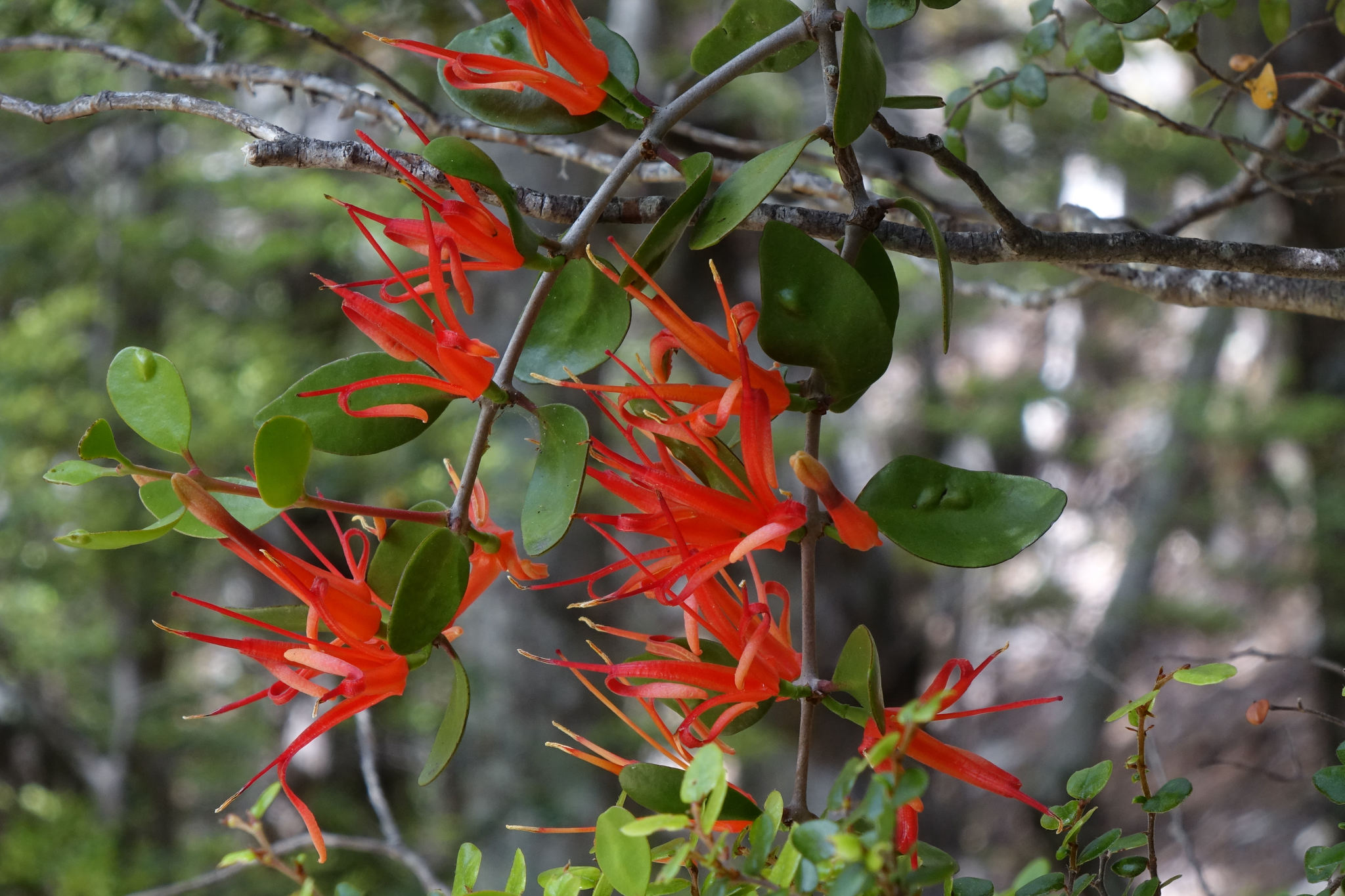
Peraxilla is a genus of two species of hemiparasitic mistletoes in the family Loranthaceae, both endemic to New Zealand. The genus belongs to one of the most conspicuous groups of flowering parasites in the country, prized for their striking scarlet blooms that smother beech forest canopies from October to January.
Both species grow as woody shrubs — reaching up to 2–3 metres across — embedded in the branches of their host trees, primarily southern beech species (Nothofagus). Like all mistletoes, they are hemiparasites: they photosynthesise independently but draw water and nutrients directly from the host via haustoria (root-like attachment organs). The two species occupy slightly different niches on the same hosts: Peraxilla tetrapetala (red mistletoe) tends to parasitise closer to the trunk and bears smaller rhombic leaves with characteristic surface blisters and solitary to four-flowered clusters of bright red blooms up to 40 mm long; Peraxilla colensoi (scarlet mistletoe) grows further along branches, has larger smooth leathery leaves with red-tinged margins, and produces showier clusters of 3–10 flowers up to 60 mm long with golden-yellow fruit.
Both species occur on the North and South Islands, though P. colensoi is most abundant in the southern South Island's silver beech forests, while P. tetrapetala ranges more widely through mountain, black, red, and silver beech forest from coastal to montane zones. Fruit dispersal is carried out by nectar-feeding birds: tui and bellbirds are important vectors, particularly in the North Island.
Both species are currently listed as At Risk – Declining under New Zealand's Threat Classification System (2023). The primary driver of decline is browsing by introduced brush-tailed possums (Trichosurus vulpecula), which preferentially consume mistletoe foliage and have eliminated Peraxilla from large tracts of beech forest. Active management — including possum control — is critical to the genus's persistence.
Etymology
The genus name Peraxilla has not been explained in available sources. The species epithets are well documented: tetrapetala derives from the Latin/Greek for "four-petalled" (referring to the four floral parts), and colensoi honours William Colenso (1811–1899), a Cornish missionary, botanist, and explorer who made important contributions to New Zealand natural history.
Distribution
Peraxilla is endemic to New Zealand, occurring on both the North and South Islands. Peraxilla tetrapetala is found from coastal to montane zones throughout both islands but is less common in the North Island. Peraxilla colensoi is found on both islands but is common mainly in the southern South Island, where silver beech (Nothofagus menziesii) forest predominates.
Ecology
Both species are hemiparasites of Nothofagus (southern beech) and related trees. P. tetrapetala parasitises mountain beech, black beech, red beech, and silver beech, and has been recorded on at least 17 host species in total. P. colensoi is mainly found on silver beech but has been recorded on 16 host species (9 exotic). Flowering runs October to January; P. tetrapetala fruits April to June with green fruit, while P. colensoi bears yellow/golden fruit. Tui and bellbirds are key pollinators and fruit dispersers.
Conservation
Both Peraxilla species are classified At Risk – Declining under the 2023 New Zealand Threat Classification System. The main threat is browsing by introduced brush-tailed possums (Trichosurus vulpecula), which preferentially consume mistletoe foliage and have caused local extinction of both species from large areas of New Zealand beech forest. Ongoing possum-control programmes are the primary conservation intervention.
Propagation
Both species can be propagated from fresh seed placed directly onto suitable host tissue — P. tetrapetala on mountain beech (Nothofagus solandri var. cliffortioides) and P. colensoi on silver beech (N. menziesii). Although seed germinates readily, the ability of the seedling to form a functioning haustorium on the host is highly variable, and failure rates are high. Success requires experimentation with large quantities of fresh seed.
Cultural Uses
Both species carry Māori names reflecting their cultural significance: P. tetrapetala is known as pikirangi, pirita, roeroe, or pirinoa; P. colensoi as korukoru, pirita, or roeroe. The plants' spectacular flowering is a well-known seasonal feature of New Zealand beech forest, and both species have become flagships for the conservation of beech forest health in Aotearoa.










