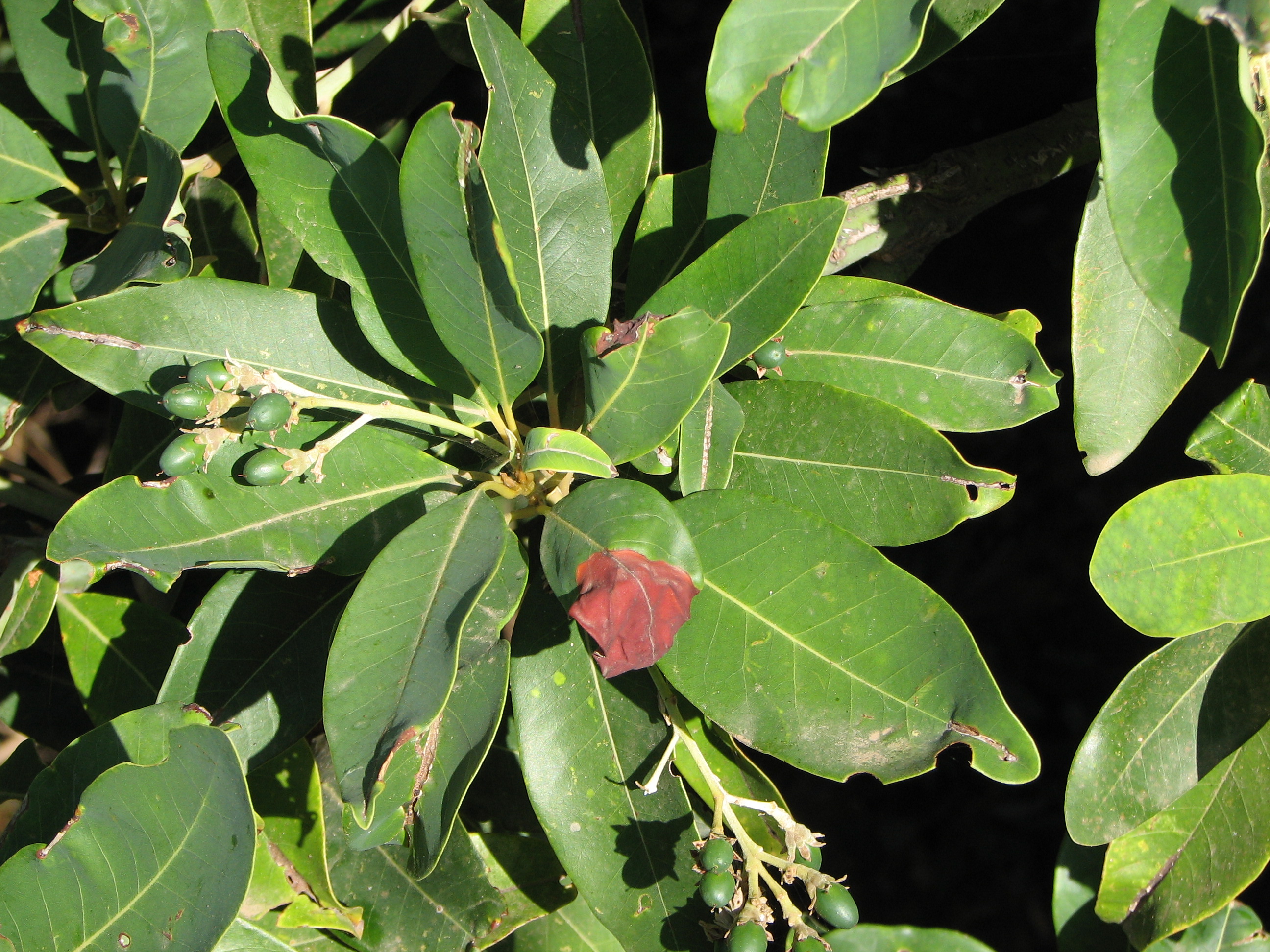
Persea is a genus of approximately 111 species of evergreen trees in the laurel family Lauraceae, placed in the order Laurales. The genus is best known for the avocado (P. americana), widely cultivated across subtropical regions for its large, edible fruit, but the majority of species are wild forest trees of little direct commercial importance.
Members of the genus are medium to large evergreen trees with simple, alternately arranged leaves and small, inconspicuous flowers typical of the Lauraceae. Like other laurels, they produce fleshy, one-seeded drupes that serve as important food sources for wildlife, particularly frugivorous birds.
The distribution of Persea is strongly Neotropical, with roughly 109 species spanning Argentina and Chile northward through Central America, Mexico, and the Caribbean. Two outlier species—P. indica and P. barbujana—survive as relicts in the fog-shrouded mountains of the Canary Islands and Madeira, remnants of a broader Laurasian range that contracted following Oligocene–Pleistocene aridification. Fossil evidence suggests the genus originated in West Africa during the Paleocene before spreading to Asia, South America, and Europe.
The genus was formally described by Philip Miller in 1754, taking its name from the Greek Περσέα, a term used by Theophrastus and Hippocrates for an uncertain Egyptian tree, possibly Cordia myxa or a Mimusops species.
Etymology
The name Persea was applied by Philip Miller in 1754, derived from the Greek Περσέα—a word used by Theophrastus and Hippocrates for an unidentified Egyptian tree, tentatively identified as Cordia myxa or a Mimusops species.
Distribution
Persea has a predominantly Neotropical distribution, with about 109 species ranging from Argentina and Chile through South America, Central America, Mexico, and the Caribbean. Two species (P. indica and P. barbujana) occur as Macaronesian relicts in the Canary Islands and Madeira. No species tolerates severe winter cold; all require continuously moist soil.
Ecology
In Mesoamerica, wild Persea species produce small berries (aguacatillo) that are a critical food source for the resplendent quetzal, whose migratory movements between forest elevations track the sequential fruiting of different species. Persea foliage also supports larvae of certain Lepidoptera, including Coleophora octagonella, which feeds exclusively on P. carolinensis. Many species occupy laurel forest habitat that is increasingly threatened by agricultural encroachment and deforestation.
History
Fossil evidence indicates Persea originated in West Africa during the Paleocene, subsequently dispersing to Asia, South America, Europe, and North America via land bridges and island chains. Progressive drying from the Oligocene through Pleistocene, combined with glaciation of Europe, eliminated the genus from most of its original range, leaving only the Macaronesian outliers and the large Neotropical radiation that survives today.
Cultural Uses
The avocado (P. americana) is the genus's dominant economic species, cultivated globally in subtropical regions for its nutritious fruit. Other species in the genus have limited local timber and food uses across their Neotropical range.










