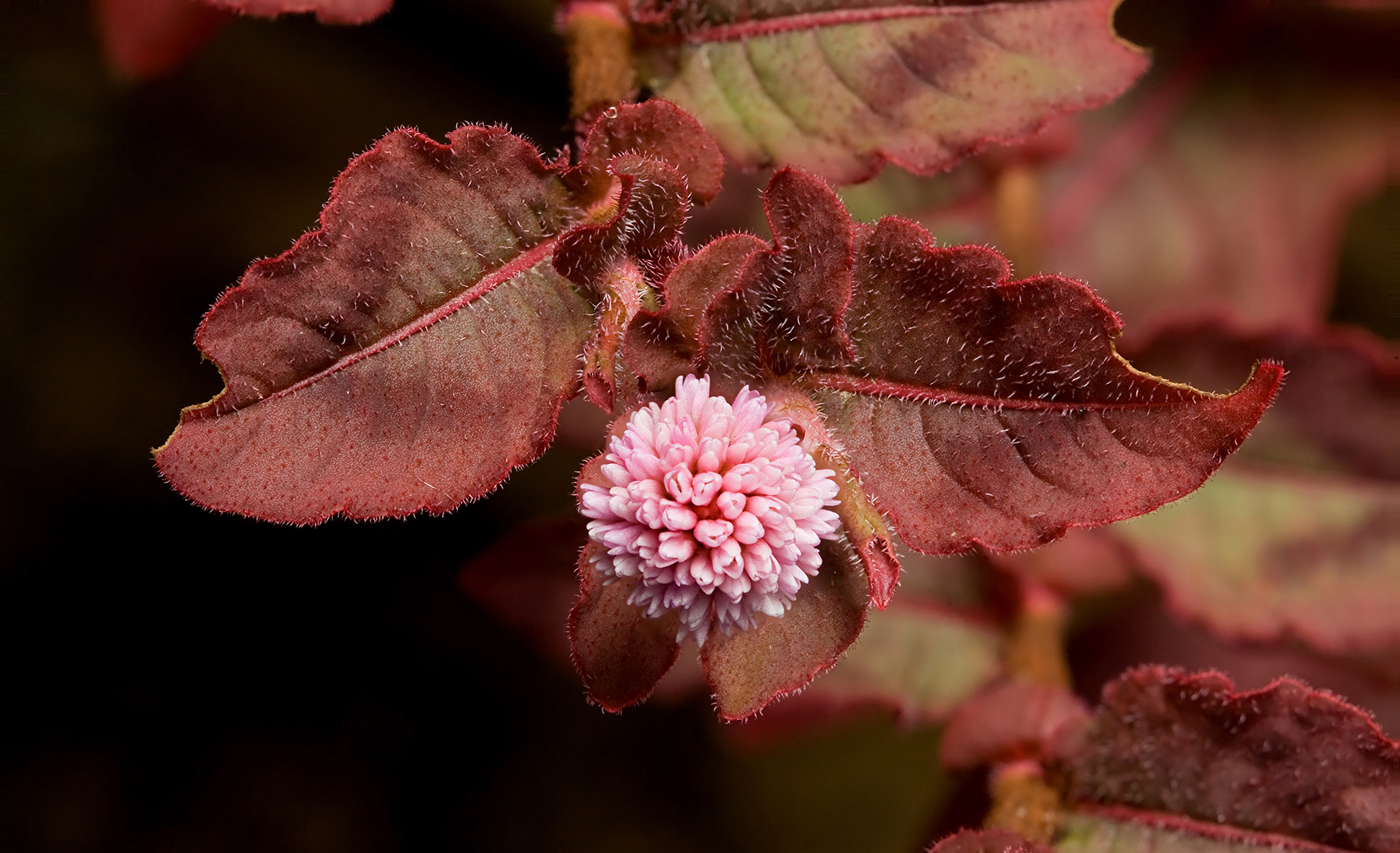
Persicaria is a cosmopolitan genus of flowering plants in the buckwheat family (Polygonaceae), order Caryophyllales. It comprises roughly 132 to 140 accepted species depending on the checklist consulted, and was segregated from the much larger genus Polygonum as molecular and morphological evidence accumulated. The genus name derives from the Latin persica, meaning peach, in reference to the willowy, peach-like shape of the leaves of many of its members. Common names attached to the group include knotweed, smartweed, mountain fleece, and tearthumb.
Members of Persicaria are annual or perennial herbs with taproots, fibrous root systems, rhizomes, or stolons. Stems may stand erect, sprawl across the ground, or even float in shallow water in the case of amphibious species. Leaves are alternate and deciduous, often lance-shaped, and where the petiole meets the stem the genus produces a distinctive sheath called an ocrea, typically brownish or reddish in tone. This ocrea is one of the most reliable field characters for the family. The small flowers, white, greenish, pink, red, or purple, are clustered in dense terminal or axillary spikes or panicles that can be eye-catching despite the size of each individual bloom. Each pollinated flower develops into a small dry achene.
The genus is distributed almost worldwide. Species occur across Africa, Asia, Europe, North and South America, and Oceania, occupying habitats from wet meadows, marshes, and stream margins to disturbed roadsides and cultivated fields. In the southwestern United States alone, regional checklists record more than fifty species. The aquatic and semi-aquatic habit of several species, including Persicaria amphibia and Persicaria hydropiper, ties the genus closely to wetland ecology, while species such as Persicaria capitata have become widespread ornamentals and naturalised colonists of disturbed ground in warm-temperate regions.
Several Persicaria species have notable economic and cultural value. Persicaria odorata, Vietnamese coriander, is grown as a culinary herb across Southeast Asia, with young leaves used fresh in salads, rice dishes, and vegetable preparations for a flavour reminiscent of coriander but sharper. Persicaria tinctoria, Chinese indigo, has long been cultivated for the blue dye extracted from its leaves. Persicaria hydropiper, water-pepper, has a peppery taste that has historically given it both culinary and medicinal use. In gardens, cultivars of Persicaria amplexicaulis such as 'Firetail' and 'Golden Arrow', Persicaria microcephala 'Red Dragon', Persicaria affinis 'Superba', and the variegated Persicaria 'Painter's Palette' are grown for their long flowering season, ease of culture in moist soil, and bold foliage. Taxonomically, modern treatments have absorbed earlier segregate genera such as Tovara, Tracaulon, and Truellum into Persicaria, reflecting a broader phylogenetic understanding of the smartweeds.
Etymology
The genus name Persicaria comes from the Latin persica, meaning peach, a reference to the elongated peach-like shape of the leaves seen in many members of the group. The name was formally taken up at genus rank by Philip Miller in the fourth edition of the Gardeners' Dictionary in 1754, segregating these species from the broad Linnaean concept of Polygonum.
Distribution
Persicaria has an essentially cosmopolitan distribution, with species native across Africa, Asia, Europe, North America, South America, and Oceania. The POWO range list for the genus spans the alphabet from Afghanistan to Zimbabwe. Many species favour moist habitats such as wet meadows, stream margins, marshes, and disturbed ground near water. Regional floras reflect this breadth: SEINet records over fifty Persicaria species in the southwestern United States alone, including widespread taxa such as Persicaria amphibia, Persicaria hydropiper, Persicaria hydropiperoides, and Persicaria lapathifolia. Persicaria odorata, by contrast, has a more restricted native range across mainland Southeast Asia, including Cambodia, Laos, Thailand, Vietnam, and Malaysia, where it has long been cultivated.
Taxonomy
Persicaria sits in the family Polygonaceae within the order Caryophyllales. The accepted name is Persicaria (L.) Mill., first published in Miller's Gardeners' Dictionary, Abridged Edition 4, in 1754. POWO currently accepts 140 species in the genus and lists 19 synonyms, including the historical segregate genera Tovara, Tracaulon, and Truellum, all now consolidated under Persicaria. Wikipedia cites 132 accepted species as of November 2023, a slightly lower count that reflects the ongoing flux in smartweed taxonomy following the breakup of the traditional broad concept of Polygonum. GBIF reports 293 descendant taxa under the genus, indicating substantial infrageneric and synonym-level diversity. The IPNI identifier for the genus is urn:lsid:ipni.org:names:60433517-2.
Cultivation
Many Persicaria species are grown as garden perennials, valued for long flowering seasons, bold foliage, and adaptability to moist soils. Missouri Botanical Garden's Plant Finder lists several common ornamentals: Persicaria affinis 'Superba' (a low groundcover, USDA zones 5–8, around 0.5–1 ft tall), Persicaria amplexicaulis 'Firetail' (mountain fleece, zones 4–7, 3–4 ft) and the related 'Golden Arrow' (zones 4–7, 2–3 ft), Persicaria microcephala 'Red Dragon' (zones 6–8, 2–2.5 ft), a "clump-forming sterile cultivar which lacks the spreading stoloniferous characteristics" of the species, the variegated Persicaria 'Painter's Palette' (zones 4–8, 1.5–2 ft), and the tender culinary Persicaria odorata (zones 9–11). Persicaria odorata thrives in moist or wet soils and tolerates a wide range of textures from sandy to clay. The hardier ornamental species are generally grown in sun to part shade in moist, fertile soil; some, such as P. amplexicaulis cultivars, form clumps suitable for borders, while spreading species like P. capitata and unselected P. microcephala can colonise rapidly via stolons or rhizomes and may need siting with that vigour in mind.
Cultural & Economic Uses
Several species in the genus carry significant culinary, dye, and medicinal traditions. Persicaria odorata, Vietnamese coriander or Asian mint, is widely grown across Southeast Asia for its young leaves, which are used raw or cooked as a flavouring with a coriander-like but sharper, spicier note in salads, rice dishes, and vegetable preparations; the flavour is best fresh, as it diminishes with prolonged cooking. The same species has a deep traditional medicinal record: leaves used as "a diuretic, stomachic, febrifuge and anti-aphrodisiac", with fresh leaf juice reported as an antidote to snake venom and crushed leaves applied externally for fever and skin conditions. Persicaria tinctoria, Chinese indigo, is cultivated for the blue dye extracted from its leaves. Persicaria hydropiper, water-pepper, is named for its peppery taste and has been used both as a flavouring and in folk medicine across its broad range.










