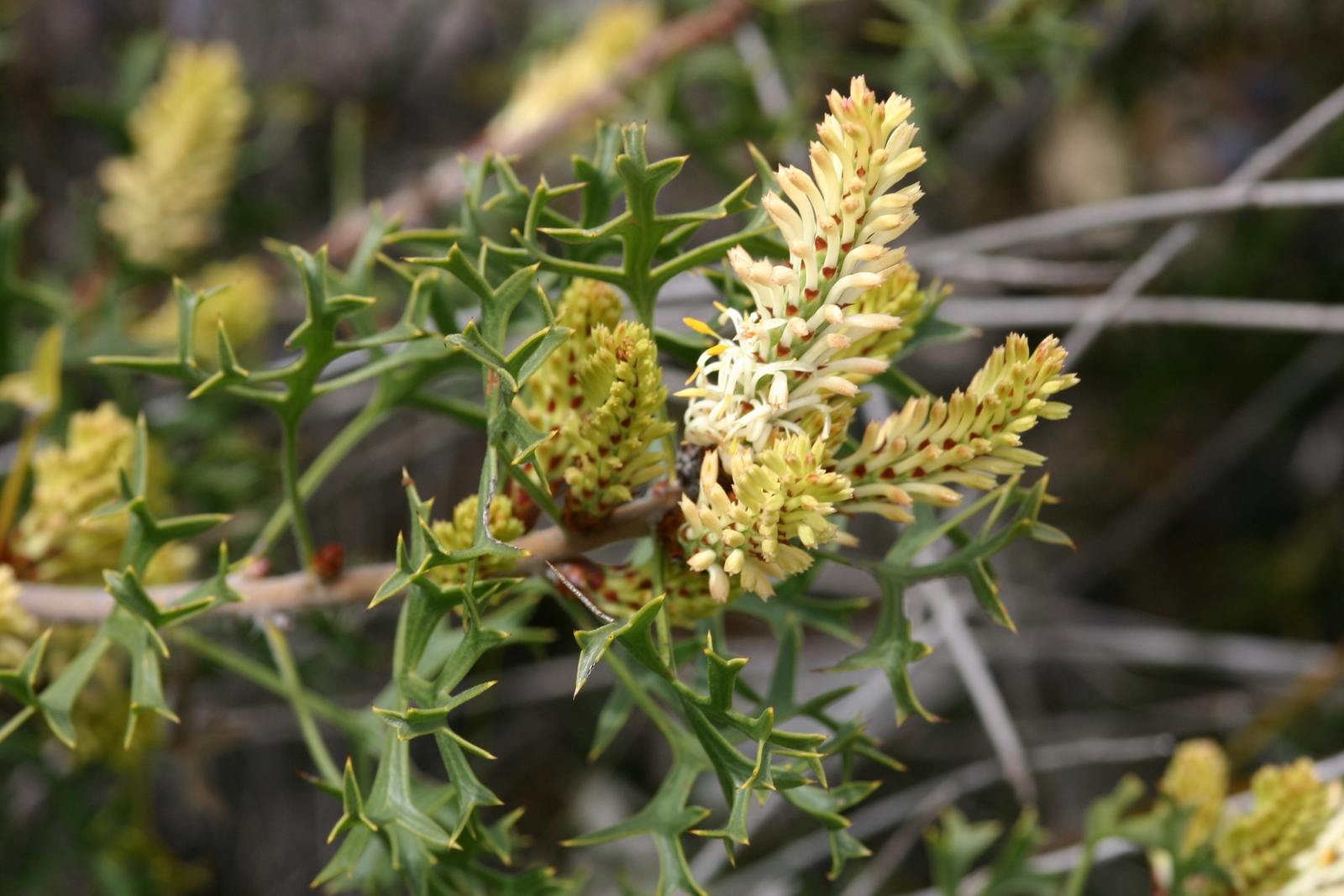
Petrophile, commonly known as conebushes, is a genus of approximately 100 species of evergreen shrubs in the family Proteaceae (order Proteales), endemic to Australia. The genus was first formally described in 1809 by Joseph Knight, with Robert Brown later validating the name in 1810 in Transactions of the Linnean Society of London.
Plants in the genus are typically compact to medium shrubs bearing stiff, prickly, finely divided leaves — a characteristic that distinguishes them from many other proteaceous shrubs. Flowers are prominently displayed in shades of pink, yellow, or cream, making many species attractive ornamentals. After flowering, plants produce distinctive grey, conical fruits that give rise to the common name "conebush."
The genus is predominantly found in Western Australia, where the nutrient-poor sandy and gravelly soils of the southwest support the greatest diversity of species. A smaller number of species extend into South Australia, New South Wales, and Queensland. Several species are cultivated in Australian gardens for their ornamental flowers and tolerance of dry conditions, and some have found use in the cut-flower trade.
Etymology
The genus name Petrophile derives from the Greek words petra (rock) and philos (seeking or preferring), a reference to the rocky habitats in which a number of species naturally grow.
Distribution
Petrophile is endemic to Australia, with the great majority of species occurring in Western Australia. Smaller numbers of species are distributed across South Australia, New South Wales, and Queensland.
Cultivation
Plants in this genus require freely draining soil and tolerate periods of drought as well as mild frosts. They perform well in full sun or part shade. Propagation is possible from cuttings taken in autumn or from seed, though new plants established by either method can be slow to develop.

