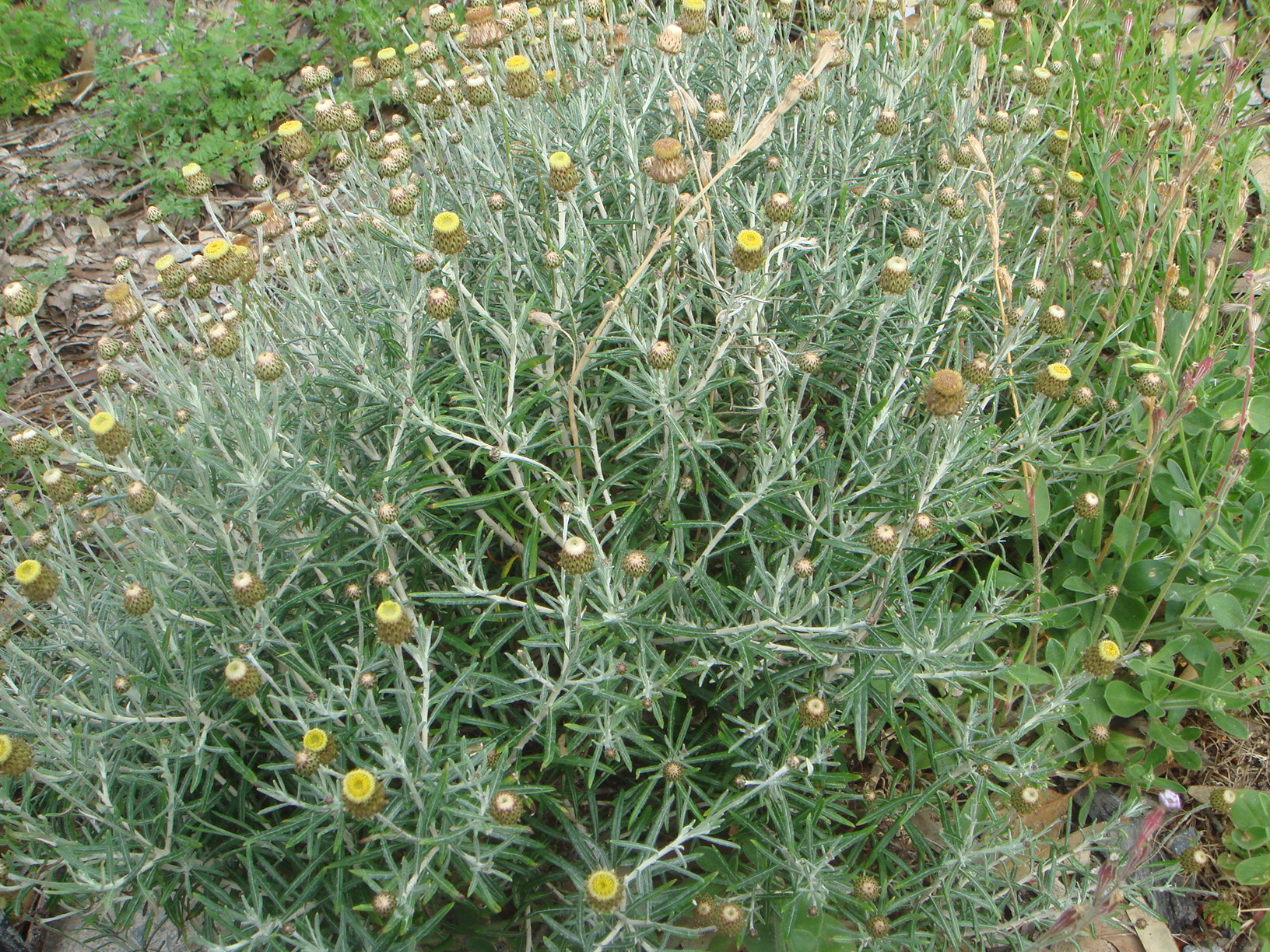
Phagnalon is a genus of perennial flowering plants in the daisy family (Asteraceae), order Asterales, comprising approximately 32 accepted species. The genus was described in 1819 by the French botanist Alexandre Henri Gabriel de Cassini, who placed it in the tribe Inuleae; the type species is Phagnalon saxatile, originally named by Carl von Linné in the genus Conyza.
Plants in this genus are herbaceous or, occasionally, small subshrubs. The stems contain phloem fibres but lack pericyclic cambium and resin canals. Leaves are generally sessile and sparsely hairy, with margins that are often toothed and revolute (rolled downward). The flowerheads (capitula) are solitary or borne in small clusters; they are heterogamous and disciform, with yellow, bisexual disc florets. The phyllaries (bracts surrounding the flowerhead) are cartilaginous, often with a papulose apical portion, and arranged in several rows more numerous than the disc florets. Fruits are achenes with two to three vascular bundles, sparsely hairy with elongated twin hairs; each achene is topped by a single row of barbellate capillary pappus hairs with acute tips.
The genus is native to the Mediterranean Basin and extends through the Middle East east to the Himalayas and Tibet, and south through northeastern Africa to Ethiopia. It is a characteristic element of Mediterranean scrubland and rocky habitats across southern Europe, North Africa, and Western Asia.
Etymology
The genus Phagnalon was established in 1819 by the French botanist Alexandre Henri Gabriel de Cassini. Cassini originally placed it within the family Synanthereae, tribe Inuleae, section Gnaphalieae. The synonym Gnaphalon Lowe reflects the close morphological relationship Cassini perceived with the genus Gnaphalium.
Distribution
Phagnalon is distributed across the Mediterranean region and Middle East, ranging west to Portugal, north to metropolitan France, south to Ethiopia, and east to Tibet and the Himalayas. It occurs in southern Europe, North Africa, northeastern Tropical Africa, and Western Asia including the Arabian Peninsula.
Taxonomy Notes
The genus was described by Alexandre Henri Gabriel de Cassini in 1819 and originally placed in the tribe Inuleae, section Gnaphalieae of the family Synanthereae (now treated within Asteraceae). The type species is Phagnalon saxatile (L.) Cass., whose epithet saxatile refers to rocky habitats. The genus name Gnaphalon Lowe is a synonym. Approximately 32 species are currently accepted, along with several interspecific hybrids.










