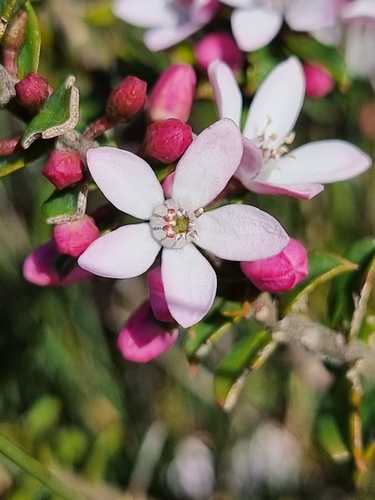
Philotheca is a genus of approximately fifty species of flowering shrubs in the family Rutaceae (citrus family), order Sapindales. All species are endemic to Australia, where representatives occur in every state except the Northern Territory.
Plants in the genus are either hairless (glabrous) or bear tiny simple hairs. The leaves are simple, narrow oblong to almost cylindrical, and arranged alternately along the stems. Flowers are borne singly or in clusters in leaf axils or at the tips of branchlets. Each flower typically has five sepals, five petals that overlap at the base, and ten stamens that curve inward over the ovary; the anthers bear a small appendage called the apiculum. The ovary consists of five carpels fused near their bases, and the 2–5 mm seeds are released explosively from their capsules.
Philotheca was first formally described in 1816 by the English botanist Edward Rudge from a specimen collected near Port Jackson (Sydney) and published in the Transactions of the Linnean Society of London. The genus originally encompassed species now known under the name Eriostemon, and a significant reclassification transferred many Eriostemon species into Philotheca. With around 70 species accepted by GBIF, it represents one of the more species-rich shrub genera of the Australian flora.
Etymology
The name Philotheca was recorded as a probable misnomer. According to Wikipedia, it should have been written Psilotheca, from the Ancient Greek psilos ("bare", "smooth", "bald", or "naked") and theke ("case", "container", "envelope", or "sheath"), a reference to the smooth tube of the stamens.
Distribution
All species of Philotheca are endemic to Australia. The genus is represented in every Australian state but is absent from the Northern Territory.
Taxonomy Notes
Philotheca was first formally described in 1816 by Edward Rudge, based on a specimen from near Port Jackson (Sydney), with the description published in the Transactions of the Linnean Society of London. The first species Rudge named, P. australis, is now treated as a nomen illegitimum and a synonym of Philotheca salsolifolia by the Australian Plant Census. Many species formerly placed in the genus Eriostemon have since been transferred to Philotheca following taxonomic revision.










