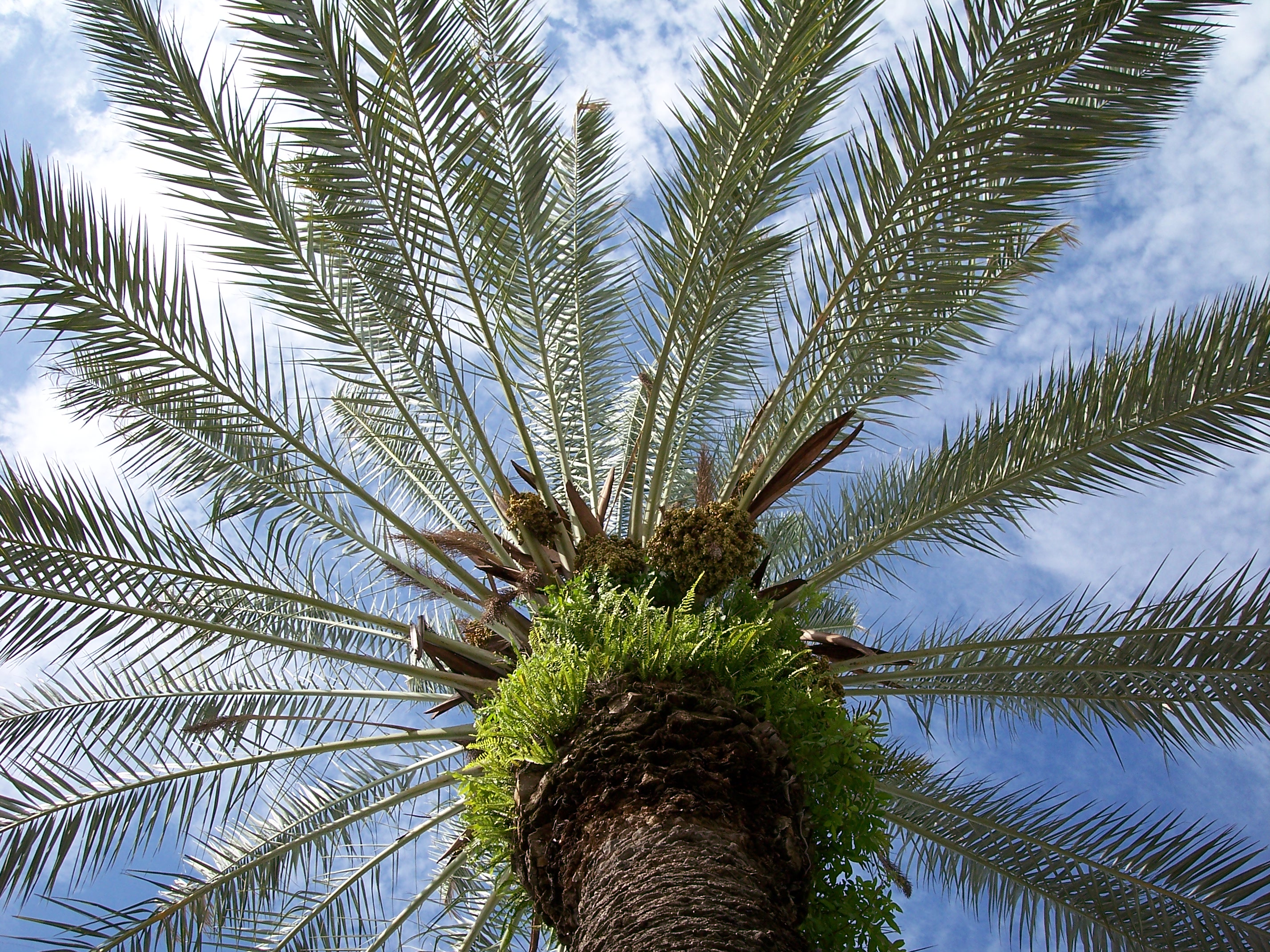
Phoenix is a genus of 14 palm species in the family Arecaceae (subfamily Coryphoideae, tribe Phoeniceae), ranging from medium to robust in stature, with some dwarf forms. They are instantly recognizable by their pinnate, arching leaves, which can reach 1–6 metres in length; the lower leaflets are metamorphosed into stiff, sharp spines that protect the base of each frond.
All Phoenix palms are dioecious — male and female flowers are borne on separate individuals — with inconspicuous yellowish-brown flowers arranged in large panicles. The fruit is a berry developing from a single carpel, 1–7 cm long, turning yellow, red-brown, or dark purple at maturity. In the best-known species, P. dactylifera, these fruits are the familiar sweet dates of commerce.
Species in the genus reproduce both by seed and by vegetative offshoots (bulbils). Because the species are closely related, natural hybrids form readily where ranges overlap. The group has ancient roots: fossil evidence from India and France places Phoenix in the fossil record as far back as the Paleocene.
The genus is economically and culturally extraordinary. P. dactylifera, the date palm, has been cultivated in the Middle East and South Asia for at least 7,000 years and remains one of the world's important fruit crops. P. canariensis, the Canary Island date palm, is a familiar ornamental planted in parks and boulevards across temperate and subtropical regions worldwide. Other species contribute starch from their stem pith as a food source in South Asia. Together, Phoenix palms rank among the most historically significant plants in human civilization.
Etymology
The genus name Phoenix is taken directly from the ancient Greek φοῖνιξ (phoinix). Classical scholars proposed several referents: the Phoenicians of the eastern Mediterranean coast, the Homeric figure Phoenix (son of Amyntor and Cleobule in Homer's Iliad), or the legendary phoenix bird sacred in ancient Egypt. The specific connection to the Phoenicians is especially plausible given that the date palm was a signature trade commodity of the Levant in antiquity.
The most economically important species, P. dactylifera, carries an additional layer of etymology: its species epithet comes from Greek daktylos (δάκτυλος, meaning "date" or "finger") combined with Latin fero ("to bear"), an allusion to the finger-like shape of the fruit.
Distribution
The natural range of Phoenix extends from the Canary Islands in the Atlantic eastward across North Africa, into southern Europe (notably Crete, where P. theophrasti is endemic), through Asia Minor, the Middle East, and the Indian subcontinent, reaching as far as southern China and Malaysia. Most species are adapted to semi-arid or seasonally dry environments and characteristically grow near reliable water sources — rivers, springs, oases, or shallow groundwater — rather than in fully arid desert interiors. P. reclinata is the most widespread African species, extending across sub-Saharan Africa.
Several species, particularly P. canariensis and P. dactylifera, have been introduced far beyond their native ranges through cultivation and have naturalized in Mediterranean climates worldwide, including parts of southern Europe, California, South Africa, and Australia.
Ecology
Phoenix palms occupy niches in semi-arid landscapes where subsurface or seasonal water is accessible. They are characteristically found along wadis, riverbeds, coastal dunes, and rocky hillsides with seasonal seepage. Their deep root systems allow them to exploit groundwater unavailable to most other vegetation.
Reproduction occurs both by seed and by lateral vegetative offshoots called bulbils, which can give rise to multi-stemmed clumps in some species (notably P. reclinata). Because the 14 species share close genetic relationships, natural hybrids arise readily wherever two species grow in proximity. Several nothospecies — including Phoenix ×intermedia and Phoenix ×nabonnandii — are formally recognized in taxonomic literature.
Taxonomy
Phoenix L. was formally described by Linnaeus in Species Plantarum (1188) in 1753. The genus belongs to the order Arecales, family Arecaceae, subfamily Coryphoideae, tribe Phoeniceae — a monogeneric tribe, meaning Phoenix is the sole genus in Phoeniceae. GBIF recognizes the genus as accepted and lists 31 infrageneric taxa (species and nothospecies). The species count in current authoritative treatments is typically cited as 14 accepted species; higher numbers reflect synonyms and historically described variants not accepted by current monographers.
The species are notably interfertile; two accepted hybrid nothospecies, Phoenix ×intermedia and Phoenix ×nabonnandii, are formally recognized, and additional undescribed hybrids occur in cultivation and in areas of overlapping natural range.
History
The cultivation of Phoenix dactylifera is among the earliest and most sustained in human history. Archaeological evidence documents date palm cultivation at Mehrgarh in present-day Pakistan around 7000 BCE, and in eastern Arabia between approximately 5530 and 5320 calBC. The ancient Egyptians used dates for wine and food, and Phoenician traders carried the crop westward through North Africa and into Iberia. Spanish missionaries brought date palms to California by 1769 and to Mexico during the 16th century.
At the genus level, fossil pollen and leaf impressions place Phoenix in the Paleocene, with ancient specimens recovered from India and France, indicating a wide early distribution that has since contracted to its present range.
Cultivation
Phoenix canariensis is among the most widely planted ornamental palms in the world, valued for its graceful crown and tolerance of mild frost; it has naturalized across multiple continents through horticulture. P. dactylifera is the primary commercial species: mature trees yield 70–140 kg of dates annually, though commercial orchards require 7–10 years of establishment before productive harvests begin.
Many Phoenix species tolerate dry conditions once established but perform best with reliable moisture at the root zone. Their dioecious nature means both male and female plants are needed for fruit production. Propagation is typically by seed or by removal and replanting of basal offshoots (bulbils).
Propagation
Phoenix palms can be propagated by two main routes. Seed propagation is straightforward — fresh seed germinates reliably — but seedlings are slow-growing and, because the species are dioecious, sex cannot be determined until flowering, which may take several years. Vegetative propagation via basal offshoots (bulbils) is preferred for commercial date production: offshoots are genetically identical to the mother plant, sex is known, and bearing age is reached sooner. Bulbil removal and replanting is most successful during spring when offshoots are young. Not all species produce abundant offshoots; single-stemmed species such as P. canariensis and P. dactylifera produce fewer than clustering species like P. reclinata.
Cultural Uses
The date palm (P. dactylifera) has exceptional cultural and religious significance across the Middle East, North Africa, and South Asia. Dates are referenced more than 50 times in the Bible and 20 times in the Quran. The date palm is counted among the Seven Species associated with the Land of Israel in Jewish tradition, and palm fronds (lulav) play a central role in the Sukkot festival. In ancient Rome, palm fronds were the symbol of military victory carried in triumphal processions.
Economically, global date production reached 9.9 million tonnes in 2024, with Saudi Arabia, Egypt, Algeria, and Iran together accounting for 63% of output. Beyond fresh fruit, dates are processed into syrups, pastes, vinegar, and fermented beverages; seeds are used as animal feed and in cosmetics; structural parts of the plant serve as building and craft materials across the date-palm belt. In South Asia, the starchy pith of P. rupicola, P. acaulis, and P. humilis is extracted and processed into bread.

