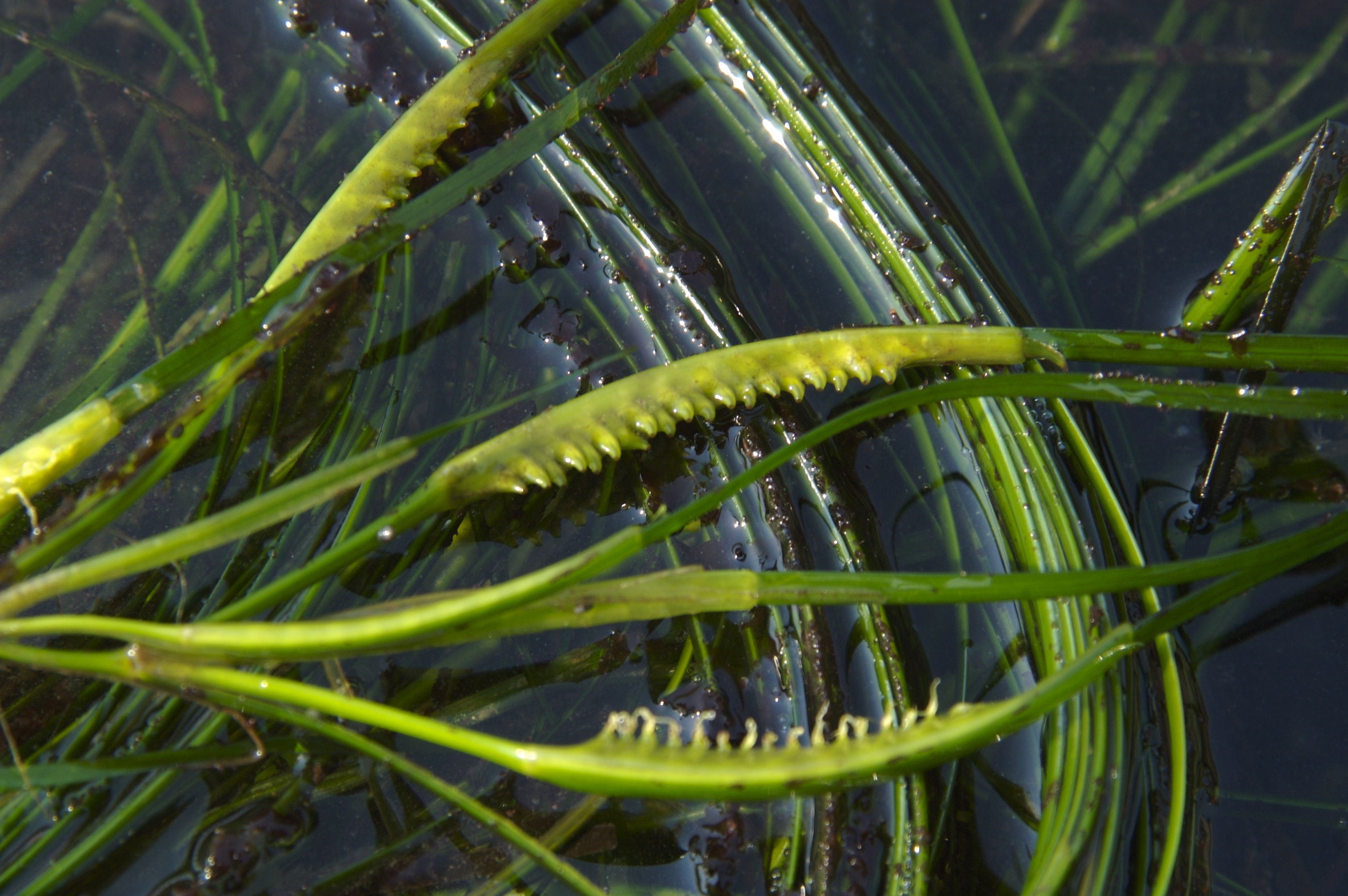
Phyllospadix, commonly known as surfgrass, is a genus of five species of seagrass in the family Zosteraceae (order Alismatales). Unlike most seagrasses, which grow in sandy or muddy sediments in sheltered bays, surfgrasses are adapted to wave-exposed, rocky substrates along the coasts of the temperate North Pacific — the only seagrass genus to occupy this niche. The genus was described in 1840 and contains five accepted species distributed across the Pacific Rim, from the Russian Far East, Japan, Korea, and China in the west, to Alaska, British Columbia, Washington, California, and Baja California in the east.
As true flowering plants (angiosperms), Phyllospadix species produce flowers, pollen, and seeds entirely underwater. The genus is one of a small number of seagrass genera capable of fully submerged, or hydrophilous, pollination — pollen is released directly into the water column and carried to receptive flowers without any aerial phase. The strap-like leaves are anchored to rock by rhizomes and holdfasts, forming dense intertidal and subtidal meadows that provide critical habitat for juvenile fish, invertebrates, and marine algae. Phyllospadix scouleri is the type species of the genus.
Distribution
Phyllospadix is restricted to the temperate North Pacific. Western Pacific species (P. iwatensis, P. japonicus) occur in Japan, Korea, China, and the Russian Far East. Eastern Pacific species (P. scouleri, P. torreyi, P. serrulatus) range from Alaska and British Columbia south to Baja California and northwestern Mexico. All species occupy wave-exposed rocky shores, typically in the intertidal and shallow subtidal zones.
Ecology
Surfgrasses grow attached to hard rock substrates in high-energy, wave-swept coastal environments — a habitat largely unavailable to other seagrass genera. Their dense leaf canopies form important marine meadows that shelter juvenile fish and invertebrates, reduce sediment movement on rocky reefs, and support epiphytic algae communities. Phyllospadix is one of the few flowering plant genera to achieve fully submerged hydrophilous pollination, releasing pollen directly into the water column.
Taxonomy Notes
Phyllospadix belongs to the family Zosteraceae (order Alismatales, class Magnoliopsida), the same family as the closely related genus Zostera (eelgrass). It was described as a genus in 1840. GBIF recognizes five accepted species. The type species is Phyllospadix scouleri.

