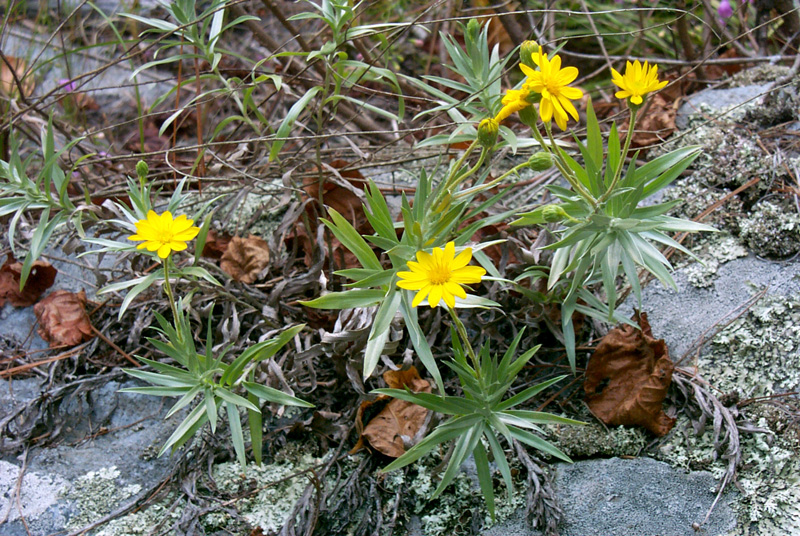
Pityopsis is a genus of flowering plants in the family Asteraceae (tribe Astereae), comprising roughly 8–10 species of perennial herbaceous plants native to North America. The genus is commonly known by the names silkgrass, golden asters, or grass-leaved goldenasters, reflecting both the narrow, grass-like leaves characteristic of most members and the bright yellow daisy-like flower heads they produce.
Plants in this genus typically grow in well-drained, often sandy or rocky soils, and are particularly associated with open habitats such as pine barrens, sandhills, and dry grasslands across the southeastern United States. The foliage is frequently silky or silvery in appearance due to a covering of fine hairs, giving rise to the common name silkgrass.
The distribution of the genus is centered in the southeastern United States, with most species concentrated in states such as Florida, Georgia, Alabama, and the Carolinas. Pityopsis graminifolia, the most widespread member, extends beyond the United States into Mexico (Chiapas, Oaxaca, Veracruz, Tamaulipas), Belize, Honduras, and the Bahamas. At the other extreme, Pityopsis ruthii — known as Ruth's golden aster — is one of North America's rarest plants, confined to a handful of sites along the Hiwassee and Ocoee rivers in Tennessee and listed as an endangered species.
Etymology
The name Pityopsis derives from Greek, combining pitys (pine) and opsis (resemblance or appearance), likely alluding to the pine-needle-like, narrow leaves of many species in the genus. The common name silkgrass similarly refers to the silky, grass-like foliage.
Distribution
Pityopsis species are native to North America, with the genus concentrated in the southeastern United States — particularly Florida, Georgia, Alabama, Mississippi, Louisiana, South Carolina, and North Carolina. Pityopsis graminifolia has the broadest range, extending into Texas, Virginia, Maryland, Delaware, West Virginia, Ohio, Kentucky, Tennessee, Arkansas, Oklahoma, and south into Mexico, Belize, Honduras, and the Bahamas. Pityopsis falcata reaches as far north as Ontario (Canada), New York, Massachusetts, Connecticut, Rhode Island, and New Jersey. Pityopsis ruthii is narrowly endemic to riparian sites in Tennessee.
Ecology
Members of Pityopsis are characteristically plants of open, nutrient-poor habitats — pine barrens, sand scrub, dry grasslands, sandhills, and rocky outcrops. Their tolerance of dry, sandy, or acidic soils with low organic content allows them to persist in communities where more competitive species are excluded. Pityopsis ruthii is specifically associated with rocky riverbanks along swift-flowing streams in the Tennessee River system.
Conservation
Pityopsis ruthii (Ruth's golden aster) is federally listed as an endangered species in the United States, with a highly restricted range limited to a small number of rocky streambank sites along the Hiwassee and Ocoee rivers in Polk and Bradley counties, Tennessee. Its habitat is vulnerable to altered river flow, flooding, and bank disturbance.










