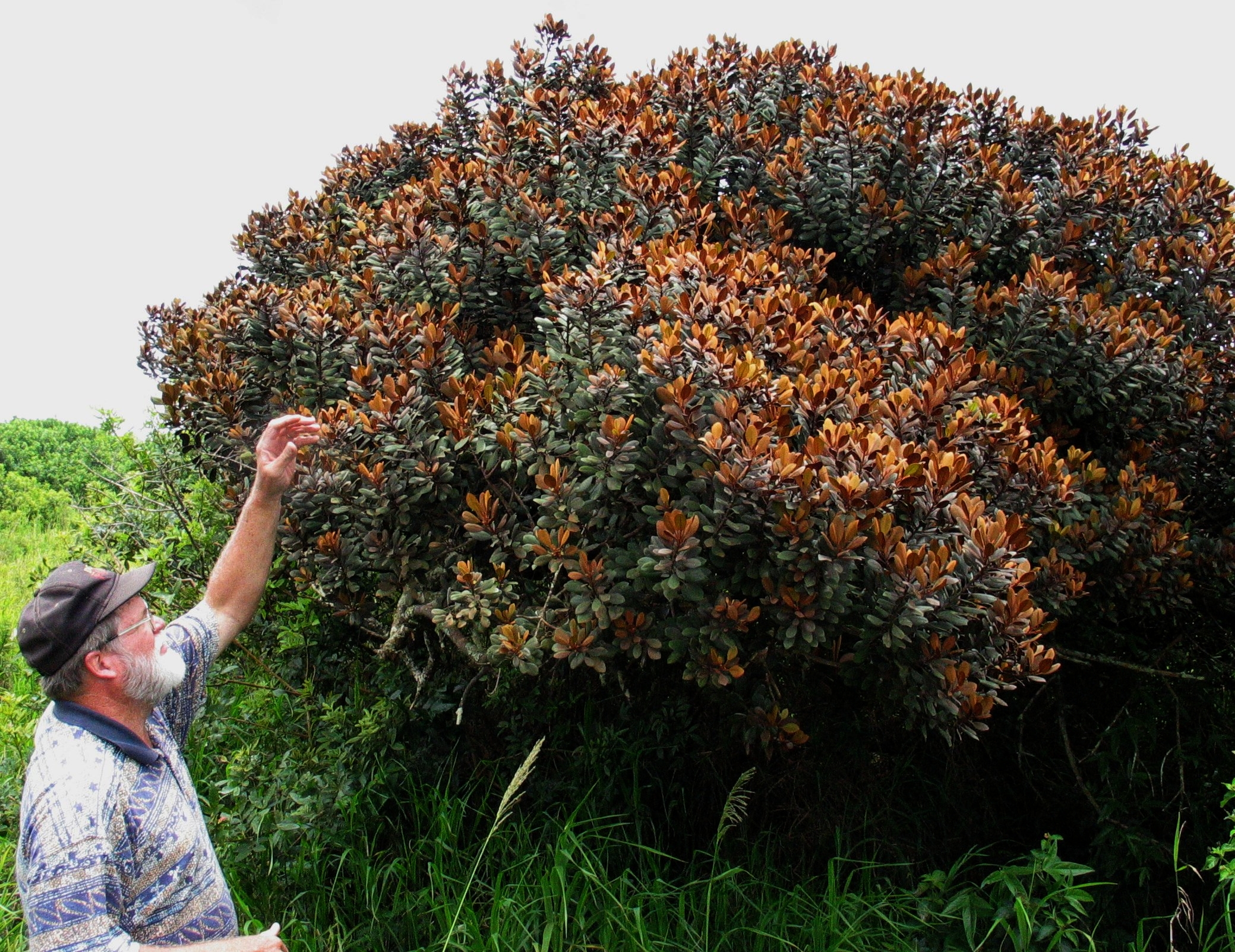
Planchonella is a genus of flowering trees and shrubs in the family Sapotaceae (the gutta-percha family), placed in the order Ericales. The genus contains around 110 mainly tropical species distributed across a broad Indo-Pacific arc, from the Seychelles through Southeast Asia and New Guinea to northern and eastern Australia, New Zealand, and the Pacific Islands. The greatest concentration of species occurs in New Caledonia and New Guinea.
Members of the genus vary considerably in size but share a recognisable set of vegetative and floral characters. The leaves are typically alternate, simple, and entire, with clearly marked venation. Flowers are small, with five-lobed, short, tubular corollas. A useful diagnostic feature is stamen attachment: in Planchonella the stamens insert on the corolla tube just below its opening, distinguishing it from the closely related genus Pichonia (stamens at the tube orifice) and Pleioluma (stamens near the base).
The type species is Planchonella obovata. The genus was described by French botanist Jean Baptiste Louis Pierre in 1890 and named in honour of fellow French botanist Jules Émile Planchon. Its taxonomic history has been turbulent: Planchonella has repeatedly been synonymised into the broadly circumscribed genus Pouteria before being reinstated. In 2007 it was re-established as a valid genus on the basis of a combined analysis of ITS sequence data and morphology.
Etymology
The genus name honours Jules Émile Planchon (1823–1888), a prominent French botanist best known for his work on viticulture and plant taxonomy. It was formally described by Jean Baptiste Louis Pierre in 1890.
Distribution
Planchonella species are distributed across the tropical Indo-Pacific, from the Seychelles eastward through Southeast Asia, New Guinea, northern and eastern Australia, New Zealand, and the Pacific Islands. Species richness peaks in New Caledonia and New Guinea.
Taxonomy Notes
Planchonella has a complex synonymic history, having been repeatedly absorbed into the large tropical genus Pouteria and later segregated again. The genus was conclusively reinstated in 2007 following a molecular phylogenetic study combining ITS sequence data with morphological evidence. It is distinguished from close relatives Pichonia and Pleioluma primarily by the position of stamen insertion on the corolla tube.










