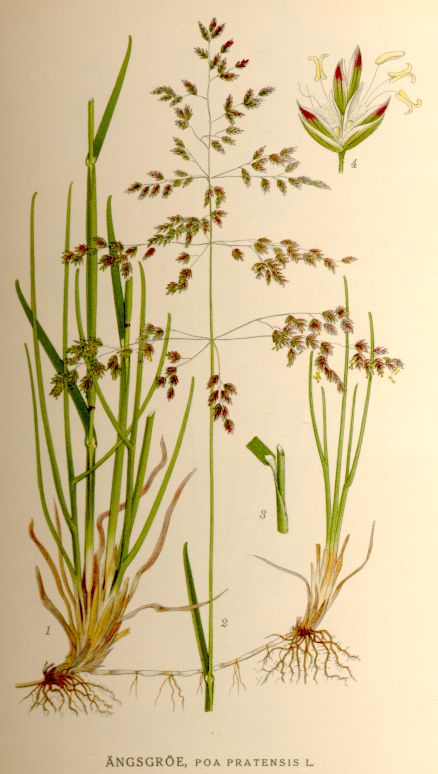
Poa L. is a large genus of annual and perennial grasses in the family Poaceae (subfamily Pooideae, tribe Poeae), comprising approximately 570 species distributed across temperate regions of both hemispheres. Established by Carl Linnaeus in 1753, the genus is commonly known as bluegrasses or meadow-grasses — names that reflect both the characteristic blue tint of the seed heads when plants reach their natural height of two to three feet, and their prevalence in meadow habitats.
Plants are morphologically distinguished by narrow leaves that fold or lie flat, with a characteristic boat-shaped (hooded) leaf tip. The basal sheaths are flattened or thickened, and the ligule is membranaceous. Spikelets are laterally compressed and 2-to-several-flowered, with lemmas that are keeled, 5-veined, and in many species bearing a distinctive web of cobwebby hairs at their base. Panicles may be open or contracted. Most species are monoecious; a smaller number are dioecious.
The genus is taxonomically complex: many species form polyploid series, and apomixis (asexual seed production) is widespread, generating swarms of morphologically similar taxa that blur species boundaries. GBIF records over 1,000 descendent taxa, while more conservative treatments recognise approximately 500–570 species. Common English names include bluegrass and meadow-grass; French: Pâturin; German: Rispengras; Danish: Rapgræs.
Etymology
The genus name Poa is derived from the ancient Greek word πόα (poa), meaning "fodder" or grass used as animal feed. The Greek term reflected the primary economic role of these grasses in antiquity — providing grazing and cut fodder for livestock — a role the genus continues to fulfil across temperate pastures worldwide. The colloquial English name "bluegrass" refers to the distinctive blue-green or bluish tint visible in the seed heads of many species when plants are allowed to reach their natural height.
Distribution
Poa is one of the most broadly distributed grass genera on Earth, native to temperate and boreal regions of both the northern and southern hemispheres. The genus is described as "widespread, mostly temperate and boreal" and occurs on every continent except Antarctica, with centres of diversity in Eurasia, the Americas, and Australasia. In Europe, 26 species are documented in Switzerland alone. In North America, over 150 species or infraspecific taxa are recognised, spanning arctic tundra, alpine meadows, prairies, and woodland margins. High-latitude and high-altitude species such as Poa arctica and Poa alpina extend into polar and subalpine zones.
Ecology
Many Poa species are foundational components of cool-season grassland ecosystems, providing forage for grazing livestock and cover for small mammals and ground-nesting birds. Poa grasses serve as larval host plants for several Lepidoptera, including the common wood-nymph, Hobomok skipper, and Zabulon skipper.
The genus is notable for widespread apomixis — asexual seed production without fertilisation — which allows individual genotypes to reproduce clonally through seeds. This reproductive strategy, combined with polyploidy, generates extensive complexes of morphologically overlapping taxa, making species delimitation exceptionally difficult. Many species are adapted to disturbed habitats: Poa annua is a pioneer of bare ground, compacted soils, and lawns worldwide.
Cultivation
Poa pratensis (Kentucky bluegrass) is described as the most extensively used cool-season grass in lawns, sports fields, and golf courses in the United States. Its dense, spreading growth via rhizomes produces a durable, fine-textured turf valued for both residential and professional applications. Poa species are also popular as ornamental grasses in New Zealand gardens and landscaping.
Poa annua (annual bluegrass), by contrast, is commonly treated as a weed in managed turf, appearing in lawns, pathways, and agricultural fields globally. Its prolific seed production and tolerance of close mowing make it a persistent management challenge.
Cultural Uses
Poa grasses have historical uses in traditional medicine. The ancient Greek physician Galen recorded that roots of certain species were applied to treat fresh wounds and stop bleeding. By the sixteenth century, European practitioners were using Poa preparations for the treatment of kidney inflammation. Beyond medicine, the genus has long been central to pastoral agriculture across temperate regions, providing essential grazing and hay fodder for horses, cattle, and sheep since antiquity — a role directly encoded in the genus name.
Taxonomy
The genus Poa was formally established by Carl Linnaeus in 1753 in Species Plantarum (p. 67). It belongs to the family Poaceae, subfamily Pooideae, tribe Poeae, subtribe Poinae. GBIF places it in the class Liliopsida, order Poales, phylum Tracheophyta.
Approximately 20 synonyms are recognised at genus level, including Anthochloa, Eremopoa, and Ochlopoa. Within the genus, polyploidy and apomixis have produced extensive taxonomically complex species groups; GBIF records over 1,000 descendent taxa, while authoritative treatments accept a lower number (commonly cited as ~500–570 species). Many taxa intergrade through polyploid series, and species boundaries are contested in several groups.










