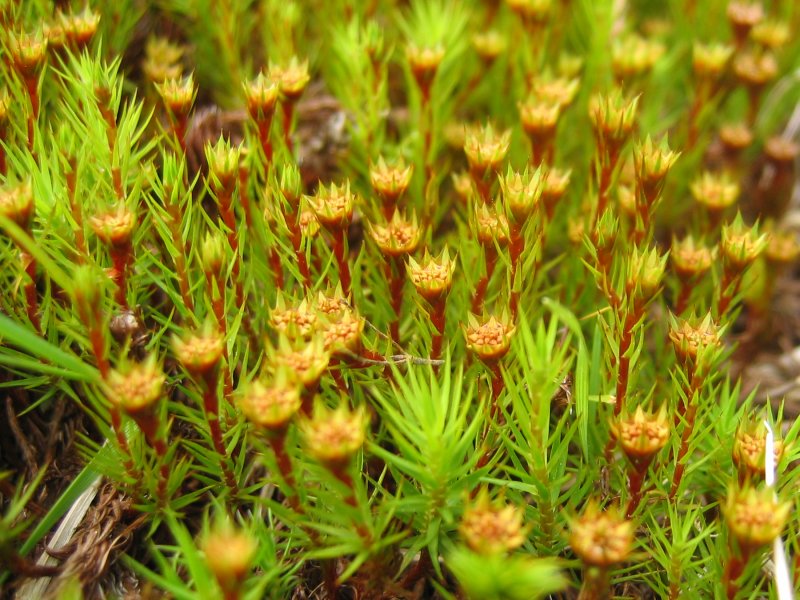
Polytrichum is a genus of approximately 70 species of mosses in the family Polytrichaceae, order Polytrichales, commonly known as haircap moss or hair moss. The genus has a cosmopolitan distribution, occurring across a wide range of habitats worldwide. Plants are generally dark green and grow 4–20 cm tall, with stiff, spirally arranged pointed leaves that give the plant a characteristic star-shaped appearance when viewed from above.
Unlike most mosses, Polytrichum species are endohydric — water is transported internally from the base of the plant through differentiated conducting tissues. The central stem cylinder, called the hydrome, functions analogously to xylem in vascular plants, while the surrounding leptome is analogous to phloem. This level of tissue differentiation is unusual among non-vascular plants.
The leaves bear a further distinctive feature: parallel photosynthetic lamellae on their upper surfaces. These rows of upright cells trap moist air and minimise water loss, representing a xeromorphic adaptation to dry conditions. When conditions become too dry, the leaves curve and twist around the stem as an additional protective response. The microenvironment between the lamellae can harbour microscopic organisms including parasitic fungi and rotifers.
Polytrichum species are dioicous, meaning male and female reproductive structures are borne on separate plants. The genus is divided into two major sections: section Polytrichum, characterised by narrow, toothed, and relatively erect leaf margins; and section Juniperifolia, with broad, entire, and sharply inflexed leaf margins that enclose the lamellae. The closely related genus Polytrichastrum was separated from Polytrichum in 1971 on the basis of peristome structure, though molecular and morphological evidence from 2010 supports returning some species to Polytrichum.
Etymology
The name Polytrichum derives from the Ancient Greek polys, meaning "many", and thrix, meaning "hair", originally used for plants with fine hairlike parts. It specifically refers to the hairy calyptras covering the young sporophytes. A parallel hair-based name appears in Old Norse — haddr silfjar, meaning "hair of Sif", the Norse goddess and wife of Thor.
Distribution
Polytrichum has a cosmopolitan distribution, with species recorded across virtually all terrestrial regions of the globe. The genus is particularly associated with moist, acidic, or peaty substrates including boreal and temperate forests, heathlands, bogs, and tundra.
Ecology
Polytrichum species occupy a range of habitats from boreal forests and heathlands to montane and arctic tundra. Their endohydric water transport and xeromorphic leaf adaptations — including photosynthetic lamellae that trap humid air and leaves that curl when desiccated — allow them to persist in conditions too dry for most mosses. The leaf lamellae also create a microhabitat for microscopic organisms such as parasitic fungi and rotifers. Plants are dioicous; the average lifespan is three to five years, though individuals can survive up to ten years and remain structurally intact for extended periods after death.
Taxonomy Notes
The genus Polytrichastrum was separated from Polytrichum in 1971 based on differences in peristome structure, which controls spore release. However, combined molecular and morphological analyses published in 2010 support transferring several species back into Polytrichum. GBIF places Polytrichum in the family Polytrichaceae, order Polytrichales, class Bryopsida, phylum Bryophyta.










