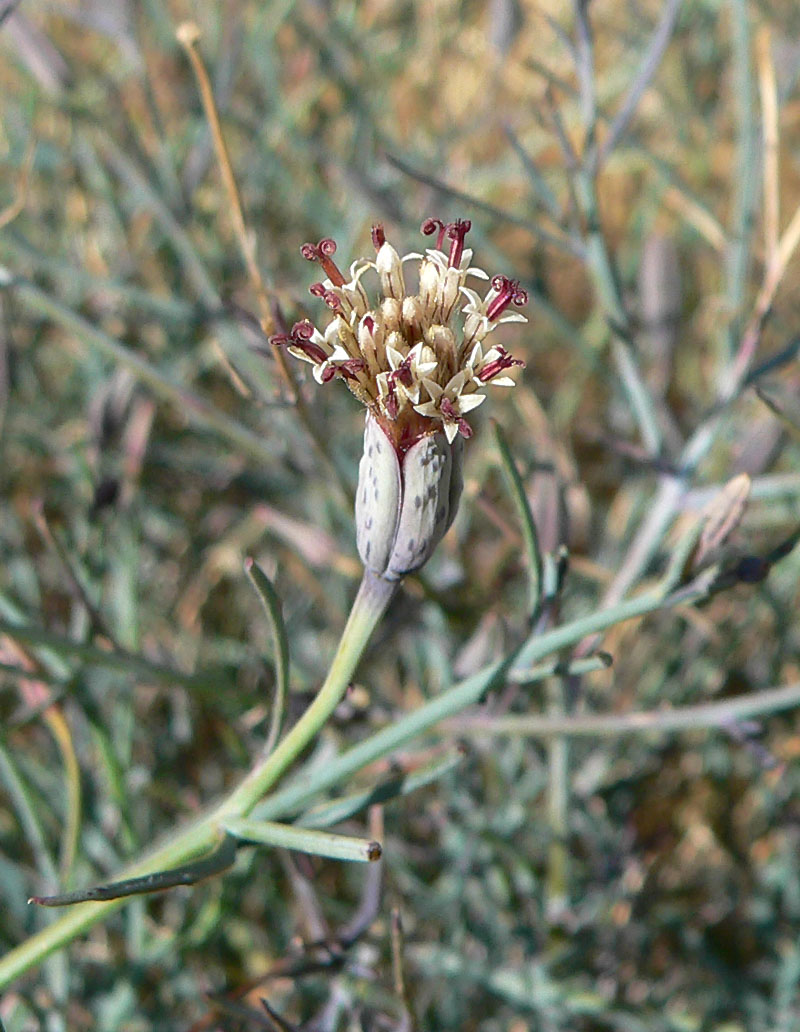
Porophyllum is a genus of flowering plants in the family Asteraceae (the daisy family), placed in the tribe Tageteae — the same tribe as marigolds (Tagetes) and related aromatic herbs. Commonly known as the poreleaf genus, it comprises roughly 28 recognised species of subshrubs native to the Americas, ranging from the southwestern United States south through Mexico, Central America, the Caribbean, and into South America as far as Argentina and Paraguay.
The genus takes its common name from its most distinctive anatomical feature: large, transparent oil glands visible through the surface of the leaves, which function as pores (from the Greek poros, pore, and phyllon, leaf). These glands produce volatile aromatic oils that give poreleaf plants a powerful, often pungent scent. The leaves are typically narrow and alternate, and the small disc-floret flower heads are borne singly or in loose clusters, consistent with the Tageteae habit.
Several species are economically significant as culinary herbs. Porophyllum ruderale — known by the common names pápalo, Bolivian coriander, quirquiña, and yerba porosa — is the most widely used, with a cilantro-like aroma and prominent presence in Mexican and Andean cuisines. Porophyllum linaria, called pipicha, is likewise used as a flavouring herb in Mexican cooking. The genus is distributed across a wide variety of arid and semi-arid habitats, and a number of species, including the slender poreleaf (P. gracile), are characteristic of desert scrub in the Chihuahuan and Sonoran desert regions.
Etymology
The genus name Porophyllum derives from the Greek poros (pore) and phyllon (leaf), referring to the conspicuous translucent oil glands in the leaves that give the plants their distinctive aroma. The common name "poreleaf" is a direct English rendering of the same concept.
Distribution
Porophyllum species are native exclusively to the Americas. Their range extends from the southwestern United States (California, Nevada, Utah, Arizona, New Mexico, Texas) through Mexico and Central America, across the Caribbean (Puerto Rico, Dominican Republic), and into South America, reaching as far south as Argentina and Paraguay. The centre of diversity lies in Mexico, which holds the largest number of endemic and widespread species.
Cultural Uses
Multiple Porophyllum species have long been used as culinary herbs throughout Latin America. P. ruderale (pápalo or quirquiña) is a staple herb in Mexican street food — particularly in tortas and salsas — and in Bolivian and Andean cooking, where it serves as a substitute or complement to cilantro. P. linaria (pipicha) is used similarly in Oaxacan cuisine. P. leiocarpum (yerba de peo) has traditional uses in the Caribbean and northern South America.










