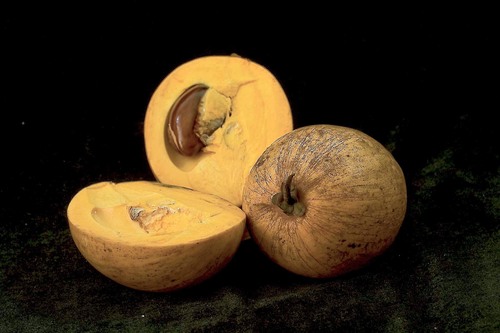
Pouteria is a large genus of tropical flowering trees in the family Sapotaceae (order Ericales), comprising approximately 170 accepted species according to Plants of the World Online. The genus is most diverse across the tropical Americas, ranging from Mexico and the Caribbean through Central America and into South America, with outlier species occurring in Cameroon and Malesia.
Members of Pouteria are typically trees with simple, alternate leaves and small, inconspicuous flowers. The genus is perhaps best known for its edible fruits: notable species include the mamey sapote (Pouteria sapota), the green sapote (P. viridis), and the abiu (P. caimito), all of which are important food sources in tropical regions and are harvested for local markets and canning. Fruits of Pouteria species also provide sustenance for a range of wildlife, including the rock-haunting ringtail possum (Petropseudes dahli).
Pouteria timber is extraordinarily dense — the wood can weigh more than 1,140 kg/m³ at 12% moisture content, meaning it sinks in water. This density makes it highly valued for outdoor and naval construction, including dock pilings and deck planking, though it also makes the wood nearly impossible to work with hand tools and poorly suited to furniture manufacture. Some species, particularly P. caimito, have been noted as resistant to shipworm damage where sufficient silica content is present.
Taxonomically, Pouteria has long been regarded as a "wastebasket taxon" whose boundaries are in flux. Phylogenetic studies have demonstrated the genus to be polyphyletic, leading to the reinstatement of numerous segregated genera including Labatia, Lucuma, and several others. Plants of the World Online currently accepts around 170 species, though that number continues to shift. Due to habitat loss and in some cases overexploitation, many species of Pouteria are threatened, and at least 10 are considered close to extinction.
Etymology
The genus name Pouteria derives from the vernacular name used in French Guiana, "pouteria," for local species of this group within the Sapotaceae. The associated segregated genus Labatia, synonymized with Pouteria in the 1930s, was named in honor of Jean-Baptiste Labat, an 18th-century French botanist.
Distribution
Pouteria is distributed primarily throughout the tropical Americas, from Mexico and the Caribbean south through Central America and across South America. Outlier species also occur in Cameroon (West Africa) and Malesia (Southeast Asia and the Pacific). The genus reaches its greatest diversity in Neotropical lowland rainforests.
Cultural Uses
Pouteria species are economically important in the tropics for two primary products: fruit and timber. Several species bear edible fruits — most notably the mamey sapote (P. sapota) and the abiu (P. caimito) — which are harvested seasonally for local food markets and are sold fresh or canned. The wood of Pouteria is among the densest of any tropical timber, exceeding 1,140 kg/m³, and is prized for naval and heavy outdoor construction such as dock pilings and deckings. Its extraordinary hardness and weight make it impractical for hand-tool woodworking or furniture, but it takes a fine polish with machine tools and fine-grained sandpaper.
Taxonomy Notes
Pouteria has been characterized as a "wastebasket taxon" — a catch-all for Sapotaceae genera that did not fit neatly elsewhere. Its circumscription has expanded and contracted repeatedly since the 19th century, with many genera established by Henri Ernest Baillon and Jean Baptiste Louis Pierre ultimately being synonymized into Pouteria. Recent phylogenetic and morphological analyses have shown the genus to be polyphyletic, prompting the reinstatement of numerous segregated genera including Achrouteria, Chloroluma, Cornuella, Englerella, Labatia, Lucuma, Martiusella, Nemaluma, Peteniodendron, Prieurella, and Ragala. Plants of the World Online currently accepts approximately 170 species, though the number continues to change as revisions proceed.
Conservation
Many Pouteria species are threatened by habitat loss and overexploitation. At least 10 species are considered close to extinction. The genus's diversity is concentrated in tropical American forests, which face ongoing deforestation pressures.










